
Energy-Intensive Businesses: Cutting Daytime Bills With Solar
The heavier your daytime electricity load, the better solar pays, which makes energy-intensive operations, manufacturers, food processors, cold stores, plastics and packaging plants, the strongest commercial cases we see. A machine hall's baseload swallows every kilowatt-hour the roof produces at full import value, no exports, no waste, and on the best-matched sites a properly sized array offsets a substantial share of daytime consumption, approaching half on some. The constraint is rarely appetite; it is roof area against load and what the grid connection will take, both answered by a survey.
In This Guide
Why heavy users win at solar
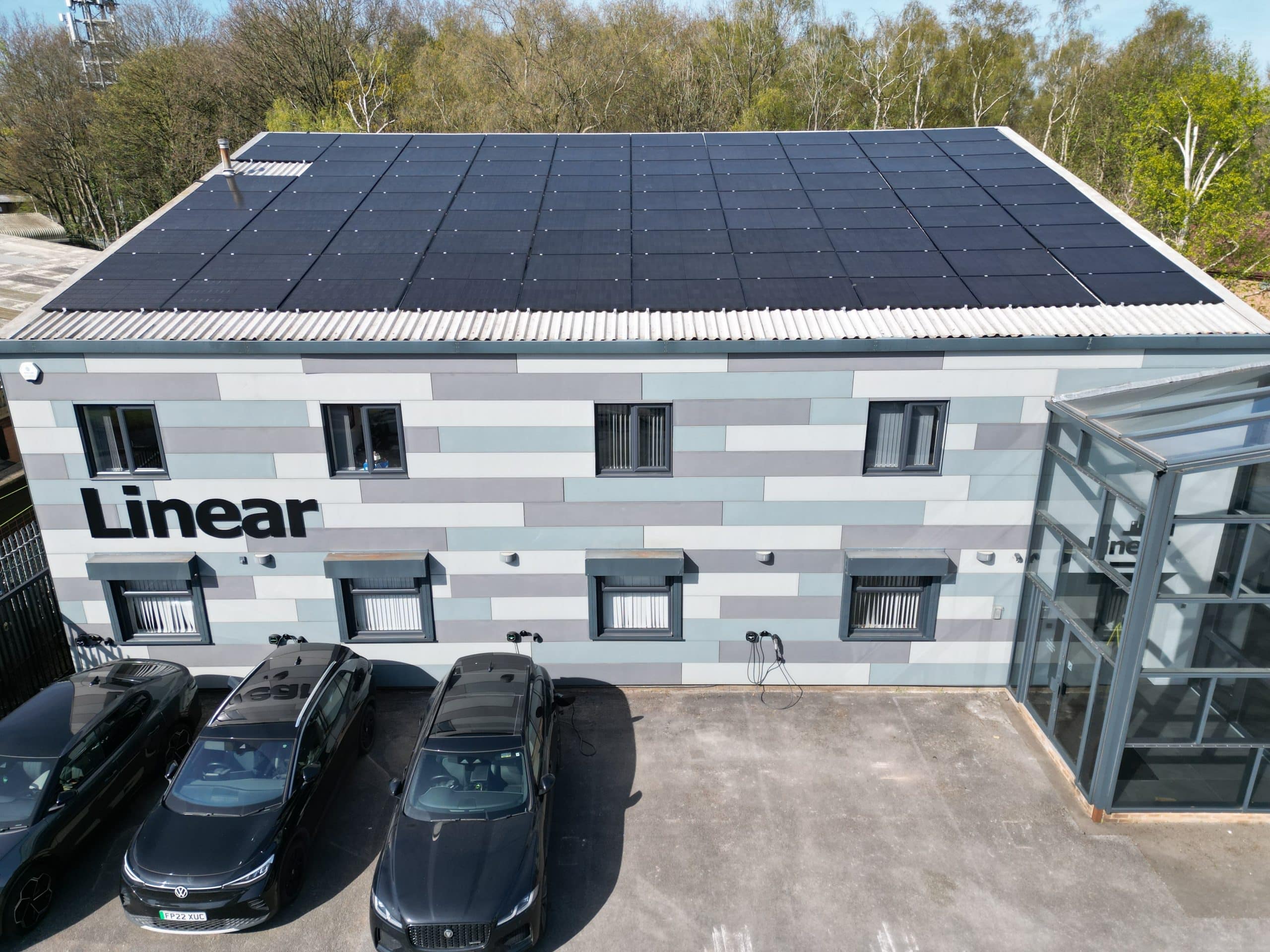
Commercial solar economics turn on one ratio: how much of the generation gets used on site at full import value rather than exported for a fraction of it. A quiet office wastes half its array's output to export; an energy-intensive plant wastes none, because the baseload, motors, compressors, chillers, extraction, lines that run whether or not anyone is watching, sits permanently above the array's output curve. Every generated kilowatt-hour displaces a bought one at the full commercial rate, which is precisely the arithmetic behind the strongest paybacks in our commercial payback guide. The insulation manufacturer pictured through this article is the archetype: a production hall whose consumption never dips below the array's best output, so the roof effectively runs flat out into its own building all year.
The sectors that fit
- Manufacturing and processingMachinery baseloads through working hours, often shift-extended, the classic match.
- Cold storage and foodRefrigeration that never switches off, and works hardest in the sunniest weather.
- Plastics, packaging, extrusionHeater bands and motors drawing steadily all day.
- Intensive agricultureThe poultry and grain-store cases are this article's farm cousins.
- Workshops and engineeringCompressors, welding sets and extraction, smaller in scale, identical in shape.
The common thread is the load profile, not the sector badge: if your half-hourly data shows a solid daytime floor, you belong in this article.
How far the roof can cut the bill
Honest expectations, because this is where sales patter usually inflates. The ceiling on solar's contribution is set by two physical limits: the roof area available for panels, and the fact that generation happens in daylight while many intensive operations run around the clock. Within those limits, well-matched sites do impressively: businesses with strong daytime baseloads routinely offset a large share of their daytime consumption, and on sites where a generous roof meets a well-shaped load, the daytime figure approaches half, which across a year still leaves grid supply doing the nights and the depths of winter. The bill line that shrinks is the expensive one, daytime commercial units, and the modelling is not guesswork: your half-hourly meter data against the roof's generation profile produces the projection before anyone quotes, the discipline our benchmark 49.68kWp project at £37,000 plus VAT was built on, paying back in circa 4 years because the sums were honest first.
Batteries and peak management
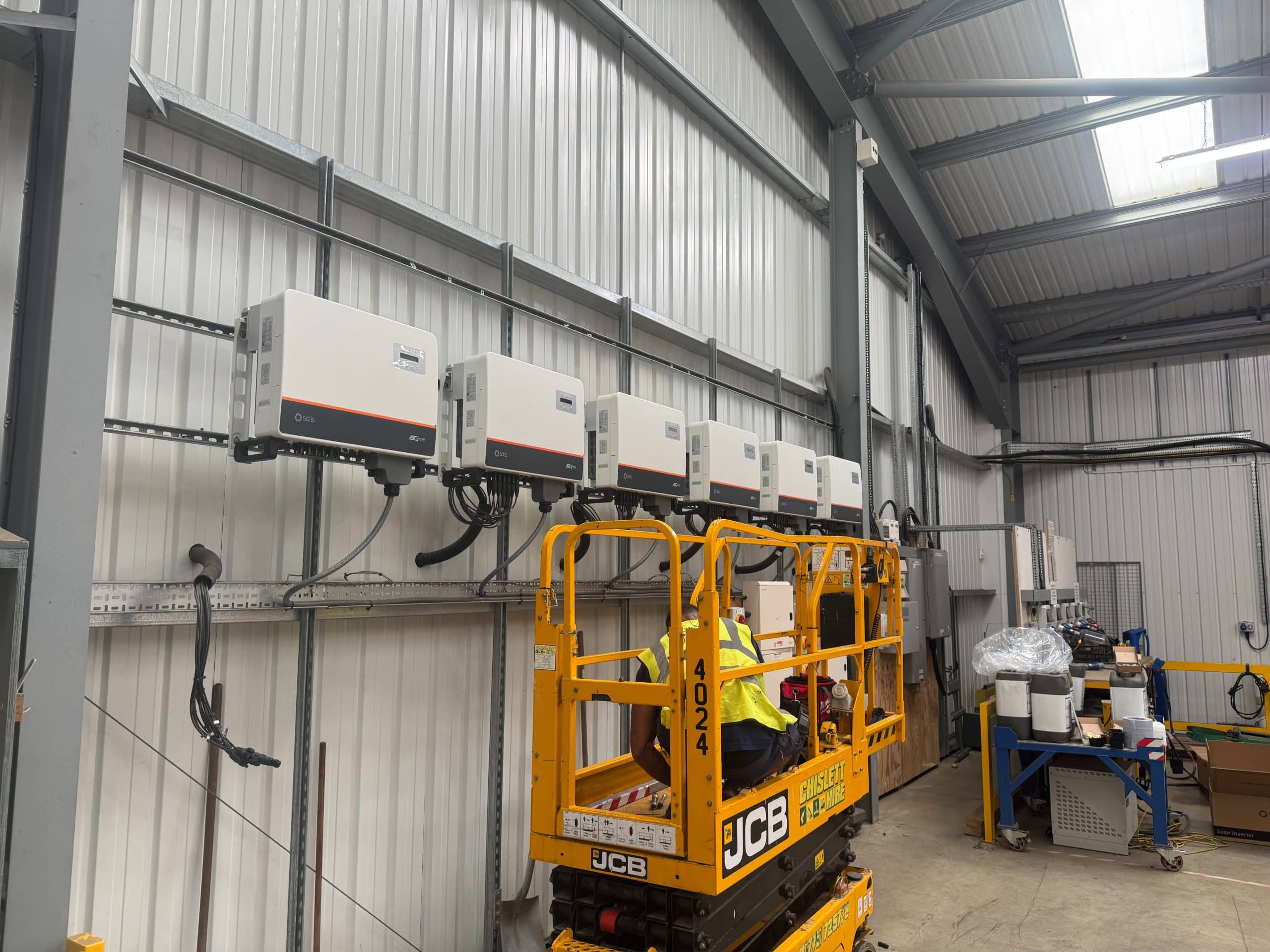
Heavy users have a second lever lighter businesses lack: their bills carry capacity and peak-related charges, and their shift patterns often extend past daylight. Commercial battery storage earns in that gap, carrying midday generation into evening shifts, shaving demand peaks, and exploiting cheap-rate windows in winter, run through commercial inverter banks like the installation pictured. Not every site justifies it; round-the-clock plants with flat profiles often do, single-shift operations often do not, and the half-hourly data decides, not the brochure. Sites at this scale are firmly G99 territory with three-phase infrastructure, both routine at survey.
The financial stack
The energy-intensive case collects every advantage the commercial framework offers: capital allowances sheltering the purchase against profits, the business rates exemption to 2035, finance routes that let the savings service the borrowing, and, increasingly decisive for manufacturers in big supply chains, the audit-proof carbon numbers our ESG reporting guide covers. For businesses whose energy line is a top-three cost, the strategic framing matters more than any single subsidy: solar converts a volatile, rising input cost into a fixed asset with a 25-year life, which is the kind of hedge finance directors buy for its own sake.
Energy one of your biggest costs?
Free commercial design and quote: your half-hourly data against your roof's real generation profile, an honest offset projection, and one all-in price plus VAT. Call 0115 773 7575, 8am to 8pm, Monday to Friday.
Get EstimateFrequently asked questions
Is solar worth it for energy-intensive businesses?
The strongest commercial cases there are: heavy daytime baseloads consume every generated kilowatt-hour on site at full import value, driving paybacks at the circa 4 year end of the commercial range. The heavier and flatter your daytime load, the better the roof performs.
How much of an industrial electricity bill can solar cover?
Honestly bounded by roof area and daylight: well-matched sites offset a large share of daytime consumption, approaching half on the best, while nights and midwinter stay with the grid. The projection comes from your half-hourly data against the roof's generation profile, not a brochure percentage.
Do energy-intensive sites need battery storage?
Sometimes powerfully, sometimes not: batteries earn where shifts extend past daylight, demand peaks carry charges worth shaving, or cheap-rate windows can feed overnight operations. Single-shift daytime operations often do better with generation alone. The meter data makes the call.
What size solar array can a factory install?
Physically, whatever the roof takes, industrial roofs host arrays from tens of kilowatts to megawatt scale. The practical ceilings are the grid connection, settled early through the G99 application, and the honest match to your load. Oversizing past your consumption wastes money on export-rate electricity.
Does solar help with energy price volatility?
That is arguably its deepest value for intensive users: every self-generated kilowatt-hour is immune to market swings for the system's 25-year life, converting a volatile top-three cost into a fixed one. Finance directors increasingly buy the hedge as much as the saving.
Related reading
- Commercial solar payback: real numbers
- Commercial solar battery storage
- Commercial solar finance: the four routes
- Solar and ESG reporting
- Solar panels for warehouses
Industrial solar, honestly modelled
We are Spectrum Energy Systems, MCS certified (NIC200223), installing commercial and industrial solar across the East Midlands, 10+ MW connected, designed from half-hourly data every time. Call 0115 773 7575, 8am to 8pm, Monday to Friday.
Get in touch