
Solar for Grain Stores and Arable Farms: The Honest Case
Grain stores have a match most businesses would envy: the heaviest electrical work of the arable year, drying fans and grain cooling, starts at harvest and runs through late summer and autumn while the sun is still doing useful work, on top of big clean store roofs that host serious arrays cheaply. The honest caveat is seasonality: an arable yard is quieter in spring than a dairy or poultry unit, so the design leans on export income and, where the sums support it, battery storage to sweat the array year-round. Sized honestly against the store's real load calendar, the numbers work well.
In This Guide
The grain store load calendar
Arable electricity is spiky, and the spikes are well-timed for solar. Harvest brings the year's big draw: drying fans pushing air through wet grain, sometimes with heat behind them, running for days at a stretch through August and September when generation is still strong. Then conditioning and cooling take over, fans cycling through autumn to pull the store down to safe temperatures and hold it there, with periodic runs through winter. Add the workshop, the office and grain handling, elevators, conveyors, cleaners, around intake, and the picture is a business whose consumption clusters exactly where a solar array can meet it. Every kilowatt-hour used as it is generated offsets full-price electricity, the same self-consumption arithmetic that drives all strong commercial paybacks.
The store roof advantage
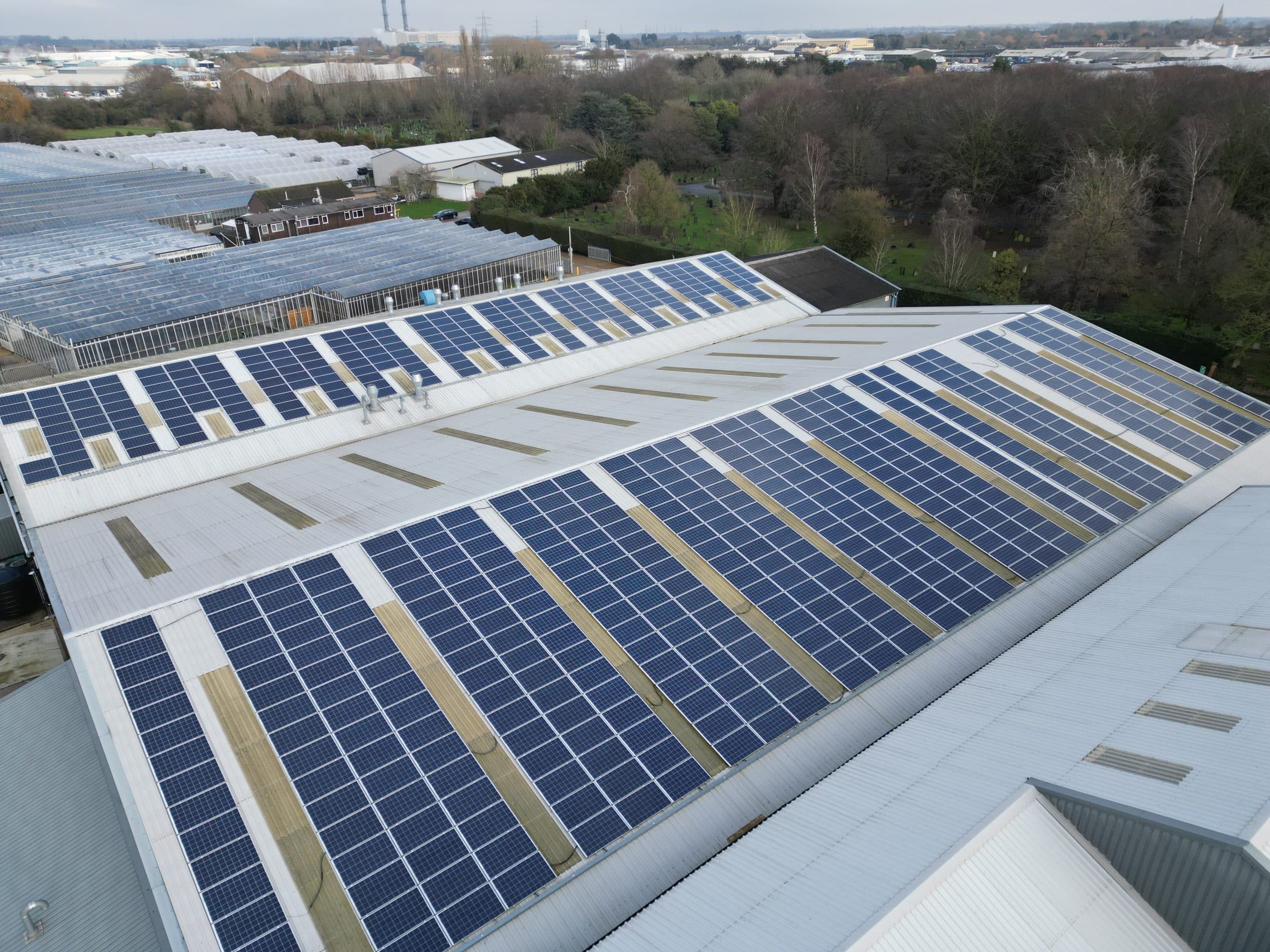
Grain stores are among the biggest roofs in agriculture, long-span steel-frame buildings under profiled sheet, like the array pictured, and they take solar the easy way: direct fixing through the sheet into the purlins per our barn install guide, no scaffolding-heavy tile work, capacity limited by the grid connection rather than the roof. Store-specific checks are few: purlin capacity verified at survey as on any farm building, panel layout respecting roof vents and any gas-tightness requirements on sealed stores, and dust management during intake weeks factored into the install plan. Most stores pass all three without drama.
The seasonality question, honestly
The honest wrinkle in arable solar: the load calendar and the solar calendar overlap at harvest but diverge either side of it. Spring is the array's second-best generating season and often the yard's quietest, sprayers and drills run on diesel, not the meter, so spring surplus largely exports. That is not a flaw, it is a design input. The store earns three ways: direct self-consumption through harvest and autumn (the premium slice), export income on the surplus months, and, where overnight cooling runs hard, battery storage carrying day generation into the night fans. An installer who sizes the array against your actual half-hourly data, rather than the roof's maximum, is designing for the return rather than the invoice, and on arable sites that discipline matters more than anywhere.
Designing for an arable yard
- Start from the meter dataHarvest and conditioning loads are visible in the half-hourly record; the array gets sized to that reality.
- Grid application earlyStore-scale arrays are G99 applications, and rural network capacity often shapes the design; the enquiry goes in before the drawing firms up.
- Three-phase checkMost stores with serious drying kit already run three-phase, which suits the inverter sizes a store roof wants.
- Battery modelled, not assumedOvernight cooling months make the storage case; quiet yards may not. The data decides, not the brochure.
The money side
A grain store array is a commercial purchase with the standard stack behind it: capital allowances against the farming business's profits, the business rates exemption to 2035 where rates apply, and finance routes if harvest cashflow argues against a capital purchase. Grant rounds come and go, our farm funding guide tracks the current position, but the underlying case stands without them: drying and cooling costs are among arable's least controllable inputs, and a store roof converts a slice of them into a fixed cost owned for 25 years. On yards where diversification thinking is live, the export side has its own logic, which the farm income article in this cluster covers separately.
Store roof idle, drying bills not?
Free farm design and quote: load analysis from your meter data, structural check, G99 position early, one all-in price plus VAT. Call 0115 773 7575, 8am to 8pm, Monday to Friday.
Get EstimateFrequently asked questions
Is solar worth it on a grain store?
On stores with real drying and cooling loads, yes: the heaviest electrical work of the arable year runs from harvest through autumn while generation is still strong, and the big steel roof hosts a serious array cheaply. The design leans on export income through the quieter spring months, which the sizing takes into account.
Can solar power grain drying fans?
Yes, in the sense that matters: drying runs through daylight-heavy weeks in late summer, so a well-sized array offsets a substantial share of the fan load at full electricity value. Continuous drying also draws at night, which is where grid supply, and on some yards battery storage, carries the balance.
What size array suits an arable farm?
The one your half-hourly meter data supports, not the biggest the roof takes. Arable loads cluster around harvest and autumn conditioning, so the honest design maximises self-consumption through those months and treats spring surplus as export income. Rural grid capacity, checked early via G99, often sets the ceiling.
Do grain store roofs need strengthening for panels?
Usually not: long-span steel-frame stores under profiled sheet take direct purlin fixing, and the panels' distributed load sits comfortably within most designs. The survey verifies purlin capacity and wind uplift as standard, and lays the array out around roof vents and any sealed-store requirements.
Should an arable farm add battery storage?
Model it rather than assume it: yards running overnight grain cooling through autumn have a genuine case, since stored day generation feeds the night fans. Quieter yards often do better with generation alone plus a good export tariff. The meter data makes the decision, which is how we quote it.
Related reading
- Agricultural solar: the full guide
- Solar on steel-frame barns
- Ground-mounted solar on farmland
- Commercial solar payback: real numbers
- SFI and farm solar funding
Arable solar sized to the season
We are Spectrum Energy Systems, MCS certified (NIC200223), installing agricultural solar across the East Midlands since 2011, designed from your meter data, not the brochure. Call 0115 773 7575, 8am to 8pm, Monday to Friday.
Get in touch