
Commercial Solar Battery Storage UK: How It Actually Gets Specified
Commercial solar battery storage in the UK is sized from your half-hourly consumption data, not guesswork. Our standard pairing is a Pylontech Force-H3 high-voltage stack on a Solis three-phase hybrid inverter. A real 49.68kWp system with 51.2kWh of storage came in at £37,000 plus VAT all-in, with payback circa 4 years.
In This Guide
What a battery actually does for a business
A commercial solar array without storage sells its lunchtime surplus back to the grid at a fraction of what you pay to import in the late afternoon. A battery closes that gap. On the commercial systems we design across the East Midlands, storage earns its place in four distinct ways, and a good specification will tell you which of the four is doing the heavy lifting on your site.
- Storing midday generation for afternoon useThe classic case. Solar output peaks between 11am and 2pm; many businesses peak in demand between 2pm and 6pm. The battery time-shifts your own generation so it offsets imported units at your full day rate instead of being exported cheaply.
- Peak shavingThe battery discharges during your highest-demand half hours, flattening the spikes that drive capacity charges and, on half-hourly settled supplies, the most expensive units on your bill.
- Avoiding low-rate exportCommercial export rates are usually poor value compared with the import units you displace. Every kWh the battery holds back from export and serves to your own load later is worth several times its export price.
- Resilience and backupConfigured with the right switchgear, the battery can hold up critical circuits through an outage. For a site with refrigeration or servers that must not drop out, that alone can justify part of the spend.
If you are weighing up the commercial case rather than the engineering, our commercial battery storage and backup service page covers what an installed system looks like for your site, and you can request a feasibility assessment from there.
The kit we specify and why
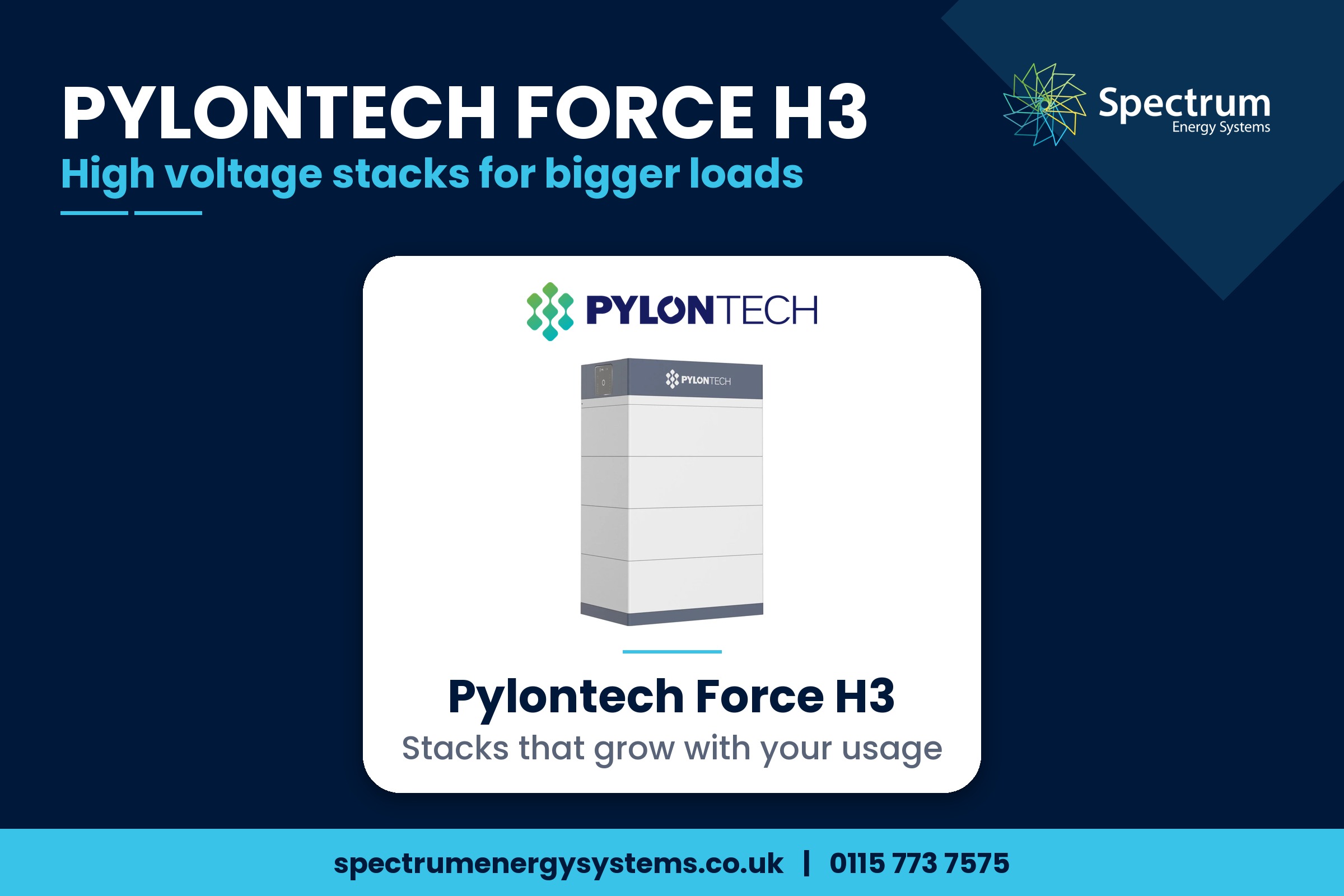
Our standard commercial pairing is a Pylontech Force-H3 high-voltage battery stack on a Solis three-phase hybrid inverter. The Force-H3 is modular: it builds in stacked increments, so a 51.2kWh bank on one job and a smaller bank on the next use the same hardware family, the same commissioning process and the same spares.
High voltage matters on commercial sites. HV stacks run lower currents for the same power, which means smaller cables and lower losses, and it integrates cleanly with a three-phase hybrid. The Solis hybrid also does time-of-use scheduling natively through SolisCloud, so charge and discharge windows can track your tariff without extra hardware.
The photo shows the shape of a typical plant-room installation: modular battery stack, wall-mounted hybrid inverter, dedicated isolation. It takes up a corner of a store room, not a chunk of the working building.
On the panel-and-inverter side, the same discipline applies. We are kit-loyal by design: Tier 1 panels, Solis inverters across the board, and battery hardware we have installed and serviced repeatedly. That is what lets us sign every install off under one MCS certification (NIC200223) with in-house crews working from our Bulwell HQ, rather than subcontracting the storage element to a third party.
A real project, priced: 49.68kWp with 51.2kWh of storage
The most useful way to understand commercial solar battery storage cost is a real design. This is a commercial system we quoted in May 2026, and it is the template for how a mid-size storage project comes together.
| Item | Specification |
|---|---|
| Solar array | 49.68kWp roof-mounted PV |
| Battery | Pylontech Force-H3 stack, 51.2kWh usable family capacity |
| Inverter | Solis 40kW three-phase hybrid |
| Grid application | G99, prepared and submitted by Spectrum, included |
| Price | £37,000 plus VAT, all-in installed |
| Payback | Circa 4 years at the site's metered consumption of around 40,000kWh a year |
Two things about that number are worth stating plainly. First, it is a single all-in price: design, hardware, installation, commissioning and the grid application. There is no breakdown to negotiate line by line and no surprise extras. Second, the payback figure is illustrative, calculated by us from that site's own consumption data and current unit rates, and it will move with energy prices. We would rather give you a defensible circa figure than a glossy one.
For a sense of how storage sits alongside the wider system cost, our guide to commercial solar panel costs in the UK covers the per-kWp numbers from our recent projects.
Where Sigenergy fits
Pylontech on Solis is the default, but it is not the only answer. On some commercial jobs we specify Sigenergy, an integrated inverter-and-battery ecosystem that suits sites wanting a single-vendor stack or bi-directional EV charging in the same platform. From our May 2026 commercial quotes: a system with 9kWh of Sigenergy storage priced at £23,000 all-in, and the same design with 18kWh at £25,500 all-in. Those figures are real quote points, illustrative for budgeting rather than a price list, and the modest gap between them shows a useful rule: once the installation is being done anyway, additional storage capacity is comparatively cheap. The step from 9kWh to 18kWh cost £2,500, not double the price.
Which route wins depends on the site. Larger arrays with heavy daytime loads tend towards the Pylontech HV stack, which grows in increments as the site needs it. Smaller commercial sites, or ones with an eye on vehicle-to-building charging, are where Sigenergy earns its look. If you want the domestic-scale version of the brand question, our Fogstar vs Pylontech comparison goes deeper on the battery hardware itself.
How we size a commercial battery: half-hourly data first
Battery sizing on a commercial site should never start from a catalogue. It starts from your consumption profile. Most commercial supplies are half-hourly metered, which means 17,520 data points a year describing exactly when your building uses energy. That profile, set against the modelled solar output for your roof, tells us how large a battery the site can actually work.
Step 1: Pull the half-hourly data
We request the half-hourly consumption data from your supplier or meter operator. A full year is ideal because it captures seasonal swings; a shorter window still beats assumptions.
Step 2: Model the solar surplus
We model the proposed array's generation against your demand profile, half hour by half hour. The surplus that would otherwise export is the energy the battery can capture. No surplus, no battery case.
Step 3: Size to the evening gap
The battery is sized to bridge the gap between the end of solar generation and the end of your working demand. Oversizing wastes capital on capacity that rarely cycles; undersizing leaves cheap surplus on the table.
Step 4: Sanity-check the cycles
A battery earns money by cycling. We check the design achieves regular deep cycles across the year, because a bank that only fills on the sunniest days pays back slowly no matter what it cost.
Step 5: Design, price, apply
The final design fixes the stack size, inverter rating and switchgear, produces the single all-in price, and feeds straight into the G99 grid application. We design and quote, normally within 2 to 4 days.
The DNO and G99 side, handled
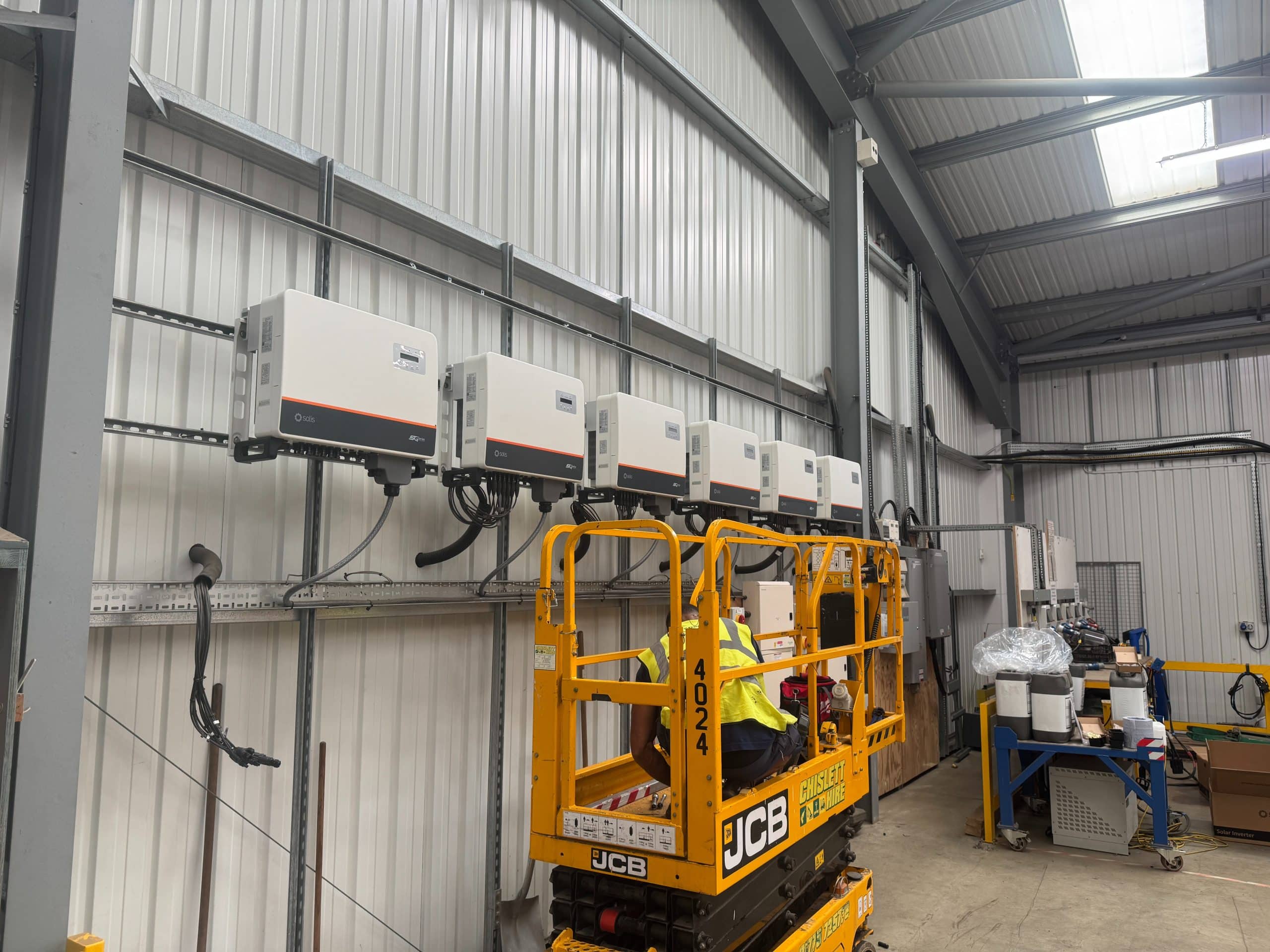
Any commercial solar and storage system of this scale needs a G99 application to your Distribution Network Operator before it can connect. Across most of the East Midlands that is National Grid Electricity Distribution. The application covers the combined export capability of the inverters, which is why the inverter schedule, like this six-unit Solis lineup at Elsoms Seeds, is designed with the grid application in mind from day one.
We prepare and submit the G99 application as part of the job. It is included in the all-in price, not an extra, and because batteries can be configured to limit export, storage often helps a constrained connection rather than hurting it. Our G99 application guide explains the process in full.
VAT and capital allowances
Commercial prices are quoted plus VAT, and for most VAT-registered businesses that VAT is recoverable in the normal way. The bigger lever is capital allowances: solar and battery plant on a commercial site can qualify for first-year allowances that materially improve the after-tax payback. The rules depend on your circumstances and your accountant should confirm the treatment, but the headline mechanics are set out in our guide to capital allowances on solar PV. We are not tax or financial advisers, so treat every figure here as illustrative and take advice on your own position.
See what storage would do on your site
Send us a recent bill and we will pull the half-hourly data, model your profile and give you a straight answer on whether a battery stacks up. It starts with a free remote roof and energy assessment, so we can see what fits and give you an idea of costs. Prefer us to visit first? We can do that too. Design and quote, normally within 2 to 4 days.
Request a Feasibility AssessmentCommercial solar battery storage FAQs
How much does commercial solar battery storage cost in the UK?
As part of a full system: a real Spectrum design of 49.68kWp solar with a 51.2kWh Pylontech stack priced at £37,000 plus VAT all-in in 2026. Incremental capacity is comparatively cheap; one quoted design added 9kWh for £2,500. Figures are illustrative and quote-dependent.
What size battery does a commercial building need?
It depends on the gap between your solar surplus and your afternoon demand, which is why we size from half-hourly meter data rather than rules of thumb. Mid-size commercial sites we design typically land between 18kWh and 51.2kWh, built from modular high-voltage stacks.
What is peak shaving and does it apply to my site?
Peak shaving means discharging the battery during your most expensive half hours to flatten demand spikes. It matters most on half-hourly settled supplies with capacity charges or steep peak rates. Your consumption data shows immediately whether your site has peaks worth shaving.
Do commercial batteries need a DNO application?
Yes. Commercial solar and storage at this scale needs a G99 application to your Distribution Network Operator, which is National Grid Electricity Distribution across most of the East Midlands. We prepare and submit the application as part of every install; it is included in the price.
Can a commercial battery keep the business running in a power cut?
With the right switchgear, yes. The system can be configured to hold up critical circuits such as refrigeration, IT or security through an outage. Backup capability is a design decision made at specification stage, because it affects the switchgear and wiring, not just the battery.
What is the payback on commercial battery storage?
On the 49.68kWp with 51.2kWh project we quoted in May 2026, payback worked out at circa 4 years at the site's metered consumption. That figure is Spectrum's own calculation from real data, illustrative rather than guaranteed, and it shifts with energy prices and usage.
We design commercial battery systems across the East Midlands - see commercial solar in Derby for local coverage.
Related reading
- Commercial solar panels cost UK: real project numbers
- How battery storage improves commercial solar PV efficiency
- Capital allowances on solar PV for UK businesses
- Octopus Shape Shifters and commercial solar export
Or start from the top with our commercial solar overview.
Speak to Spectrum Energy Systems
MCS certified (NIC200223), NICEIC approved (3182878), in-house crews from our Bulwell HQ, and every storage system designed from your own half-hourly data. Call 0115 773 7575 or start below.
Request a Quote