
Battery Storage for Commercial Solar PV: From Cost Centre to Revenue Asset
Last updated: May 2026 - Spectrum Energy Systems, MCS-trained PV Installers
Commercial battery storage has gone from cost centre to revenue asset. Paired with a Solis three-phase hybrid inverter and a Pylontech stack, a battery lets you bank midday solar surplus and dispatch it into the late-afternoon peak - where tariffs like Octopus Shape Shifters: Export pay multiples of the flat SEG rate. Add Predbat optimisation on Home Assistant and the system trades itself against tomorrow’s prices. Below: the kit, the five value streams, the sub-50kW MCS strategy, and a real 49.68kWp Spectrum install.
In this guide
- →Why commercial isn't just bigger domestic
- →The standard commercial kit list
- →Five value streams storage unlocks
- →Octopus Shape Shifters: Export
- →Predbat & Home Assistant on Solis
- →Triad avoidance & flexibility markets
- →The sub-50kW MCS strategy
- →Real Spectrum case study
- →How we size commercial battery systems
- →Design, install & G99 process
- →Frequently asked questions
- →Next step: feasibility study
Most commercial solar quotes pitch battery storage as "bigger domestic"- store the surplus, use it later, save on bills. That's table-stakes, and it's leaving most of the value on the table. The real commercial case is different: a battery sized for export arbitrage on tariffs like Octopus Shape Shifters: Export, automated by Predbat on Solis hybrid inverters. Done that way, the battery stops being a cost centre and starts being a revenue asset.
This guide shows you exactly what we fit, what it costs, what it pays back, and the five value streams a properly-designed commercial battery unlocks. Written by about Spectrum Energy Systems- MCS-certified #NIC200223, NICEIC Approved Reg. 3182878, RECC member #00080159, 10MW+ connected for East Midlands businesses since 2011. Feasibility study within 48-72 hours, all-inclusive pricing, no hidden extras.
📋 What's in This Guide
- Why Commercial Storage Isn't Just Bigger Domestic
- The Standard Commercial Kit List
- Five Value Streams Commercial Storage Unlocks
- Octopus Shape Shifters: Export
- Predbat & Home Assistant on Solis
- Triad Avoidance & Flexibility Markets
- The Sub-50kW MCS Strategy
- Real Spectrum Case Study: 49.68kWp + 51.2kWh
- How We Size Commercial Battery Systems
- Design, Install & G99 Process
- Frequently Asked Questions
- Next Step: Feasibility Study
Want a Commercial Feasibility Study?
Send us your annual kWh consumption, current unit rate, supply type (single or three-phase) and a roof image. It starts with a free remote roof and energy assessment, so we can see what fits and give you an idea of costs. Prefer us to visit first? We can do that too. We'll model the right system and feasibility study within 48-72 hours - Solis hybrid, Pylontech Force H3 stack, sized for export arbitrage, with an honest payback range. All-inclusive price, no hidden extras.
Request a Feasibility Study Speak to Our TeamWhy Commercial Storage Isn't Just Bigger Domestic
A domestic battery cuts your electricity bill. That's the whole pitch, and it's a good one - typical payback 8-10 years on a 16.1kWh Fogstar system. Useful, worthwhile, but a relatively narrow value proposition.
Commercial battery storage operates in a completely different economic environment. You're not just dodging peak-rate evening imports - you're playing in a market with:
- Half-hourly settled electricity where wholesale prices swing 5-10x within a single day
- Capacity (kVA) charges billed on your peak demand, not just your total consumption
- Triad periods where three winter half-hours determine a large chunk of your annual transmission costs
- Export tariffs like Shape Shifters: Export that pay multiples of the flat SEG rate at the right times
- Flexibility markets where you can earn revenue for the grid having the *option* to call on your storage
None of that exists on a domestic install. Sizing, kit choice and automation strategy all change accordingly. A commercial battery designed only for self-consumption is leaving most of its value on the table.
Our position is straightforward: design the commercial solar panels to match the site's demand pattern, size the battery for export arbitrage rather than just self-consumption, and automate the dispatch so the battery earns money whether the sun's shining or not. Commercial solar with battery storage done this way pays back in 4-7 years on typical East Midlands jobs - half the domestic timeline.
The Standard Commercial Kit List
What goes on a Spectrum commercial install in 2026:
Panels: JA Solar or Aiko, 500W+ as standard
Tier-1 panels, all-black bi-facial where the roof suits, 540W where we've got the space. Anyone installing 420W panels in 2026 when 540W is readily available is reselling old stock. The panel choice doesn't usually change much between domestic and commercial - what changes is the count and the mounting system.
Mounting: Renusol MetaSol for commercial flat / trapezoidal roofs
Most commercial roofs are flat or trapezoidal metal. We use Renusol MetaSol - appropriate for the load case, weatherable, well-understood by the DNOs. On flat roofs we use Esdec ballasted systems where penetrative fixings aren't an option (the Johns of Nottingham reference install). On standing-seam metal we use clip-on solutions that don't pierce the roof.
Inverter: Solis S6-EH3P three-phase hybrid
Solis is our default inverter across both commercial and domestic. For commercial we use the S6-EH3P series - three-phase hybrid, common sizes 30kW, 40kW, 50kW. These handle both PV input and battery charge/discharge from a single unit, simplifying both the install and the warranty path.
The 150% DC headroom rule applies: a 40kW AC inverter takes up to 60kWp of DC panels. We routinely use this to fit more PV than customers initially expect on their existing inverter capacity.
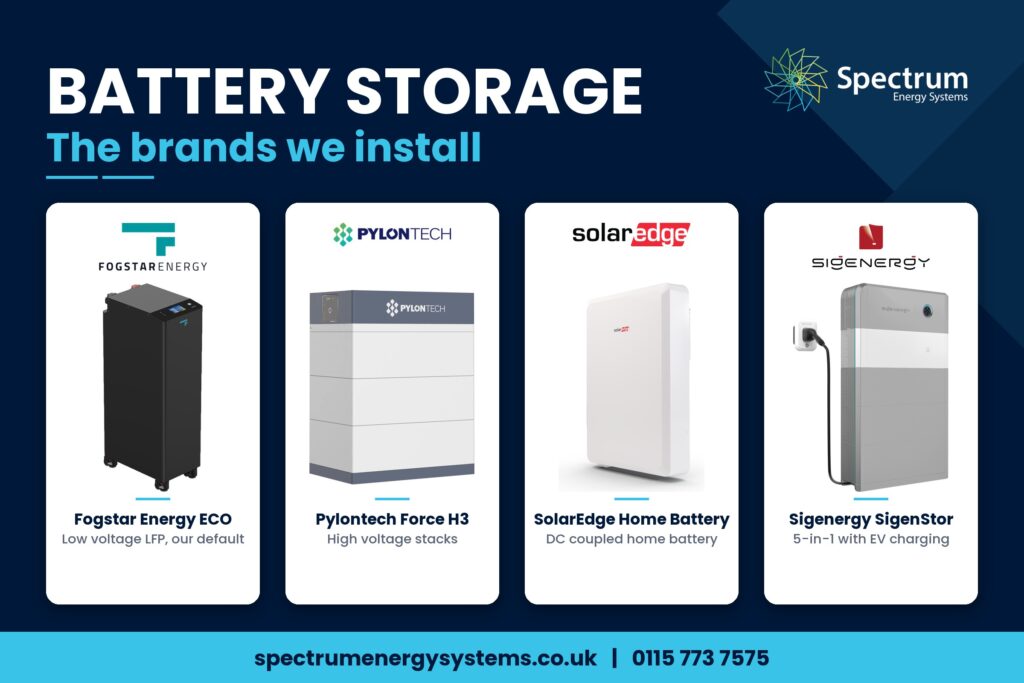
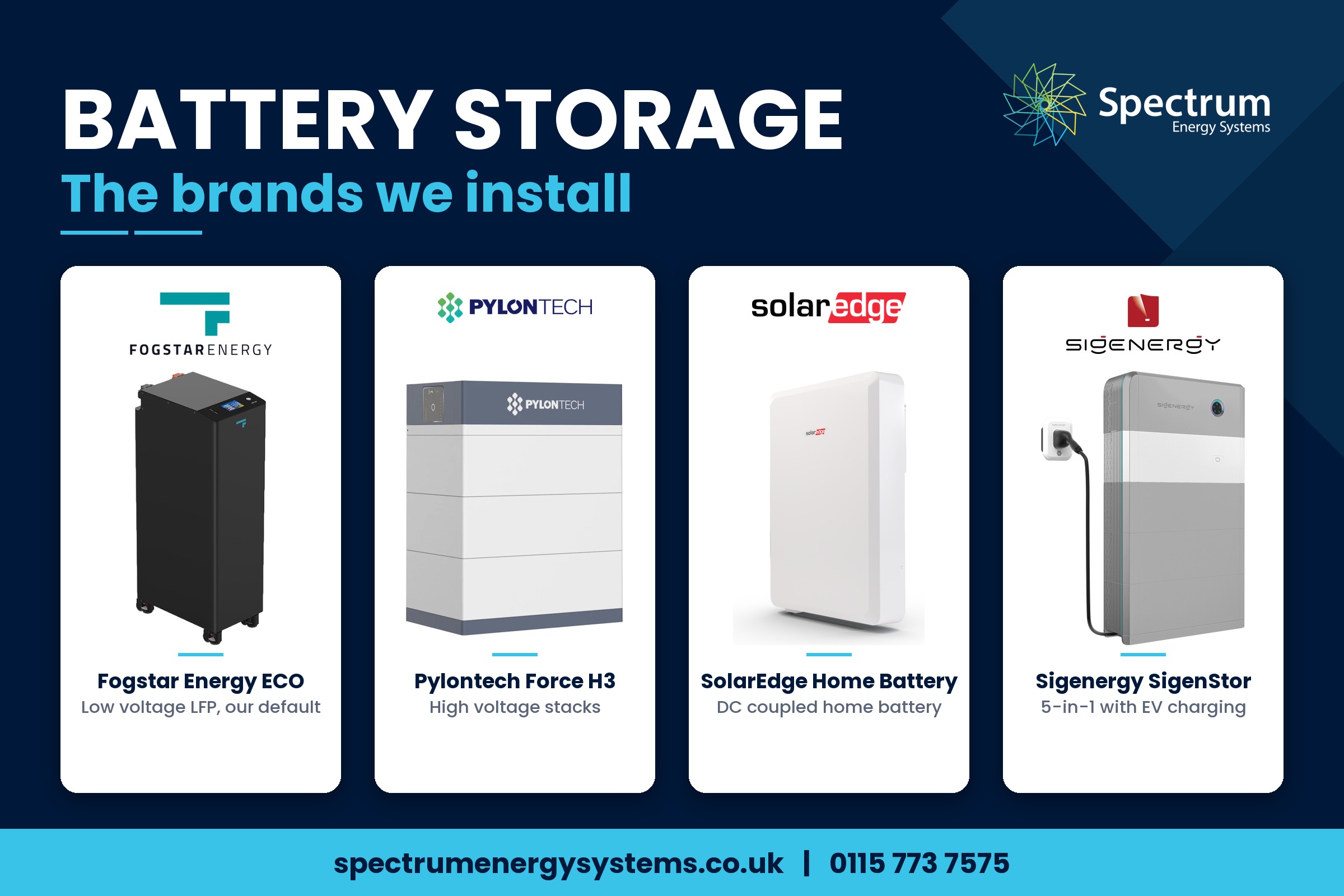
Battery: Pylontech Force H3 for commercial
Pylontech Force H3 is our default commercial battery. Modular LFP stack architecture, up to 50kWh+ in a single cabinet (one of our recent installs uses a 51.2kWh stack). LFP chemistry means 6,000+ cycle life, 70%+ capacity retention at 10 years, and no thermal management headaches. Pairs natively with Solis high-voltage hybrid inverters above 15kW AC.
For mid-sized commercial where the customer has a specific feature requirement we'll fit Sigenergy - 9kWh and 18kWh units have appeared on recent quotes. For commercial installs below 15kW AC inverter capacity, Fogstar covers the same role as on domestic, with an IP65-rated 48V modular stack option for outdoor cabinet placements where the battery sits outside a plant room.
The voltage class rule: Solis hybrid inverters split into low-voltage (up to 15kW AC, the "-L" suffix models) and high-voltage (above 15kW, including the S6-EH3P three-phase range). LV-class pairs with Fogstar. HV-class pairs with Pylontech. Get this wrong and the battery won't talk to the inverter. We always confirm voltage class before specifying the battery brand. There's more on this in our guide to choosing the right solar battery.
Five Value Streams Commercial Storage Unlocks
Most installers pitch commercial battery storage on just one of these (solar self-consumption). The real value comes from running all five in parallel. Here's the honest breakdown.
1. Solar Self-Consumption
The basic case. Without storage, surplus midday solar exports to the grid at flat SEG rates (typically 3-15p/kWh). With storage, you hold that surplus and discharge it during expensive grid-import periods later in the day. For a typical commercial site importing at 25-35p/kWh in the afternoon, the saving per cycled kWh is 15-30p.
For a 50kWp solar array on a commercial roof, well-sized battery storage can shift 8,000-15,000kWh/year from export to self-consumption. At a 20p/kWh average differential, that's £1,600 - £3,000/year from solar self-consumption alone.
2. Peak Demand Charge Reduction
Commercial electricity bills include a capacity charge based on your peak kVA demand. Spike to 80kVA once for fifteen minutes and you pay that 80kVA every month. A battery sized to shave 20-40% off your peak demand cuts the capacity charge proportionally - often £200 - £800/month on a mid-sized commercial site.
This is where the design matters. Sizing the battery for peak shaving needs a clear understanding of your load profile (when do you draw your peaks, how high, how long). We model this from your half-hourly meter data before specifying battery capacity.
3. Triad Avoidance
Triad charges hit non-half-hourly settled customers on the three highest National Grid demand half-hours of the winter (Nov - Feb). For a commercial customer paying triad-linked transmission charges, discharging through those three peaks can save £2,000 - £10,000+/year.
You don't know exactly when triad periods will fall - they're announced retrospectively - but the windows are predictable (typically 4:30-6pm on cold weekday evenings in late November to early February). A properly-automated battery dispatches through these windows without you needing to lift a finger.
4. Export Arbitrage on Octopus Shape Shifters: Export
This is the angle most commercial installers miss. Octopus Energy's business tariffs include Shape Shifters: Export, which tracks wholesale electricity prices half-hourly. Peaks routinely hit 40-60p/kWh in the 4-7pm window - multiples of the flat 5-15p that SEG pays.
For a commercial battery sized to hold midday solar surplus and dispatch it into the late-afternoon peak window, the export revenue uplift versus continuous-as-generated SEG export is 30-80% annually. On a 50kWh battery cycling daily this works out at £1,000 - £3,000/year of extra revenue purely from when you export, not how much.
This is the differentiator we lean on in commercial bids. Most competitors are not yet designing for it.
5. Power Factor & Flexibility Services
Larger commercial batteries can provide reactive power support, improving site power factor and reducing penalty charges. They can also participate in National Grid flexibility services like Dynamic Frequency Response and Capacity Market schemes - earning revenue for the grid having the option to call on your storage during demand events.
These markets generate £5,000 - £20,000+/year for suitably-sized commercial systems with the right metering and aggregator agreement in place. They're not for every install - sub-50kWh systems usually don't qualify - but for larger commercial they materially improve the payback case.
Octopus Shape Shifters: Export - The Tariff That Changes the Maths
Worth dwelling on this one because it's central to the commercial case.
Smart Export Guarantee (SEG) is the default UK export tariff. It pays a flat rate - usually somewhere between 3p and 15p per kWh - for every kWh you push to the grid. Simple, low, no time variation. Fine for households who don't want to think about it; suboptimal for any commercial site that actually pays attention.
Shape Shifters: Export is Octopus Energy's variable-rate business export tariff. Pricing tracks wholesale electricity prices half-hourly. When the grid is short of electricity (typically the 4-7pm weekday peak, especially in winter), export prices spike. We've seen 40p - 60p+ per kWh routinely in those windows.
The difference matters. A 50kWh commercial battery cycling once daily exports roughly 18,000kWh/year. At a flat SEG rate of 10p that's £1,800. Concentrated into Shape Shifters peak windows the same export volume can be worth £3,000 - £4,500. Same battery, same solar generation, just smarter dispatch.
For this to work, the battery has to be:
- Sized for export arbitrage, not just self-consumption. Most installers spec a battery just big enough to cover the customer's own evening usage. That misses the export revenue play entirely.
- Automated against tariff data. Manually scheduling a commercial battery to hit Shape Shifters peaks daily is unrealistic - it needs to be machine-driven. That's where Predbat comes in.
Predbat & Home Assistant on Solis
Octopus has a sister product called Intelligent Flux that auto-schedules your battery for you. Charges off-peak, discharges peak, handles export decisions automatically. The catch: Intelligent Flux currently supports SolarEdge, Tesla, FoxESS and Alpha inverters. Solis isn't on the auto-list.
Solis customers can run Octopus Flux manually - set the charging schedule once via the Solis inverter app, leave it. That works for domestic. For commercial, where the value of dispatch decisions is much higher and tariffs change half-hourly, manual scheduling is leaving money on the table.
Our answer is Predbat. Predbat is an open-source optimiser that runs on Home Assistant, supports Solis hybrid inverters natively, and automates battery charge/discharge decisions against the next day's tariff and solar forecast. It does what Intelligent Flux does for SolarEdge customers - for Solis customers, via the open-source route.
For commercial customers running Solis + Pylontech on Shape Shifters: Export, this is how the gap can be closed. Available as an optional add-on on our installs, it runs on a small Home Assistant server on-site (or in the cloud), pulls the tariff data daily, dispatches the battery to maximise revenue.
What This Means in Plain English
Your battery looks at tomorrow's weather forecast and tomorrow's half-hourly tariff prices, decides when to charge (probably overnight at 12p), when to hold (during high-export-price windows), and when to discharge (peak window, premium export, or to dodge a triad period).
You don't touch it. The battery earns money while you run your business.
Triad Avoidance & Flexibility Markets
Triad Charges (and How Storage Beats Them)
If your commercial site is on a non-half-hourly settled tariff, your annual transmission costs are based partly on your demand during three specific National Grid peak half-hours each winter - the Triads. Get caught drawing high during all three and your TNUoS bill goes up substantially. Avoid them and it stays flat.
The three Triad periods are picked retrospectively from the highest National Grid demand half-hours between November and February, separated by at least 10 days. The candidate windows are highly predictable - cold weekday late afternoons, typically 4:30-6pm. The actual three half-hours are only confirmed in arrears.
A battery dispatched through every candidate window in November to February completely avoids triad exposure. Savings range from £2,000/year for a mid-sized commercial site to £10,000+ for a heavy user. The battery doesn't need to be huge - it needs to be discharging during the right half-hours.
Dynamic Frequency Response & the Capacity Market
For larger commercial installations (typically 50kWh+ battery, with appropriate metering and an aggregator agreement), there's revenue available from grid services markets:
- Dynamic Frequency Response (DFR / DC / DM / DR): National Grid pays for the capability to inject or absorb power within milliseconds of a frequency event. Aggregators bundle many small batteries together to bid into these markets.
- Capacity Market: Annual auctions pay for the *option* on your battery being available during system stress periods. The actual call rate is low; the option premium is paid regardless.
- Demand Side Response (DSR): Various local schemes pay for short-notice load reduction or storage dispatch.
Combined, these markets typically generate £5,000 - £20,000+/year for properly sized commercial systems on the right aggregator agreement. They're not a fit for every install - but where they fit, they materially improve the payback case.
The Sub-50kW MCS Strategy
MCS (Microgeneration Certification Scheme) certification only applies to renewable installs up to 50kW. Above 50kW you get no MCS cert and you don't need one - the install just runs under standard CDM and building regs compliance.
But MCS comes with real customer-facing benefits: insurance-backed guarantee eligibility (we use QANW), Smart Export Guarantee tariff access, lender confidence on green-finance products, and a clear quality framework. For commercial customers who want those benefits, we'll deliberately design the array at 49.something kW to stay inside the MCS threshold, even if the roof could physically take more panels.
That's a design choice, not a limitation. If the customer's load profile genuinely needs more than 50kWp, we'll often design the install as two phases - phase one at 49.5kWp under MCS, phase two as a separate non-MCS expansion later. Both options on the table, customer decides.
Note on MCS eligibility: Spectrum holds active MCS certification (MCS #NIC200223) and RECC membership (RECC #00080159) alongside our NICEIC contractor approval (Reg. 3182878). All commercial installs we quote today are MCS-eligible where the sub-50kW design fits.
Real Spectrum Case Study: 49.68kWp + 51.2kWh Pylontech
Manufacturing Site, East Midlands
Customer profile: Mid-sized manufacturing operation, weekday daytime production, ~40,000kWh annual consumption, three-phase supply, 30p/kWh average import rate.
Design intent: Sub-50kW for MCS eligibility, sized for export arbitrage on Shape Shifters: Export rather than just self-consumption.
Kit specified:
- 92 × JA Solar 540W panels (49.68kWp) split east/west across the factory roof
- Solis S6-EH3P 40kW three-phase hybrid inverter
- 51.2kWh Pylontech Force H3 stack
- Full G99 application + DNO commissioning
- Home Assistant + Predbat for automated tariff dispatch
All-in price: £37,000 +VAT
Annual revenue + savings: ~£9,000 - £10,000 (combined solar self-consumption + peak demand reduction + Shape Shifters export arbitrage)
Payback: 4 years
The key thing about that install: the battery was sized for export, not just self-consumption. A more conservative installer would have specified a smaller 25-30kWh battery just big enough to cover the site's evening usage. That would have meant missing the Shape Shifters export window because the battery would already be empty by 4pm.
Sizing the battery up to 51.2kWh costs more upfront but unlocks the export revenue stream. The arithmetic is straightforward: the extra battery capacity pays for itself out of premium export income within the same payback window as the rest of the system.
This pattern repeats across our commercial portfolio - from the 56kW Jacksons Nurseries install to the 67kW Linear Insulation install to the 177kWp Elsoms Seeds install. Different scales, same principle: design the storage around how the customer's site actually behaves, not a stock formula.
How We Size Commercial Battery Systems
Sizing a commercial battery isn't a formula - it's a model. We work from your actual data, not a rule of thumb. The inputs:
- Half-hourly consumption data from your supplier (last 12 months). This tells us when you draw your peaks, how long they last, and what your overnight baseload looks like.
- Current tariff structure- unit rate, capacity charge, standing charges, whether you're triad-exposed, whether you're already on a TOU tariff.
- Roof image and survey (Google Earth screenshot to start, formal survey after quote acceptance). Roof type, orientation, shading, any constraints from skylights or HVAC kit.
- Operational context- process loads, shift patterns, expansion plans, EV charger rollout, heat pump replacement, anything that'll shift the load profile in the next 5 years.
From that we model the array size, the inverter size, and the battery size as one integrated system. The battery sizing in particular isn't just "match evening usage"- it includes:
- Capacity to hold the day's solar surplus through to peak export window
- Capacity to shave the customer's peak demand by the target percentage
- Reserve capacity for triad events through winter
- Headroom for future growth (we'd rather oversize 10% than have to retrofit a second unit in three years)
Most quotes we issue land on Pylontech Force H3 modular stacks because the architecture lets you start at one capacity and add modules later without ripping anything out. That matters when commercial sites grow.
Design, Install & G99 Process
Commercial battery installs are more involved than domestic but not dramatically so. The headline difference: most need G99 grid application (not G98), and three-phase electrical work needs a different specialist skillset than single-phase.
What Spectrum Handles
Every Spectrum commercial quote is an all-inclusive price. Single figure, no itemised line list, no hidden extras. The price covers:
- Full design including yield modelling and structural assessment
- Roof survey (after quote acceptance)
- G99 DNO application and connection agreement
- Scaffolding and access equipment
- All electrical work (NICEIC-qualified, NIC #3182878)
- Inverter, battery and mounting kit supply and install
- Commissioning, testing and handover
- Smart Export Guarantee paperwork ready to submit
- MCS certification (for sub-50kW installs)
- 5-year workmanship warranty backed by QANW Insurance-Backed Guarantee
- Home Assistant + Predbat automation available as an optional add-on
There are never any hidden extras. Larger jobs may need additional CDM construction phase plans and RAMS - those are included as standard on tender-style commercial work.
Lead Times
Commercial design + DNO approval typically takes 6-10 weeks from acceptance. Install on site is 3-7 days for sub-50kW, 2-4 weeks for larger commercial. We schedule installs around your operational hours where possible and agree the programme with you before work starts.
Maintenance & Aftercare
Remote monitoring through the Solis portal is included from day one. For commercial customers we offer broader solar care and maintenance services with SLAs, annual electrical health checks and warranty management built in. Domestic-style health check (£395+VAT one-off) and annual maintenance plan (£495/year) options are also available where the commercial site is small enough to suit them.
Why Choose Spectrum for Commercial Battery Storage
- Designing and installing commercial solar across the East Midlands since 2011
- 10MW+ connected to date - domestic and commercial
- MCS-accredited (MCS #NIC200223)
- NICEIC Approved Contractor, Reg. 3182878
- RECC member (RECC #00080159)
- QANW Insurance-Backed Guarantee on every install
- £10M Employers' Liability / £5M Public Liability / £1M Professional Indemnity, QBE UK underwritten
- Standard kit list: Solis three-phase hybrid + Pylontech Force H3 (Sigenergy on request)
- Predbat + Home Assistant automation for Solis tariff scheduling, available as an optional add-on
- Feasibility study turnaround within 48-72 hours of receiving your annual kWh, supply type and roof image
- All-inclusive pricing - no hidden extras, ever
Want the numbers for your building?
We’ll model your consumption, surplus and the export-arbitrage upside, then size the array and battery around it - commercial pricing is +VAT and subject to a site survey.
Request a commercial feasibility assessmentFrequently Asked Questions
Next Step: Get a Commercial Feasibility Study
If you've read this far, you've already done more research than most commercial customers we quote. Honest summary of what to do next:
- Pull your annual kWh figure off your latest electricity bill
- Confirm your supply type (single-phase or three-phase) - usually on the bill or your DNO connection details
- Get a Google Earth screenshot of your roof or grab the postcode
- Note your current unit rate and any time-of-use structure
- Send all of that to us
We'll model a system within 48-72 hours and come back with a feasibility study covering the array size, battery capacity, inverter spec, expected annual generation, expected savings + revenue across all five value streams, and an honest payback range. No pressure, no upsell.
Ready for a Feasibility Study?
Spectrum has been designing and installing commercial solar with battery storage across the East Midlands since 2011 - 10MW+ connected, MCS-accredited, NICEIC Reg. 3182878, RECC member, all-inclusive pricing, QANW Insurance-Backed Guarantee on every install.
Request Your Feasibility Study Contact Our TeamRelated reading: How to choose the right solar battery · Benefits of solar battery storage · Are commercial solar panels worth it? · Benefits of commercial solar for business.
Spectrum commercial service pages: commercial solar · commercial battery storage & back-up · renewable power for companies · solar care & maintenance services · EcoCharge EV stations.
Commercial resources: complete business solar guide · smart solar investment for businesses · funding solutions for solar energy.
Commercial case studies: Elsoms Seeds 177kWp · Linear Insulation 67kW · Johns of Nottingham 35kW · Jacksons Nurseries 56kW · all case studies.
Trust pages: about Spectrum · warranties · insurance & accreditations.