Agricultural Solar Panels UK: The Farm Building Guide
For most UK farms, agricultural solar panels belong on the barn roof, not in a field. A steel portal frame building carries the array on structure you already own, needs no planning battle, and sits next to the loads that use the power. Commercial farm systems typically cost £850 to £1,100 per kWp plus VAT installed.
In This Guide
Why Barn Roofs Beat Fields for Most Farms
Agricultural solar panels are PV arrays fitted to farm buildings or farmland to cut a farm's electricity costs. The first decision is where they go, and for most farms the answer is the roof. A modern steel portal frame barn is close to an ideal solar platform: a large, unshaded, single-pitch surface that you already own, already insured, and already connected to your supply.
Field arrays have their place, but they carry costs a roof does not. Ground mount frames have to be bought and anchored. A field array usually needs planning permission, and on productive land the application can meet resistance. Cable runs back to the meter get long and expensive. A roof array avoids all three problems, which is why we fit far more barn roofs than paddocks.
There is also a quieter reason: distance to the load. Solar pays best when the power is used on site as it is generated. Panels above the grain store or the milking parlour feed the equipment directly underneath them. Panels three fields away feed a long cable first.
Which Farm Roofs Can Take Panels
Steel and trapezoidal sheet: the ideal case
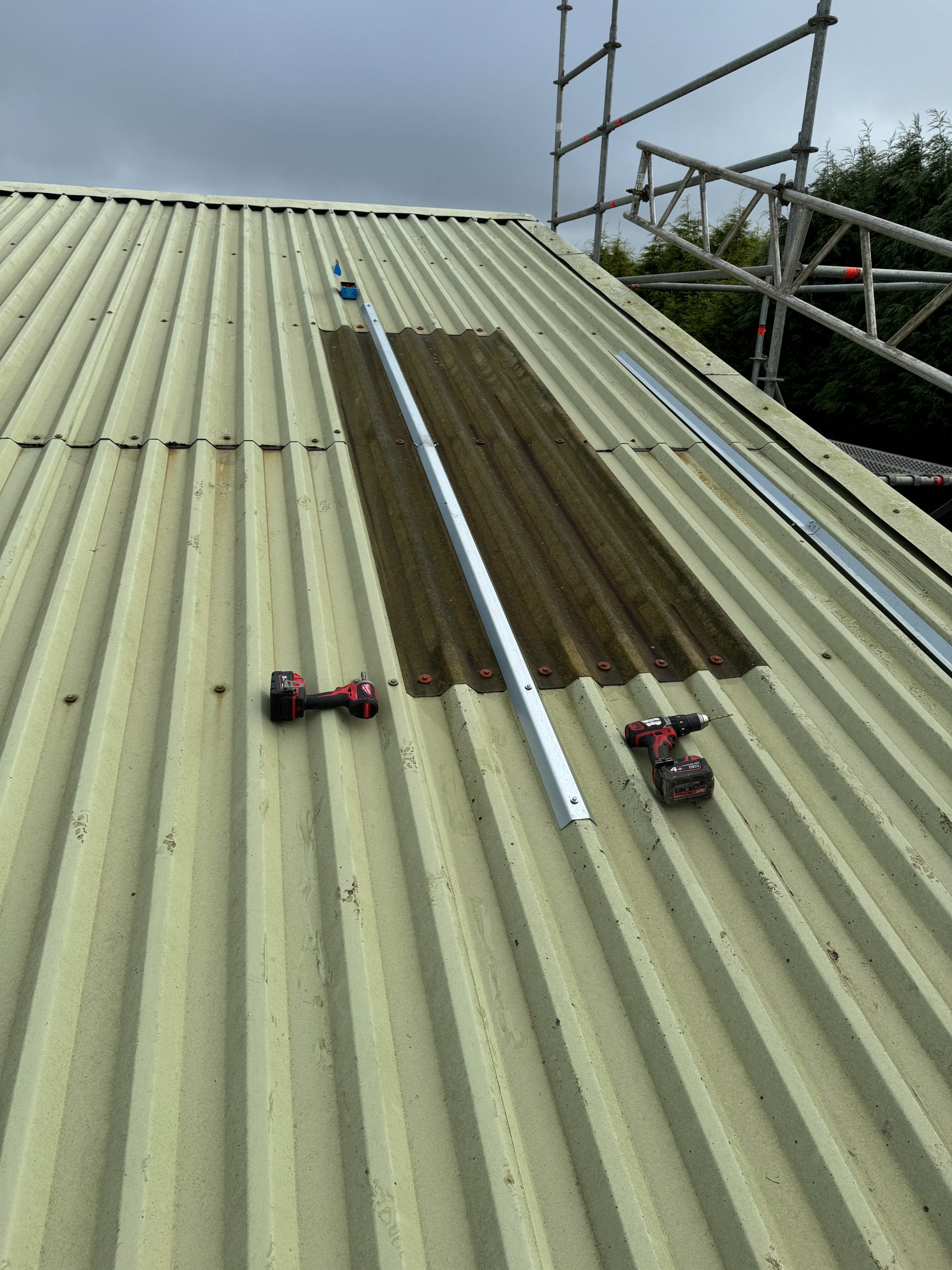
Trapezoidal metal sheet on a steel portal frame is the best agricultural solar roof in Britain. The sheet profile takes short mounting rails, like the Renusol MetaSole rails pictured here mid-install, fixed straight through the crown into the purlins. No penetrating brackets through tiles, no heavy ballast, and the frame itself was engineered to carry snow loads far beyond the weight of a panel array.
Fibre cement sheet is the roof to treat with caution. Newer fibre cement can sometimes be worked with using load-spreading fixings, but it is brittle, and the panels' point loads need careful assessment by the installer and often the sheet manufacturer.
The hard stop is asbestos cement. Most fibre cement roofs fitted before 2000 contain asbestos, and in our experience they usually cannot take panels at all: the sheets are brittle, drilling them creates a licensed-work hazard, and no responsible installer will fix rails through them. If your barn dates from before 2000, get the roof assessed by an asbestos specialist first. The usual outcome is either a re-sheet in modern steel, which turns a liability into a first-class solar roof, or siting the array on another building or on the ground.
Concrete tile and slate barns sit in between. They can be fitted with standard hook systems, the same way we mount domestic roofs, but the labour is higher than on sheet metal so the price per kWp creeps up.
Farm Loads That Suit Solar
Solar suits farms because so much agricultural demand happens in daylight. The loads below are the ones where we see arrays pay back fastest:
- Grain drying and ventilationDrying floors and fans run hard through late summer, exactly when the array is at peak output.
- Refrigeration and cold storesProduce chillers and milk tanks run around the clock, but their compressors work hardest in warm daytime hours when solar is generating.
- Milking parloursVacuum pumps, plate coolers and water heating create a heavy, predictable daily load, and the afternoon milking sits squarely in generation hours.
- Irrigation pumpsPumping demand peaks in dry, bright weather. A pump fed by the sun that is drying your field out is solar at its most logical.
- Poultry ventilation and lightingSheds need continuous ventilation, and fan demand climbs with daytime temperature, tracking solar output closely.
If your heaviest loads run at night, a battery changes the picture: it shifts daytime generation into the evening milking or overnight ventilation. We cover the dairy case in detail in our guide to solar for dairy farms in the UK.
Three Phase, G99 and the Grid
Most working farms already have a three phase supply for motors, pumps and driers, which is good news: it means the site can usually accept a solar system far larger than a house could take. Any system above 3.68kW per phase needs G99 approval from your DNO before it is switched on. Across the East Midlands that is National Grid Electricity Distribution.
Step 1: Application
Your installer submits the G99 application with a single line diagram of the proposed system. This happens before installation, not after.
Step 2: DNO assessment
The DNO checks the local network can accept your export capacity. Rural lines can be constrained, so this step decides whether the full array size, an export limit, or network reinforcement applies.
Step 3: Connection offer and commissioning
Once the offer is accepted the system is installed, commissioned and witnessed where required, then energised with the DNO's approval in place.
On remote farms the grid, not the roof, is often the limiting factor. It is worth knowing early: Spectrum runs a standalone £500 grid application service, so you can find out what your connection will accept before committing to a full project. If the grid refuses an extension, the £500 goes towards reconfiguring the existing system. The full process is explained in our G98 and G99 grid connection guide.
When Ground Mount Makes Sense
If your buildings are asbestos cement, heavily shaded or simply too small, a ground mounted array on a low-grade corner of land is the sensible alternative. The trade-off looks like this:
✓ Barn roof mounting
- Uses structure you already own, so no framing cost
- Usually permitted development, no planning application
- Short cable runs to the loads and the meter
- No land taken out of production
- Panels sit above stock, machinery and mud
✗ Ground mounting
- Frames and groundworks add cost per kWp
- Planning permission usually required
- Longer cable runs back to the supply
- Takes land, needs fencing and vegetation control
- More exposed to accidental damage at ground level
Ground mount is not a bad option; it is the second-best option that becomes the right one when the roofs rule themselves out. Orientation and pitch can be set perfectly, and maintenance access is easy. We walk through frames, foundations and planning in our guide to installing solar panels on the ground in the UK.
What Agricultural Solar Costs in 2026
Commercial scale farm installations typically come in at £850 to £1,100 per kWp plus VAT, installed. Sheet metal roofs sit at the lower end because mounting is fast; tile, slate or ground mounted systems sit higher. As a working example, a 50kWp array on a steel barn would typically land between £42,500 and £55,000 plus VAT as an all-in project including design, the G99 application, installation and commissioning.
| System size | Suits | Indicative installed cost (plus VAT) |
|---|---|---|
| 20kWp | Smaller units, workshops, small dairies | £17,000 to £22,000 |
| 50kWp | Grain stores, larger parlours, packhouses | £42,500 to £55,000 |
| 100kWp | Large sheds, poultry units, cold storage | £85,000 to £110,000 |
Payback on a well-matched farm system is circa 5 years. That figure is illustrative, not guaranteed: it assumes a high share of the generation is used on site and is based on Spectrum's own installed commercial projects at current commercial electricity prices, with export income at published SEG-style rates on top. A farm that uses most of its power at night without a battery will see a longer return, and we will tell you so before you commit.
Two things improve the numbers further. Solar plant qualifies for capital allowances, which can deliver 100% first-year tax relief on the investment; our solar capital allowances guide explains how the claim works. And environmental land management funding can support wider farm energy plans; see our separate article on SFI funding and agricultural solar for what is and is not covered. We are not financial or tax advisers, so confirm your position with your accountant.
A Real Installed Project: Jacksons Nurseries, 56kW
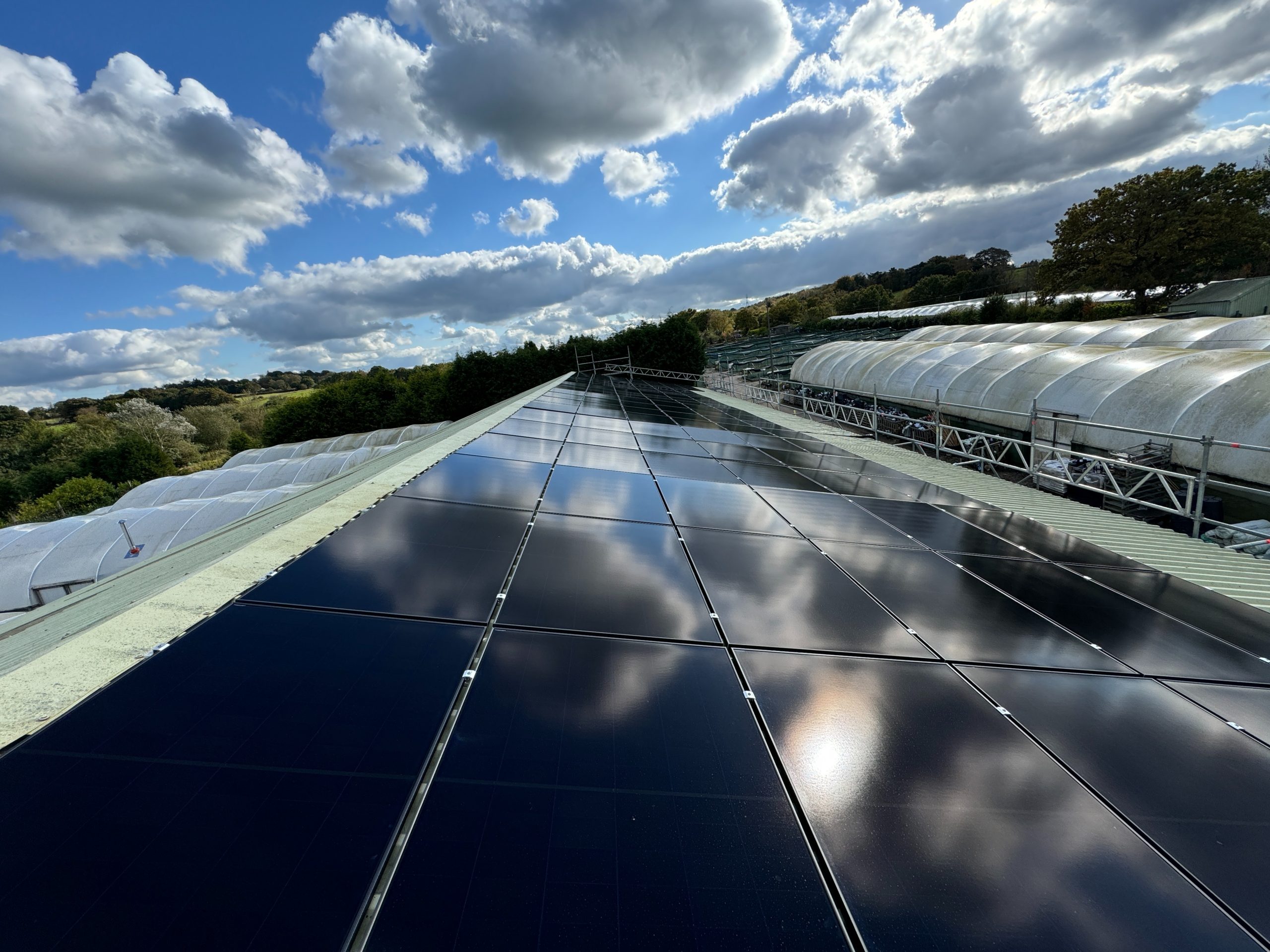
Horticulture running on its own roof
Jacksons Nurseries in Bagnall, Staffordshire, is a working plant nursery with growing tunnels, irrigation and refrigeration running through the season. We fitted a 56kW array of Aiko 455W all-black panels to the trapezoidal metal roof of their main building, mounted on Renusol MetaSole rails fixed directly to the sheet, with a Solis 50kW three phase inverter feeding the site supply.
The building was already there and no planning application was needed. The array sits metres from the pumps and chillers it powers. You can read the full write-up on our Jacksons Nurseries case study.
Spectrum Energy Systems has installed solar across the East Midlands and neighbouring counties since 2011, with more than 1,000 systems connected. Every installation is carried out by our own in-house crews from our Bulwell HQ under one MCS certification (NIC200223), backed by NICEIC approval (3182878), RECC membership (00080159) and a QANW insurance-backed guarantee on our 5-year workmanship guarantee.
Find Out What Your Farm Buildings Could Generate
Send us your address and a rough idea of your roofs and we will run a feasibility assessment. It starts with a free remote roof and energy assessment, so we can see what fits and give you an idea of costs. Prefer us to visit first? We can do that too. Site survey included, and we design and quote, normally within 2 to 4 days.
Request a Feasibility AssessmentFrequently Asked Questions
Do I need planning permission for solar panels on a farm building?
Usually not. Roof-mounted solar on agricultural buildings generally falls under permitted development in England, subject to conditions on size and siting. Ground-mounted arrays normally do need planning permission. Listed buildings and land in conservation areas or national parks carry extra restrictions, so check with your local planning authority first.
Can solar panels go on an asbestos cement barn roof?
Usually not. Fibre cement sheets fitted before 2000 typically contain asbestos, are too brittle to take mounting fixings safely, and drilling them creates a licensed-work hazard. The realistic options are re-sheeting the roof in modern steel, using a different building, or ground mounting. Always get a specialist asbestos assessment before any work.
How much do agricultural solar panels cost in the UK?
Commercial farm installations typically cost £850 to £1,100 per kWp plus VAT installed, so a 50kWp barn roof array lands around £42,500 to £55,000 plus VAT. Sheet metal roofs price at the lower end; tile roofs and ground mounts price higher. Figures are illustrative and based on Spectrum's installed projects.
Do farms need a battery with solar?
Not always. If your big loads run in daylight, like grain drying, irrigation or daytime refrigeration, most generation is used as it is made. Batteries earn their place where demand is heavy at night, such as overnight poultry ventilation or early milking, by shifting daytime solar into those hours.
Is a three phase supply required for farm solar?
No, but it helps. Single phase supplies limit how much inverter capacity the DNO will allow, typically constraining you to small systems. Three phase, which most working farms already have, supports much larger arrays. Either way, systems above 3.68kW per phase need G99 approval from your DNO before energisation.
Can I claim tax relief on agricultural solar panels?
Solar plant and machinery qualifies for capital allowances, and businesses can currently claim 100% first-year relief on qualifying spend, which takes a real chunk off the net cost. The right claim route depends on your business structure, so confirm the treatment with your accountant. We are not tax advisers and this is not financial advice.
How long does an agricultural solar installation take?
The on-roof work on a typical 50kWp sheet metal barn takes a matter of days once scaffolding and access are in place. The longer lead time is the G99 grid application, which runs before installation and varies with your DNO and local network capacity. We handle the whole process end to end.
Lincolnshire is one of our busiest farming counties - our solar panel installers in Lincoln cover farms and rural properties across the whole county.
Related reading
- the benefits of solar panels on your farm
- Solar for dairy farms in the UK
- SFI funding and agricultural solar
- How to install solar panels on the ground in the UK
- Capital allowances on commercial solar
For the full picture of what we install on farms, nurseries and rural businesses, start with our solar for agriculture page.
Speak to Spectrum Energy Systems
MCS-certified installer NIC200223, in-house crews, and more than 1,000 systems connected since 2011. Tell us about your buildings and we will tell you honestly whether solar stacks up.
Speak to Our Team