
Octopus Flux Explained: Is It Right for Your Solar and Battery?
Octopus Flux is a time-of-use tariff built specifically for homes with solar panels and a battery. It splits every day into three price windows: a cheap overnight slot from 2am to 5am for charging the battery, a premium slot from 4pm to 7pm where exported electricity earns its highest rate, and standard pricing in between. The battery buys low overnight and sells high at teatime, on top of your solar generation. For a well-sized solar and battery system it is one of the strongest tariffs available; the catch is that both your import and export need to be with Octopus, and rates move with the market each quarter.
In This Guide
How Flux actually works
Most electricity tariffs charge one rate all day. Flux charges, and pays, three different rates depending on the clock, on both sides of your meter:
| Window | Time | Import (buying) | Export (selling) |
|---|---|---|---|
| Off-peak | 2am to 5am | Cheapest of the day | Lowest of the day |
| Standard | All other hours | Around the normal market rate | A solid mid rate |
| Peak | 4pm to 7pm | Most expensive of the day | Highest of the day, the reward window |
We have deliberately not printed pence figures: Flux rates vary by region and reset quarterly with the market, so any number written here would be stale within months. Check the current rates for your postcode on Octopus's own site; the structure above is the part that stays put. Our export tariff comparison holds the market-wide view.
A day on Flux with a battery
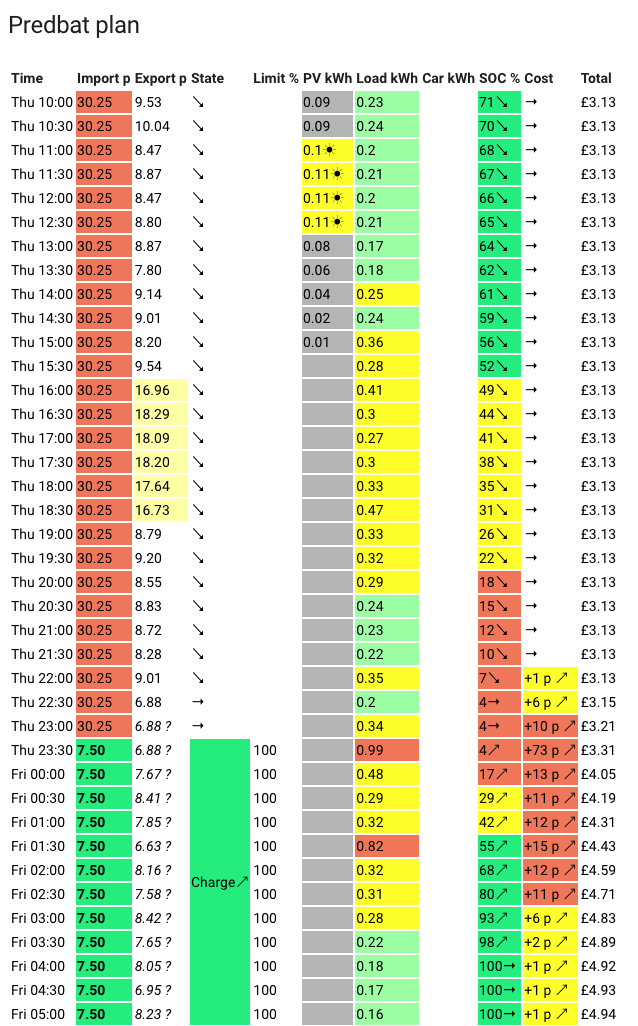
Here is the rhythm, and the screenshot shows a real battery schedule doing exactly this automatically:
- 2am to 5amThe battery charges from the grid at the day's cheapest rate, topping up whatever yesterday's sun left behind.
- Morning and afternoonThe house runs on battery and solar. Surplus generation exports at the standard rate.
- 4pm to 7pmThe money window. The house avoids expensive peak imports by running on the battery, and anything spare exports at the day's best rate.
- EveningWhatever charge remains carries the house to bedtime, then the cycle repeats.
The economics behind this buy-low-sell-high pattern are the subject of our battery time-shifting guide, which is worth reading alongside this one.
Who qualifies
The Flux entry requirements
- Solar panels and a home batteryFlux is designed around storage; without a battery you cannot play the windows and other tariffs suit better.
- A certified installationMCS certification (or the Flexi-Orb equivalent) with the certificate in hand. Every Spectrum install comes with its MCS certificate as standard.
- A working smart meterA SMETS2 meter (some SMETS1 models qualify) sending half-hourly readings, covered in our smart meter guide.
- Octopus on both sidesImport and export both sit with Octopus; you cannot pair Flux export with another supplier's import tariff.
- Grid registrationYour export MPAN and DNO paperwork in order, which your installer sorts during commissioning, as we do on every job.
Flux vs a standard export tariff
A flat export tariff pays the same for a kilowatt-hour at 1pm as at 6pm. Flux pays substantially more in the 4pm to 7pm window, and a battery is the tool that shifts your surplus into it. The bigger the battery relative to your evening usage, the more surplus there is to sell at peak, which is one of the quiet arguments for the 16.1kWh battery in our most installed package: it covers the evening and still has something left to export. The trade-off is engagement. Flat tariffs are set-and-forget; Flux rewards a battery that follows a schedule, and modern systems automate that completely once configured. Our SEG rates comparison shows what the flat alternatives pay.
Who it suits, and who it does not
- Strong fit: solar plus a decent-sized batteryThe classic 5 to 6kWp with 16.1kWh storage setup has enough capacity to charge cheap, cover the peak and export the rest. This is the home Flux was designed for.
- Moderate fit: small battery, high evening usageThe battery empties covering your own peak consumption, leaving little to export. Still worthwhile, mostly through avoided peak imports.
- Poor fit: solar without a batteryYou cannot shift anything, so a straightforward export tariff pays better for less faff. Our panels-without-battery guide covers that route honestly.
- Worth comparing: EV householdsIf a car charges overnight most nights, an EV-first tariff sometimes beats Flux overall. The right answer depends on your usage split, not the tariff's headline.
One honest caveat to finish: tariffs change. Suppliers rework products, rates reset quarterly, and the best pick for your home can shift year to year. The solar and battery hardware is the twenty-five-year decision; the tariff is a setting you revisit annually. Buy the system for your usage, then let the tariff market compete for it.
Want a system built for time-of-use tariffs?
Free site survey, battery sized to your evening usage and tariff strategy, one all-in price. Design normally within 2 to 4 days depending on workload. Call 0115 773 7575, 8am to 8pm, Monday to Friday.
Book a feasibility assessmentFrequently asked questions
What is Octopus Flux?
A time-of-use import and export tariff for homes with solar and battery storage. Every day has three price windows: cheap 2am to 5am for charging the battery, premium 4pm to 7pm where exports earn most, and standard rates otherwise. The battery buys low overnight and sells high at teatime.
Do I need a battery for Octopus Flux?
Yes, in practice. Flux's value comes from shifting electricity between its price windows, which is precisely what a battery does. Solar-only homes are better served by a flat export tariff, where surplus generation earns the same rate whenever it happens.
Can I be on Flux with a different import supplier?
No. Flux requires both your import and export to be with Octopus. If your import sits elsewhere, you would switch supply to Octopus first, then apply for Flux with your MCS certificate, smart meter and export MPAN details.
What are the Octopus Flux rates?
They vary by region and reset roughly quarterly with the wholesale market, which is why we have not printed figures that would date. The stable facts: off-peak import is the day's cheapest electricity, peak export from 4pm to 7pm is the day's best-paid, and current rates for your postcode are on Octopus's site.
Is Octopus Flux worth it?
For a home with solar and a well-sized battery, it is consistently among the strongest tariffs available, stacking cheap overnight charging and premium peak exports on top of self-consumption. For small batteries or battery-less systems the advantage shrinks, and an EV on a car-first tariff can change the answer. Compare against your own usage once a year.
Related reading
- Battery time-shifting: the two-rate tariff play
- Solar export tariffs compared
- SEG rates comparison
- Smart meters and solar
- How long do solar batteries last?
Battery systems designed around your tariff
We are Spectrum Energy Systems, MCS certified (NIC200223), installing solar and battery systems across the East Midlands since 2011, commissioned and paperwork-ready for tariffs like Flux from day one. Call 0115 773 7575, 8am to 8pm, Monday to Friday.
Get in touch