
Battery Time-Shifting: The Other Half of a Battery's Value
Time-shifting means charging your home battery at a cheap overnight rate and running the house on it through the expensive daytime. On a two-rate tariff the gap between rates can exceed 12p per kWh, and the battery closes that gap every single day of the year, including December when your roof generates almost nothing.
In This Guide
A battery earns twice. Most quotes only count once
Ask most installers what a battery does and you will hear about self-consumption: storing your own midday solar for the evening instead of exporting it cheap. True, and important. But it is only half of what the battery does, and it is the half that stops growing once the battery is big enough to hold a day's generation.
The other half is time-shifting. The battery does not care where its electrons come from. On a tariff with a cheap overnight window, it fills up at the low rate while you sleep and runs the house through the next day at what would otherwise be the full rate. Self-consumption only earns when the sun shines. Time-shifting earns every day of the year, and it earns most in winter, exactly when the solar half goes quiet.
How time-shifting works, hour by hour
Overnight, in the cheap window
The inverter charges the battery from the grid at the off-peak rate. A typical hybrid inverter fills a domestic battery comfortably inside a standard off-peak window, so charge speed is rarely the limit.
Morning and daytime
The house draws from the battery first. Kettle, washing, heating controls, the lot, all running on electricity bought at the overnight price rather than the daytime one.
When the sun contributes
Solar tops the battery back up for free, and the system only buys overnight what tomorrow's forecast says the sun will not cover. In summer, that is often nothing at all.
Evening
The evening peak, the most expensive hours on many time-of-use tariffs, runs on whatever mix of sunshine and cheap overnight charge the battery holds. The grid gets bought at full rate only when the battery is empty.
The honest maths
The arithmetic is short enough to show in full. Take the spread between your day rate and your overnight rate, and multiply it by the electricity you can move from one to the other. A home importing around 2,000 kWh a year from the grid, on a tariff with a 12p spread, has up to circa £240 a year available from time-shifting alone. That sits on top of what the battery already earns from storing sunshine, because shifted kWh are ones you were buying anyway.
Three honest caveats, stated plainly. You cannot shift more than you actually import, so the annual import is a hard ceiling. The figure is conditional on being on a time-of-use tariff, because a flat tariff has no spread to trade. And the numbers above are illustrative, built on the current cap rate and published tariff ranges rather than a promise about your bill. What we do in a real quote is run your own consumption through the same sums and show the result as a floor and an upside, never one flat number.

Why time-shifting justifies the bigger battery
Here is the argument that changes battery sizing decisions. Winter grid import is concentrated into days when the roof contributes almost nothing, so the house runs on whatever the battery holds. A battery holding two thirds of your daily demand means the last third of every winter day is still bought at the full day rate. A battery holding a full day means the whole day rides on the cheap rate.
That is the arithmetic reason a 16.1kWh battery out-earns a 10kWh one even when self-consumption figures say they are level. Self-consumption is capped by your sunshine. Time-shifting is capped by how much of a day your battery can hold. Our battery sizing guide works through the capacities.
The tariff condition, stated openly
Time-shifting needs a time-of-use tariff. On a flat tariff there is no spread, so the battery earns from self-consumption alone, which is why we never bake time-shifting into a headline savings figure without saying so. The good news: two-rate and smart tariffs are now mainstream, particularly for households with an EV or storage, and switching is straightforward once the battery is in. Our guides to Agile pricing with solar and the best battery setups for Agile cover the tariff side, and our export tariff comparison covers what your surplus earns.
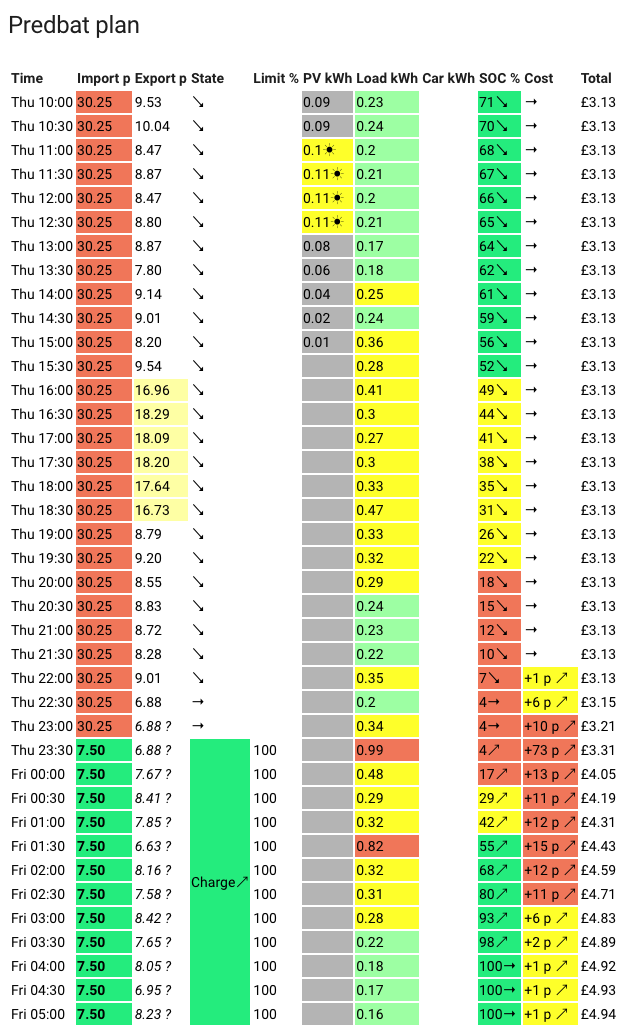
Automating it: this is what the plan looks like
The screenshot is a real Predbat plan of the kind running on our customers' systems. Read the two price columns: the daytime import rate showing over 30p, and the overnight window at 7.5p where the plan schedules a full charge to 100%. Nobody is setting timers by hand. The software reads tomorrow's prices and the solar forecast, then charges when power is cheapest and holds back when the roof will do the work.
We can add Home Assistant with Predbat as an optional extra on systems we install, for customers who ask for it, and it is one of the genuinely uncommon things we offer: most installers fit the battery and leave the tariff value on the table. Our Predbat guide shows the full setup.
Want both halves of the battery's value?
Tell us your usage and whether you would consider a two-rate tariff, and we will show you the floor figure from sunshine plus the honest off-peak upside for each battery size. Over 1,000 installs across the East Midlands since 2011.
Book a feasibility assessmentFrequently asked questions
What is battery time-shifting?
Charging a home battery from the grid during a cheap overnight window and using that stored power through the day instead of buying at the full rate. It works alongside solar self-consumption: the sun fills the battery for free when it can, and cheap overnight power covers what the forecast says the sun will not.
How much can time-shifting save per year?
Multiply your annual grid import by your tariff's spread between day and night rates. A home importing 2,000 kWh on a 12p spread has up to circa £240 a year available, on top of solar savings. The figure is illustrative and conditional on a time-of-use tariff, which is exactly how we present it in quotes.
Does time-shifting work without solar panels?
The mechanism does, yes: a battery alone can buy cheap overnight power and discharge it through the day. Whether battery-only stacks up depends on your usage and tariff, and pairing the battery with panels earns from both sunshine and the spread. We model both honestly when asked.
Do I need a special tariff for time-shifting?
You need a time-of-use tariff, meaning any tariff with cheaper off-peak pricing. Two-rate tariffs, EV tariffs and dynamic tariffs like Agile all qualify. On a flat tariff there is no price gap to capture, so the battery earns from self-consumption only until you switch.
Does charging from the grid every night wear the battery out?
Modern LFP home batteries are warranted for thousands of cycles, which is a daily cycle sustained for well over a decade. Time-shifting works the battery as designed rather than abusing it, and the warranty terms account for daily cycling. Battery chemistry detail is in our LFP guide.
Is a bigger battery worth it for time-shifting?
Often, yes, and this is the point most quotes miss. Self-consumption stops improving once the battery holds your surplus, but winter time-shifting keeps scaling with capacity until the battery holds a full day's demand. Comparing sizes with and without the off-peak upside shows the difference honestly.
Related reading
- How much battery storage do I need?
- Solar battery payback time in the UK
- Predbat battery optimisation explained
- Octopus Agile with solar: the full guide
- Solar panels without a battery: when it makes sense
Batteries set up to actually trade
We are an MCS certified installer (NIC200223) based in Bulwell, Nottingham. Fogstar batteries, Solis hybrid inverters, and Predbat automation as an optional add-on for customers who want the tariff value captured automatically. Call 0115 773 7575, 8am to 8pm, Monday to Friday.
Get in touch