
Solar Battery Storage Payback Time UK 2026
Battery-plus-solar payback in the UK in 2026 is typically circa 9 years for a domestic install on a flat tariff, dropping to 6 to 7 years on Octopus Agile with Predbat automation, and 4 to 6 years on most commercial installs. Battery-only retrofits (no solar) pay back in 6-9 years depending on tariff. The headline numbers some installers advertise (‘1-3 years’, ‘guaranteed savings of £X’) are not honest.
Battery payback in the UK has shortened steadily over the last three years. Electricity prices have risen, lithium-ion battery prices have fallen, and dynamic tariffs like Octopus Agile have made arbitrage genuinely lucrative. But payback also depends heavily on the household - consumption pattern, tariff, EV, heat pump - and we’d rather quote you circa 9 years and beat it than quote you 4 years and miss.
What ‘payback’ actually counts
Battery payback combines three savings streams:
- Self-consumption. Solar electricity stored and used in the evening that would otherwise have been exported at 5-15p/kWh and re-imported at 27p/kWh. The arbitrage is the difference.
- Tariff arbitrage. On Octopus Agile or Flux, charge the battery from the grid at 2-10p/kWh and use it (or export it) at 25-35p/kWh.
- Avoided grid pulls during peak windows. Even on a flat tariff, a 4-7pm draw avoided is a 27p/kWh saving.
Worked example - typical domestic flat tariff
| Assumption | Value |
|---|---|
| Annual consumption | 4,400 kWh |
| Annual solar generation (5kWp JA Solar) | 4,750 kWh |
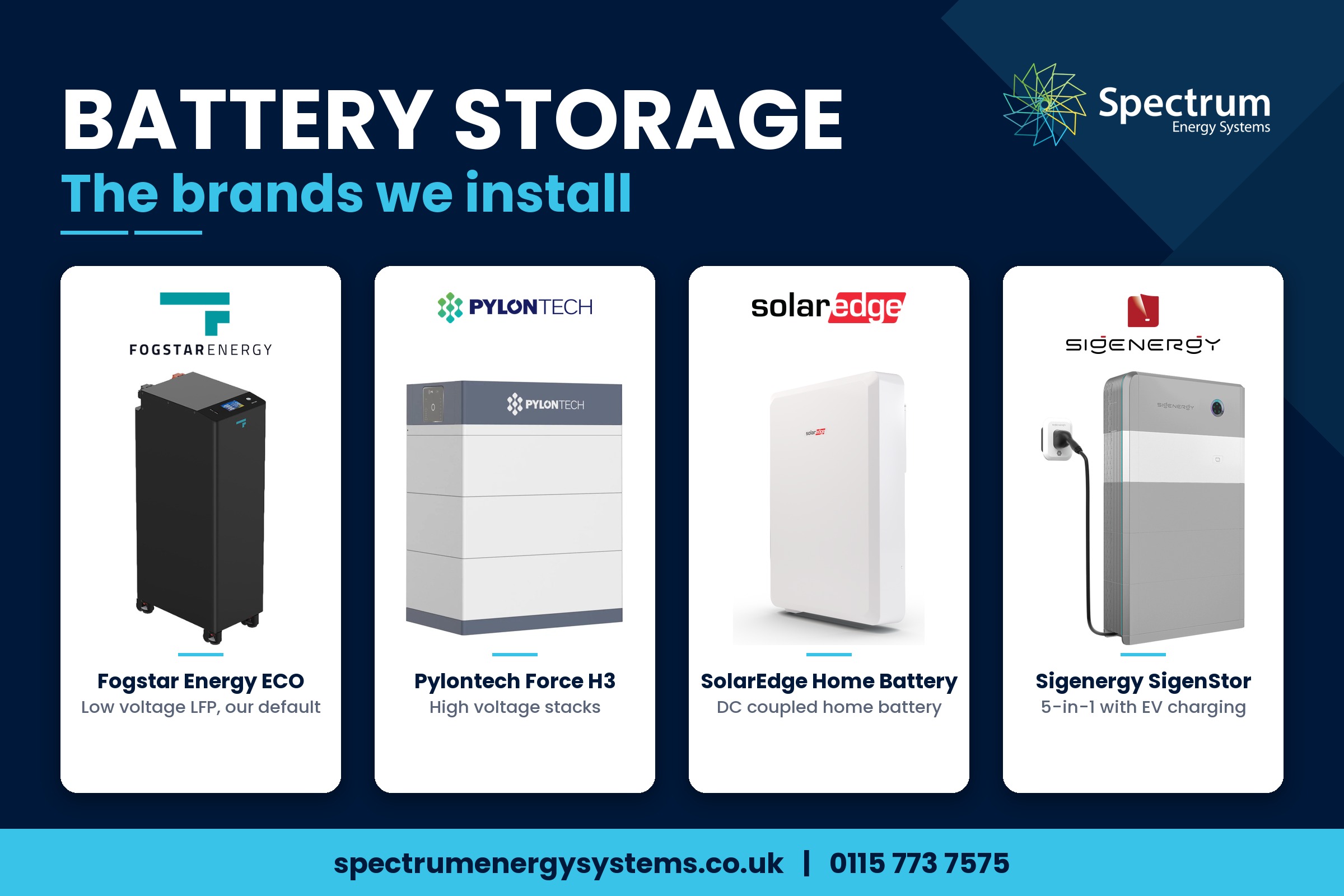
| Battery | Fogstar 16.1kWh |
| Self-consumption without battery | ~30% |
| Self-consumption with battery | ~75% |
| Annual savings (27p import, 12p to 15p export) | £1,100 to £1,150 |
| System cost (5-6kWp + 16.1kWh + Solis 5kW) | ~£9,995 (our most popular system) |
| Payback range | circa 9 years |
Worked example - Octopus Agile + Predbat
| Assumption | Value |
|---|---|
| Same system as above | 5kWp + Fogstar 16.1kWh + Solis 5kW |
| Agile import floor (cheap windows) | 2-10p/kWh |
| Agile peak (5pm) | 25-35p/kWh |
| Predbat-managed arbitrage uplift | +£400 - £600/year |
| Total annual savings | £1,500 to £1,750 |
| Payback range | 6 to 7 years |
Worked example - commercial 50kWp
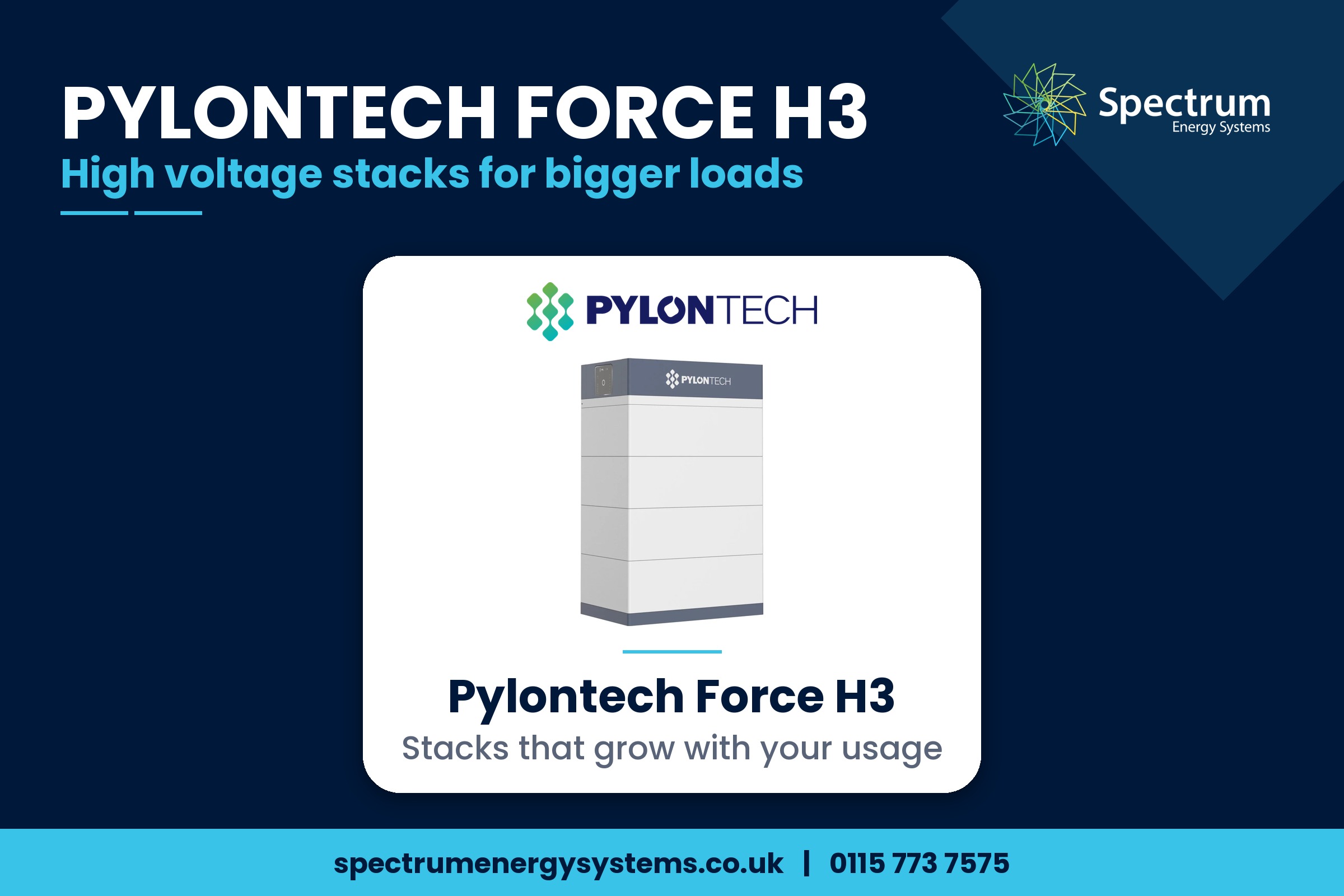
A typical Spectrum commercial install: 50kWp Aiko on a trapezoidal roof, Solis 50kW inverter, Pylontech Force H3 stack at ~20kWh. System cost in the £45,000 - £55,000 region (no VAT). Annual savings £7,500 - £9,500 from displaced import. Capital allowances knock 25% off the effective post-tax cost. Payback range 4-6 years.
See our 177kWp Spalding commercial case study for a real-world larger-scale example.
What shortens payback
- Switching to Octopus Agile (or equivalent half-hourly tariff) and running Predbat.
- Adding an EV that can be charged from solar surplus during the day.
- Higher consumption households where the battery cycles closer to 100%/day.
- Rising electricity prices (Ofgem price cap projections all trend upward through 2030).
- Choosing kit with strong price-per-kWh (Fogstar on LV systems).
What lengthens payback
- Over-sized battery that doesn’t cycle fully on a typical day.
- Flat tariffs without time-of-use pricing.
- Low-consumption households (sub 2,500 kWh/yr) where there’s little load to shift.
- Premium battery brands carrying a 30-50% price uplift on the same chemistry (you’re paying more for the same kWh).
- Specifying a closed-ecosystem battery that won’t talk to Predbat.
Get a payback number for your roof, not someone else’s
Send your annual kWh and your tariff - we’ll model two battery sizes against your real data and show the payback range. Honest, no sales script.
Use the Savings CalculatorWhy we quote a range, not a single number
Payback isn’t a single number for three reasons. First, electricity prices move - Ofgem caps the unit rate and we don’t know what 2028’s cap will be. Second, your consumption changes - people get EVs, change jobs, retire, kids leave home. Third, tariff structures evolve - Octopus has added five new tariffs since 2022. The honest framing is ‘circa 9 years on a flat tariff, on current trajectory’, not ‘exactly 7 years 2 months’.
If an installer quotes you a single-number payback to two decimal places, that’s a marketing number, not an engineering one.
Battery degradation in payback maths
Fogstar and Pylontech both warrant 10 years to ~80% capacity. A 16.1kWh battery has roughly 12.9kWh of guaranteed usable capacity at year 10. In payback maths we model linear degradation from year 1 to year 10 - year-5 figures are typically ~92% of nameplate. That degradation knocks ~5-8% off lifetime savings vs nameplate, which the simple first-year payback figures above do not include, so treat them as a slight best case.
What about replacing the battery after 10 years?
LiFePO₄ batteries don’t fall off a cliff at year 10 - the warranty ends but the chemistry keeps degrading slowly. A 10-year-old Fogstar will typically still hold ~75% nameplate capacity and remain useful. If you decide to replace, the battery cost in 2036 will probably be lower than in 2026 (the lithium price curve has trended down since 2012). Long-run replacement isn’t the disaster some sales pitches imply.
The honest payback table
| Setup | Tariff | Payback range |
|---|---|---|
| Solar + battery domestic | Flat (Octopus Tracker / standard) | circa 9 years |
| Solar + battery domestic | Octopus Agile + Predbat | 6 to 7 years |
| Solar + battery + EV domestic | Octopus Intelligent Go | 5-7 years |
| Battery only retrofit | Octopus Agile | 6-9 years |
| Solar + battery commercial 50kWp | Half-hourly business tariff | 4-6 years |
| Solar + battery commercial 150kWp+ | Half-hourly business tariff + AIA tax relief | 3-5 years |
FAQs
Is a solar battery worth it without solar panels?
Yes on Octopus Agile or Octopus Flux, where the battery can arbitrage cheap-window grid prices. Payback for a battery-only retrofit on Agile is typically 6-9 years - longer than a solar-plus-battery system, but still inside the warranty term. Without a time-of-use tariff, battery-only retrofits don’t pay back.
How much do solar panels with battery storage save UK?
A typical 5kWp + 16kWh system saves a 4-bed UK home £1,100 to £1,150 a year on a flat tariff and £1,500 to £1,750 a year on Octopus Agile with Predbat. Commercial installs scale linearly with consumption - a 50kWp commercial system saves £7,500 - £9,500/year against typical SME tariffs.
Why do some installers quote 1-3 year payback?
Usually because they’re comparing best-case annual savings to a partial system cost, or they’re including hypothetical future electricity price rises. An honest 2026 UK payback for a domestic battery-and-solar system is circa 9 years on a flat tariff. Anyone quoting much shorter is selling, not engineering.
Does the Smart Export Guarantee (SEG) help payback?
Yes, but modestly. Flat SEG rates run roughly 5-15p/kWh in 2026 (Good Energy is around 15p; Octopus Outgoing Fixed dropped to 12p in March 2026). For a battery household the strongest route is usually a variable tariff like Octopus Agile Outgoing, where Predbat shifts export into peak half-hours. Even so, most of your battery’s value comes from self-consumption, not export - SEG is the icing, not the cake. We help you choose the right tariff during commissioning.
How does battery payback compare to a heat pump?
A battery typically pays back faster than a heat pump in 2026 UK conditions. Heat pumps face higher capex per kWh saved, with payback often in the 10-15 year range without grant support. Batteries on Agile + Predbat are in the 6 to 7 year range. The two complement each other rather than competing.
What happens to payback if electricity prices fall?
Battery payback lengthens. A drop from 27p to 22p/kWh would push a typical circa 9-year payback closer to 11 years. The Ofgem price cap has not trended down materially since 2021 and no current forecast shows it falling sharply, but it’s worth modelling. Our quotes show sensitivity at ±10% on the unit rate.
Are there grants that help battery payback?
For domestic installs the main help is 0% VAT on solar PV plus battery storage to 31 March 2027 (covered in our 0% VAT article) - there is no direct cash grant for a home battery. For businesses, the Annual Investment Allowance gives a full first-year capital deduction up to £1m. Both shorten payback; standalone battery grants are rare in 2026.
Related reading
- Fogstar vs Pylontech: which solar battery is right for you?
- How much solar battery storage do I need?
- Best solar battery for Octopus Agile in 2026
- Are solar panels worth it in 2026?
For the full Spectrum service overview see savings calculator.
Speak to Spectrum Energy Systems
MCS NIC200223 - we’ll quote your system and your payback range honestly, against your own kWh, tariff and roof.
Request a Quote