
Commercial Solar Panels Cost UK: Real Project Numbers
UK commercial solar costs £850 to £1,100 per kWp installed, ex-VAT, in 2026. A 50kWp roof system lands at £42,000 to £52,000. A 100kWp system at £82,000 to £100,000. These are Spectrum Energy Systems installed prices, illustrative and quote-dependent, with payback typically circa 4 to 6 years.
In This Guide
What commercial solar costs per kWp in 2026
The most useful number for budgeting is the price per kilowatt-peak installed. Across the commercial systems we have installed and quoted through 2026, that figure sits between £850 and £1,100 per kWp, ex-VAT. Where a project lands inside that band depends on the roof type, the access, the inverter configuration and how far the DC cabling has to run.
Bigger systems come in cheaper per kWp. Scaffolding, design, grid application and mobilisation are broadly fixed costs, so spreading them across 100kWp instead of 25kWp pulls the unit rate down. That is why the bottom of the band belongs to large, simple metal roofs and the top belongs to smaller or more awkward jobs.
Commercial solar cost by system size
These bands come from Spectrum quotes and installed projects across the East Midlands in 2026. They are indicative rather than fixed: your roof, supply and consumption profile move the number. All figures exclude VAT, which commercial customers typically reclaim.
| System size | Indicative installed cost (ex-VAT) | Typical building |
|---|---|---|
| 25kWp | £22,000 to £27,000 | Small workshop, office, farm shop |
| 50kWp | £42,000 to £52,000 | Warehouse unit, mid-size factory, nursery |
| 100kWp | £82,000 to £100,000 | Large warehouse, distribution unit |
| 177kWp | £145,000 to £175,000 | Major industrial roof (our Spalding project scale) |
One sizing note worth knowing before you fix a budget: MCS certification only applies to systems up to 50kW. On projects that hover around that mark we deliberately design at 50kW so the installation keeps its MCS certificate, which some funders and landlords ask to see.
A real £37,000 quote, line by line
Ranges are useful. A real quote is better. In May 2026 we priced a 49.68kWp system for a commercial customer with roughly 40,000kWh of annual consumption. The system: 49.68kWp of Tier 1 panels, a Solis 40kW three-phase hybrid inverter and a 51.2kWh Pylontech Force H3 battery stack. The installed price was £37,000 +VAT.
That single number covered the panels, inverter, battery, mounting, scaffolding, electrical works, G99 grid application and commissioning. Modelled against the customer's consumption and current unit rates, and including export income, the projected payback came out at circa 4 years. That figure is illustrative, drawn from our own system modelling for that site, and never guaranteed: your consumption pattern and tariff will produce a different number.
Worth pausing on what that quote shows. At £37,000 for 49.68kWp plus a large battery, the solar portion prices out near the bottom of the £850 to £1,100 band. A big, straightforward roof and a single mobilisation is how you get there.
Four named Spectrum projects for scale
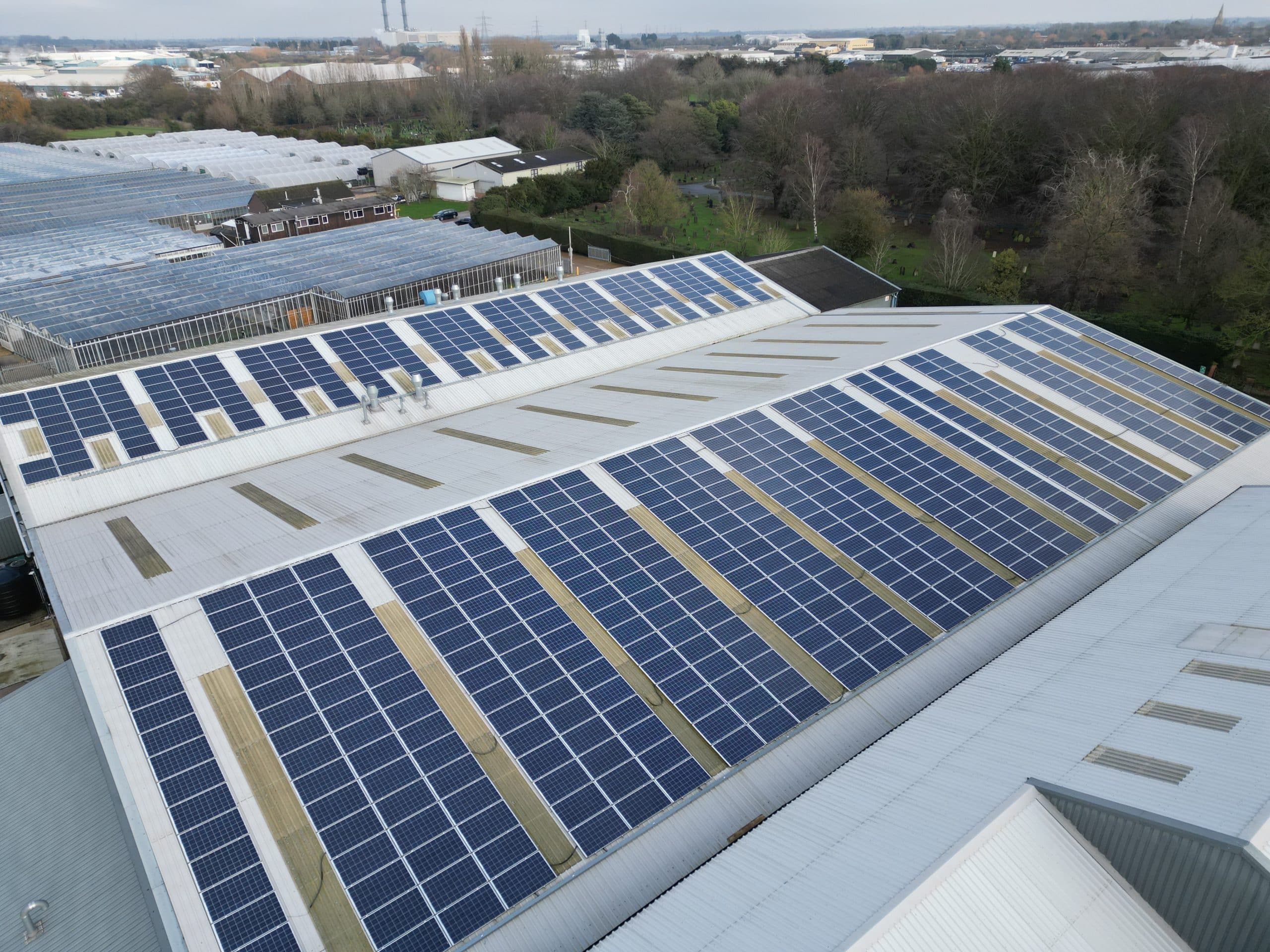
Elsoms Seeds, Spalding: 177kWp
Our largest recent commercial installation, spread across a metal warehouse roof in Lincolnshire. At this scale the per-kWp rate falls to the bottom of the band, which is why the 177kWp row in the table above starts at £145,000 rather than 177 times a small-system rate. Six Solis string inverters run the array from a single plant room. You can read the full write-up on our case studies page.
Three more completed jobs that bracket the table:
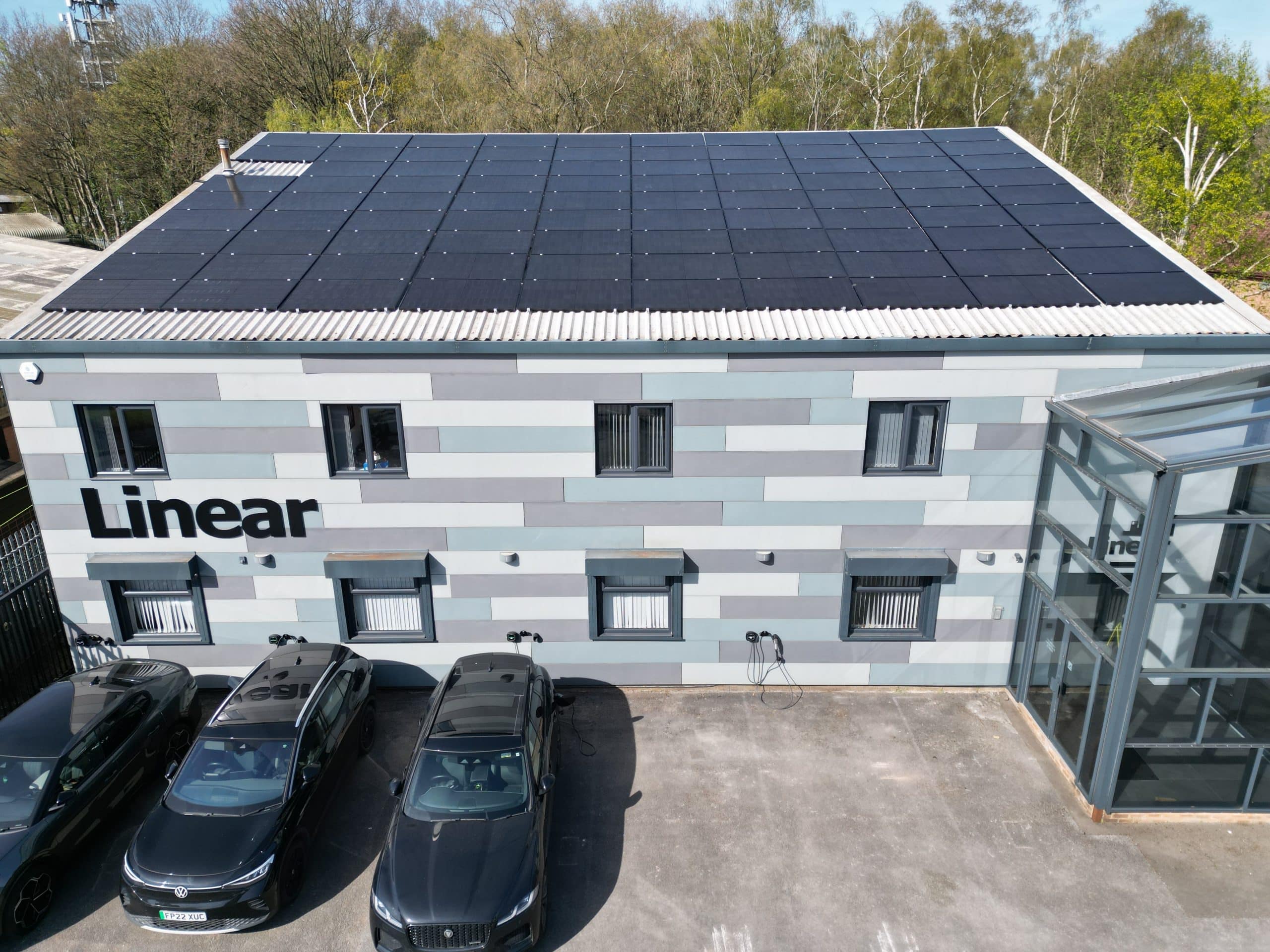
- Linear Insulation, Nottingham: 66.85kW JA Solar panels on a corrugated metal portal-frame roof, one of our commercial solar installations in Nottingham, sitting between the 50kWp and 100kWp price bands.
- Jacksons Nurseries, Bagnall: 56kW (Staffordshire, the patch our solar panel installers in Stafford cover) Aiko panels clamped to a trapezoidal metal roof with Renusol MetaSol rails. A typical mid-band commercial project for a grower.
- Johns of Nottingham: 35kW flat-roof system on Esdec ballasted mounting with an east-west panel layout, plus commercial battery storage. Flat roofs need no penetrations, but ballast design adds engineering time.
What a Spectrum commercial price includes
We quote one all-in figure. Commercial customers do not get an itemised breakdown, because the price is for a working, connected, certified system rather than a pile of parts. Inside that figure:
- Tier 1 solar panels with 25-year performance warranties, selected for the roof rather than from a single fixed brand at enquiry stage.
- Solis inverters as standard, string or three-phase hybrid depending on the design.
- Mounting and roof works matched to the roof: clamp-on rails for pitched metal, ballasted Esdec for genuinely flat roofs.
- Scaffolding and access plus lifting equipment where pallets go to roof level.
- G99 grid application to the DNO, which for most of the East Midlands is National Grid Electricity Distribution. We handle the paperwork and any export limitation requirement.
- Commissioning, certification and handover with our in-house crews working from our Bulwell HQ. We are MCS certified (NIC200223) and NICEIC approved (3182878).
Adding battery storage to a commercial system
Battery storage changes both the price and the economics. On the 49.68kWp quote above, the 51.2kWh Pylontech stack was part of the £37,000 figure. Batteries let a business hold lunchtime generation for the afternoon shift, charge cheaply overnight on a two-rate tariff, and keep more of every generated kWh on site instead of exporting it at a low rate.
Whether the battery earns its keep depends on your load profile. A daytime-only operation with consumption that tracks the sun needs less storage than a site running evening shifts or refrigeration. We model both options in the quote so you can see the difference rather than take our word for it. There is more depth in our guide to battery storage and commercial solar PV efficiency.
Payback, tax relief and the real cost
The headline price is not the number your accountant cares about. Two things pull the effective cost down:
Capital allowances
Solar PV qualifies for capital allowances, so a chunk of the spend comes back through your corporation tax position. The mechanics, including the 50% special rate first-year allowance, are covered in our guide to solar PV capital allowances in the UK. Speak to your accountant about your own position; we are not tax advisers.
Energy savings plus export
Payback modelling should include export income as well as avoided import. On recent Spectrum commercial quotes, modelled paybacks have typically come out at circa 4 to 6 years depending on consumption and tariff. Each figure is illustrative, based on our system modelling for that specific site, and never guaranteed.
After payback, the system keeps generating for decades on panels warranted for 25 years of performance. That long tail is where commercial solar quietly outperforms most other plant investment a business can make.
How to get an accurate figure for your building
Ranges get you to a budget. A design gets you to a decision. It starts with a free remote roof and energy assessment, so we can see what fits and give you an idea of costs. Prefer us to visit first? We can do that too. From there: a site survey, then a system designed from your actual roof and consumption data, then a fixed all-in quote. Design and quote normally follows within 2 to 4 days of the survey. If the grid connection is the sticking point, we also offer a standalone £500 DNO application service, and if you proceed with the install that £500 is credited against the project.
If you are still weighing up whether solar suits your building at all, start with our commercial solar overview. For the domestic side of the market, and how commercial per-kWp rates compare with home installs, see our full UK solar installation cost guide for 2026.
Frequently asked questions
How much do commercial solar panels cost in the UK?
UK commercial solar costs £850 to £1,100 per kWp installed, ex-VAT, in 2026. A 25kWp system runs £22,000 to £27,000, a 50kWp system £42,000 to £52,000, and a 100kWp system £82,000 to £100,000, based on Spectrum Energy Systems installed project pricing.
What does a 50kW commercial solar system cost?
A 50kWp commercial solar system costs £42,000 to £52,000 ex-VAT installed in 2026. A real Spectrum quote from May 2026 priced 49.68kWp with a Solis 40kW inverter and a 51.2kWh Pylontech battery at £37,000 +VAT, near the bottom of the band thanks to a simple roof.
How long is the payback on commercial solar?
Recent Spectrum commercial quotes have modelled payback at circa 4 to 6 years, including both energy savings and export income. The 49.68kWp May 2026 quote modelled circa 4 years against 40,000kWh of annual consumption. Figures are illustrative from site-specific modelling, never guaranteed.
Do commercial solar prices include VAT?
Commercial solar is quoted ex-VAT, so a £42,000 system attracts VAT on top at the standard rate. Most VAT-registered businesses reclaim it, which is why commercial pricing convention differs from domestic solar, where qualifying home installations currently carry 0% VAT.
Does battery storage change the cost much?
Yes. Commercial battery storage adds meaningfully to the capital cost but usually shortens payback, because stored solar displaces expensive imported electricity. Our 49.68kWp quote included a 51.2kWh Pylontech stack inside its £37,000 +VAT price, and the battery was central to its circa 4 year modelled payback.
Can I claim tax relief on commercial solar panels?
Solar PV qualifies for capital allowances, including the 50% special rate first-year allowance, which reduces the effective cost of the system through your corporation tax position. The rules depend on your circumstances, so confirm them with your accountant. Spectrum are installers, not tax advisers.
Why do bigger systems cost less per kWp?
Design, scaffolding, grid application and site mobilisation are broadly fixed whatever the system size. Spread across 177kWp instead of 25kWp, those fixed costs shrink per unit, which is why large warehouse roofs price near £850 per kWp while small awkward roofs sit nearer £1,100.
Pricing a project in the East Midlands? See commercial solar in Leicester for local installation coverage.
Related reading
- energy saving tips for businesses
- Solar panel installation cost UK 2026: real prices
- Solar PV capital allowances in the UK
- Battery storage and commercial solar PV efficiency
- Octopus Shape Shifters and commercial solar export
For the bigger picture on systems, sectors and installation, head to our commercial solar overview.
Get a real number for your roof
A site survey, a system designed from your actual consumption, and one fixed all-in price. Design and quote normally within 2 to 4 days.
Request a Commercial Quote