Solar Panels vs a Wind Turbine: Which Suits a UK Home?
For almost every UK house, solar wins and it is not close. Rooftop panels have no moving parts, no planning drama, predictable output and a mature installer market. Small wind only competes on genuinely exposed rural sites with space for a proper mast, because turbines in gardens and on rooftops sit in turbulent, slow air that produces disappointment rather than kilowatt hours.
In This Guide
Why wind loses in built-up Britain
Britain is a windy island, which is exactly why the comparison feels tempting and exactly why offshore wind farms exist. The physics that make a 150-metre offshore turbine brilliant make a garden turbine poor: wind power scales steeply with wind speed and blade size, and at rooftop height in a town, wind is slow, gusty and chopped up by every building and tree around you. A small turbine in that air spends its life stopping, starting and yawing, harvesting a fraction of its rated output.
Panels have no such complaint. Daylight arrives over roofs uniformly, the resource is boringly predictable across the year, and a solar array sits still while it works, which is why it carries 25-year performance warranties that no small turbine gearbox would dare to offer. Our guide to how panels work covers the mechanics of that stillness.
The comparison, side by side
| Rooftop solar | Small domestic wind | |
|---|---|---|
| Works in towns and suburbs | Yes, anywhere with daylight | Poorly: turbulent, slow air kills output |
| Planning | Usually permitted development | Masts commonly need planning permission, and neighbours notice |
| Moving parts | None | Blades, bearings, yaw systems: maintenance for life |
| Noise | Silent | Audible, and a classic neighbour dispute |
| Predictability | Seasonal but reliable, bankable with MCS-standard figures | Site-specific and frequently overestimated by sellers |
| Installer market | Mature, competitive, certified | Thin, specialist, and thin again for repairs |
| Typical all-in cost | £8,500 to £11,800 with battery at our real prices | Varies wildly with mast and site; rarely cheap done properly |
Where small wind genuinely works
Honesty both ways: small wind has a real niche, and it looks nothing like a suburban garden.
- Exposed rural sitesOpen farmland, coastal properties and hilltops with clean wind and average speeds worth harvesting.
- Room for a proper mastTurbines want clean air well above obstacles, which means a tower and the land to host it.
- Space from neighboursNoise and flicker stop being issues when the nearest neighbour is a field away.
- Often alongside solarOn farms, wind for winter nights and solar for summer days can genuinely complement, as our agricultural guide touches on.
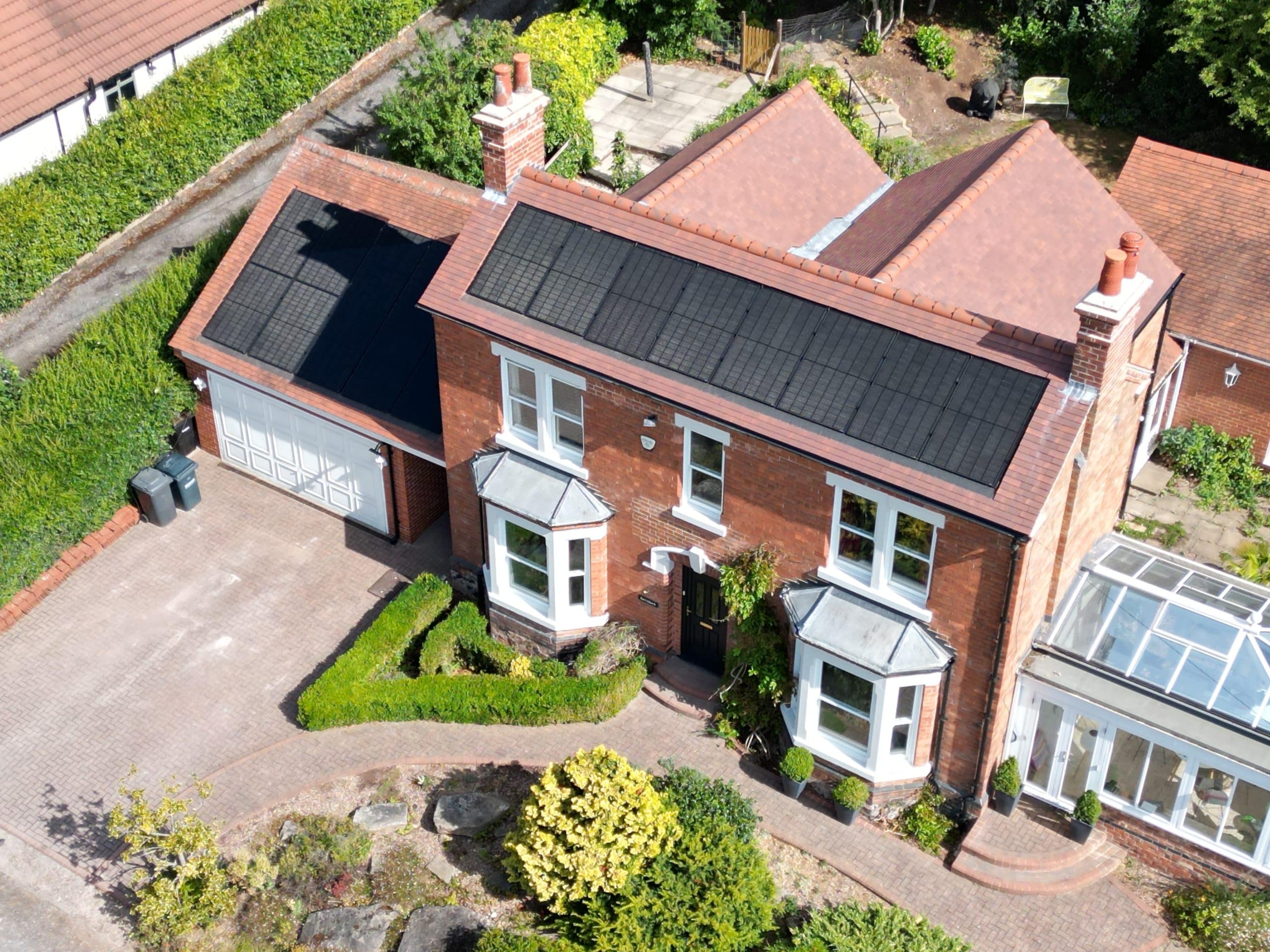
If that describes your property, get a professional wind assessment with real measured data before buying anything. If it does not, the roof in the photo is the answer.
The wind-and-sun myth for homes
The pitch writes itself: sun by day, wind by night, the perfect pair. For homes, the second half rarely survives contact with a wind assessment, and the money tells you why. The budget that buys a marginal garden turbine buys a bigger battery instead, and the battery delivers the night-time half of the promise with certainty: it stores your solar surplus and charges at cheap overnight rates through winter, no gearbox required. That combination, panels plus storage on a two-rate tariff, is the practical version of round-the-clock renewables for a house, which is why it is what we fit. The mechanics are in our time-shifting guide and package cost guide.
Want the realistic numbers for your property?
A feasibility assessment tells you what your roof can generate and what it earns, with MCS-standard figures rather than brochure optimism. Over 1,000 installs across the East Midlands since 2011. Call 0115 773 7575, 8am to 8pm, Monday to Friday.
Book a feasibility assessmentFrequently asked questions
Are solar panels better than a wind turbine for a house?
For almost every UK house, yes. Rooftop wind is slow and turbulent, so small turbines underperform their ratings badly in built-up areas, while panels deliver predictable output with no moving parts, no noise and no planning drama. Wind only competes on exposed rural sites with a proper mast.
Can I put a wind turbine on my roof?
Products exist, results disappoint. Roof-mounted turbines sit in the most turbulent air on the property, transmit vibration into the structure, and typically generate a small fraction of what the same spend on panels would. The industry consensus after years of trials is blunt: roofs are for solar.
Why do wind farms work if home turbines do not?
Height and scale. Wind farms put enormous blades into fast, clean air far above ground turbulence, where the physics of wind power pay handsomely. A garden mast in suburban air enjoys none of those advantages, which is why the same technology behaves so differently at the two scales.
Does wind power work at night when solar does not?
When the wind blows, yes, but for homes the dependable night-time answer is a battery: it banks solar surplus and cheap overnight grid rates, delivering stored power every night regardless of weather. A bigger battery beats a marginal turbine for both reliability and cost on nearly every domestic site.
Do home wind turbines need planning permission?
Frequently, particularly for masts, and the rules are far less generous than solar's permitted development position. Add the noise conversation with neighbours and the visual impact, and the consenting path is a real cost of small wind that solar simply does not carry.
Is a hybrid solar and wind system worth it?
On an exposed rural site with measured wind data, possibly, and farms sometimes prove it. For ordinary homes the hybrid pitch usually means a good solar array carrying a decorative turbine. Spend the turbine's budget on storage instead and the system performs every night of the year.
Related reading
- How do solar panels work?
- Battery time-shifting: the other half of the value
- Solar panel and battery package prices
- Agricultural solar panels UK guide
- Do solar panels work in winter?
Renewables that actually deliver at your address
We are an MCS certified installer (NIC200223) based in Bulwell, Nottingham. Panels and batteries, sized honestly for real UK conditions. Call 0115 773 7575, 8am to 8pm, Monday to Friday.
Get in touch