
Do Solar Panels Work on Cloudy Days?
Yes. Panels run on light, not sunshine, and daylight gets through cloud. An overcast day typically yields a fraction of a clear one, commonly cited between 10% and 25% depending on how thick the cloud is, and bright broken cloud can do far better. Crucially, UK solar economics already assume British weather: the yield figures behind every honest quote include the grey days.
In This Guide
How panels generate under cloud
Solar cells respond to photons, and photons do not stop at cloud, they scatter. On a clear day your panels receive direct beam radiation; under cloud they work from diffuse light, the same brightness that lets you read outside on an overcast afternoon without a lamp. Diffuse light carries less energy than direct sun, so output falls, but it never falls to nothing while there is daylight. The photovoltaic effect does not need a blue sky, just light.
There is even a curiosity in the other direction: on days of bright, broken cloud, the edges of clouds can briefly focus extra light onto an array, producing short spikes above what a clear sky would give. Monitoring apps make these visible, and they surprise every new owner.
How much output you actually get
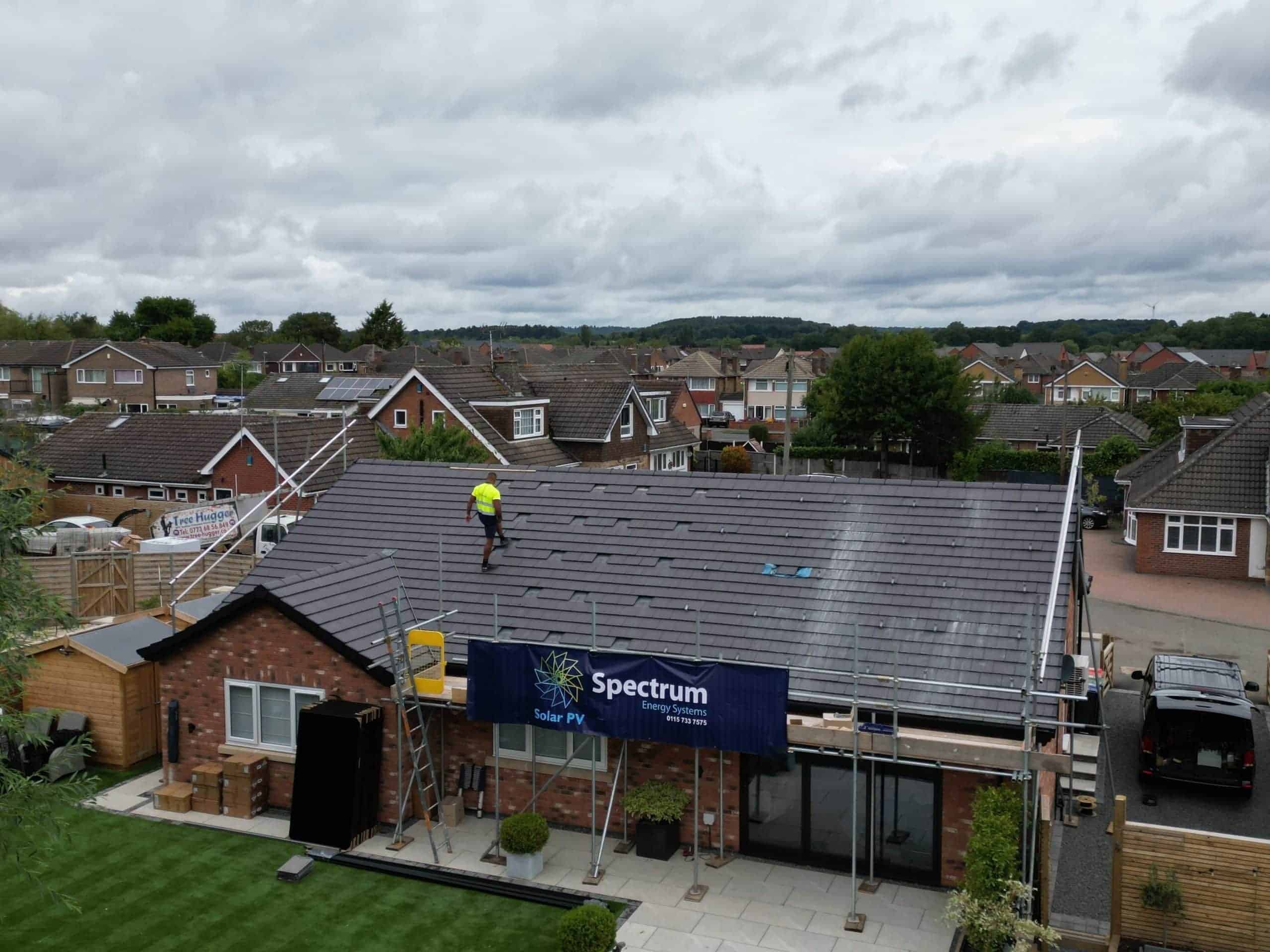
The install in the photo is happening under a properly British sky, which is fitting. What that sky means for generation:
- Thin, high cloudOutput dips modestly; the array still works hard.
- Bright overcastA substantial fraction of clear-sky output; the everyday UK condition panels are sold into.
- Thick, dark cloudDown towards the bottom of the range; the fridge and background loads may still be covered.
- RainSame as its cloud, with a bonus: rain washes the panels, which is a genuine small positive for output afterwards.
Grey days are already in the maths
Here is the point that dissolves most weather anxiety: nobody honest sells UK solar on Mediterranean sunshine. The MCS-standard yield methodology behind our quotes uses long-run regional irradiance data, which is to say decades of actual British weather, clouds, drizzle and all. When we say a system in our region generates 900 to 1,050 kWh per kWp per year, the grey days are already inside that number, not an asterisk against it. The same is true of the circa 8 year payback on our most installed package: it is a British-weather figure, as the assumptions in our cost guide spell out. The seasonal swing, summer against winter, is the bigger effect, and the winter guide covers that half of the story.
What the battery does with British weather
Weather variability is exactly the problem storage was built for. On generous days the battery banks the surplus; on grim ones it bridges the gap, and on a two-rate tariff it fills up cheaply overnight so a run of dark November days never puts you at the mercy of peak rates. Smart setups go further: forecast-aware charging reads tomorrow's weather and prices, and buys overnight only what the sky will not provide, per our time-shifting guide and Predbat guide. Cloud stops being a worry and becomes a line in the plan.
Numbers built for real British weather
A feasibility assessment gives you MCS-standard generation figures for your actual roof, clouds included. Over 1,000 installs across the East Midlands since 2011. Call 0115 773 7575, 8am to 8pm, Monday to Friday.
Book a feasibility assessmentFrequently asked questions
Do solar panels work when it is cloudy?
Yes, from diffuse daylight scattered through the cloud. Output falls rather than stops: thick overcast might deliver a tenth to a quarter of clear-sky output per commonly cited figures, while bright or broken cloud does considerably better. Every daylight hour generates something.
Is the UK too cloudy for solar panels to be worth it?
No, and the proof is that the payback maths uses British weather data, not optimism. Regional MCS-standard yields, around 900 to 1,050 kWh per kWp annually in the East Midlands, already include our cloud, and our most installed system pays back in circa 8 years on those honest figures.
Do solar panels work in the rain?
They generate at whatever level the accompanying cloud allows, and the rain itself does a small favour by rinsing dust and pollen off the glass. A good downpour is free panel cleaning, which is why UK arrays need less washing than desert ones ever would.
What weather is actually best for solar panels?
Cold, bright and clear. Panels convert light, not heat, and silicon works slightly better cool, so a crisp sunny spring day regularly beats a sweltering August afternoon. The enemy is darkness, not temperature, which is why the seasonal swing matters more than any single grey week.
Should I get a bigger battery because of cloudy weather?
Size the battery to your usage first, then let the tariff strategy handle the weather: charging cheaply overnight covers dark spells without oversizing storage for worst-case skies. A forecast-aware setup buys exactly what tomorrow's cloud will cost you, which beats guessing with capacity.
Why does my generation spike on partly cloudy days?
Cloud-edge focusing: bright cloud edges briefly concentrate extra light onto the array, pushing short bursts above clear-sky levels. It is normal, harmless and visible in any monitoring app, and inverters are designed with the headroom to handle it.
Related reading
- Do solar panels work in winter?
- How do solar panels work?
- How efficient are solar panels?
- Battery time-shifting: the other half of the value
- Predbat battery optimisation explained
Honest about the weather since 2011
We are an MCS certified installer (NIC200223) based in Bulwell, Nottingham, quoting British-weather numbers because that is where the panels live. Call 0115 773 7575, 8am to 8pm, Monday to Friday.
Get in touch