
DC-Coupled vs AC-Coupled Batteries: Which Wiring Route Fits?
DC-coupled means the battery shares the solar system's hybrid inverter, storing energy before it is converted to mains power: fewer conversions, tidier kit, the standard for new installs. AC-coupled means the battery brings its own inverter and connects on the mains side: an extra box and an extra conversion, but it bolts onto any existing solar system without touching it, which makes it the retrofit workhorse. Neither is "better", they answer different starting points, and your existing kit usually makes the decision for you.
In This Guide
DC-coupled, explained simply
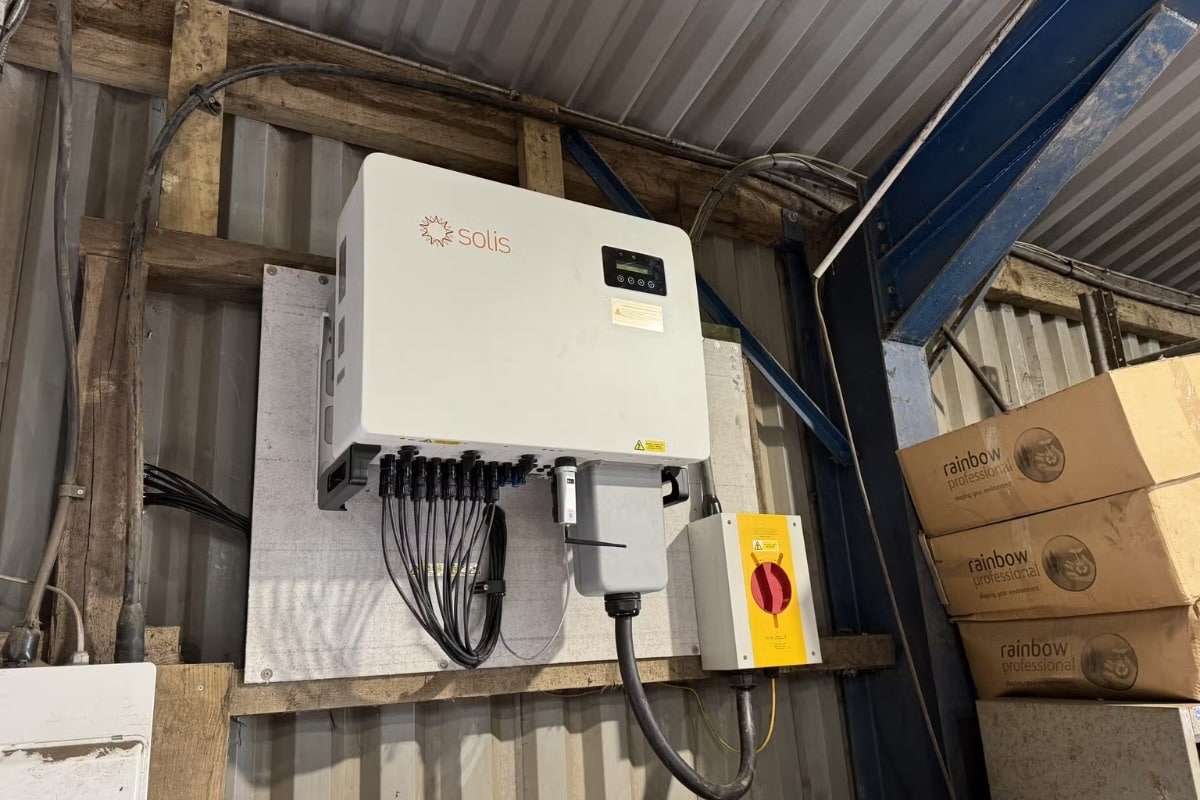
Solar panels make DC electricity; your house runs on AC. Something has to convert, and that something is the inverter. In a DC-coupled system, the battery sits on the same side of the conversion as the panels: a hybrid inverter, like the Solis units we fit, takes DC from the roof, sends what the house needs through one conversion to AC, and stores the surplus in the battery still as DC. Stored energy is converted once, on the way out, when the house wants it.
The practical wins: fewer conversion steps means slightly less energy lost in the round trip, one box on the wall instead of two, and one controller scheduling everything, which keeps time-shifting simple. This is why every new system we design is DC-coupled from day one, and why our hybrid vs string inverter guide recommends hybrid even for buyers not taking a battery yet: the DC coupling route stays open.
AC-coupled, explained simply
An AC-coupled battery carries its own inverter inside the unit and connects on the mains side of your electrics, downstream of whatever solar inverter you already have. Solar generation gets converted to AC by the existing inverter, then converted back to DC to charge the battery, then to AC again when discharged: three conversions instead of one for stored solar, each shaving a little efficiency.
What buys that inefficiency is independence. The battery neither knows nor cares what solar system it sits behind, which means it retrofits onto a ten-year-old string-inverter system without touching the existing install, its warranty or its Feed-in Tariff accreditation. For a large slice of the retrofit market, that independence is worth every conversion, and our retrofit guide walks the decision through.
Side by side
| Factor | DC-coupled | AC-coupled |
|---|---|---|
| Conversions for stored solar | One (out) | Three (out, in, out again) |
| Round-trip efficiency | Slightly higher | Slightly lower, the honest cost of independence |
| Hardware on the wall | One hybrid inverter | Existing inverter plus the battery's own |
| New installs | The natural choice | Rarely worth the extra box |
| Retrofit to existing solar | Means replacing the inverter with a hybrid | Bolts on without touching the old system |
| Charging from the grid | Yes, scheduled by the hybrid | Yes, scheduled by its own inverter |
Which route fits which home
- Buying solar and battery togetherDC-coupled, no contest: one hybrid inverter runs everything, which is how all our packages are built.
- Existing solar on a hybrid inverterDC-coupled again, the battery connects to the port your inverter already has. The cheapest, cleanest retrofit there is.
- Existing solar on a string inverterThe genuine fork. AC-coupled leaves the old system untouched; upgrading to a hybrid buys the efficiency and single-controller simplicity at the cost of replacing the inverter. Age decides it more often than not: a string inverter near the end of its life is worth replacing anyway, a young one is worth keeping.
- Battery first, solar laterA hybrid inverter now keeps the DC route open for the panels, per our battery-only guide.
The grid paperwork wrinkle
One detail worth knowing before quotes arrive: your network operator counts inverter capacity, and an AC-coupled battery adds a second inverter to the tally. A home whose solar inverter already sits near the 3.68kW per phase G98 threshold can be pushed into G99 territory, approval before connection, by the battery's own inverter. A DC-coupled retrofit that reuses or replaces the existing inverter can land differently. None of this changes what is possible, it changes the paperwork and the timeline, and it is precisely the kind of thing a competent installer checks before quoting, as our G98 and G99 guide explains. We handle it on every job, whichever coupling the design lands on.
Not sure which route your home needs?
Free survey: we look at what you have, quote the right coupling route with the grid paperwork included, one all-in price. Design normally within 2 to 4 days depending on workload. Call 0115 773 7575, 8am to 8pm, Monday to Friday.
Book a feasibility assessmentFrequently asked questions
What is the difference between DC and AC coupled batteries?
Where the battery sits relative to the power conversion. DC-coupled batteries share the solar system's hybrid inverter and store energy before conversion; AC-coupled batteries carry their own inverter and connect on the mains side. DC is more efficient; AC bolts onto any existing system.
Which is better, DC or AC coupled?
For a new install, DC-coupled: fewer conversions, less hardware, one controller. For retrofitting a battery to an existing string-inverter system you want left alone, AC-coupled earns its extra conversions through sheer independence. The starting point decides, not the technology.
How much efficiency does AC coupling lose?
Each conversion loses a small percentage, and AC-coupled storage makes three where DC-coupled makes one, so the round trip gives up a modest slice of stored solar. Real-world significance depends on how much energy cycles through the battery; for most homes it is a factor to weigh, not a dealbreaker.
Can I add a DC-coupled battery to my existing solar?
If your inverter is a hybrid with a free battery port, yes, straightforwardly. If it is a string inverter, DC coupling means replacing it with a hybrid, which is worth doing when the old unit is near end of life and rarely worth it when it is young. The survey settles which side you are on.
Does an AC-coupled battery need grid approval?
It registers with your network operator like any generation kit, and because it adds its own inverter to your total capacity, it can tip a home past the 3.68kW per phase threshold where G99 approval is needed before connection. Your installer should check and handle this before quoting timelines.
Related reading
- Hybrid vs string inverters
- Adding a battery to existing solar
- Battery storage without solar
- G98 and G99 grid connections
- Best solar batteries UK
Both routes, done properly
We are Spectrum Energy Systems, MCS certified (NIC200223), designing DC and AC coupled storage across the East Midlands since 2011, with the grid paperwork handled on every job. Call 0115 773 7575, 8am to 8pm, Monday to Friday.
Get in touch