
Adding Solar Panels to an Existing System: What Works
Yes, you can add solar panels to an existing system, and there are three routes: extend onto a spare input on your current inverter, add a second inverter for the new panels, or replace the old system entirely with higher-output modern panels. Which route makes sense depends on your inverter's spare capacity, whether matching panels still exist, and the grid rules: pushing total inverter output past 3.68kW per phase means G99 approval from the network operator before installation. A survey settles it in one visit.
In This Guide
Why people extend their systems
We get this call most weeks, and it is nearly always the same story: the system was sized for the household's electricity use at the time, and the household changed. An electric car arrived. A heat pump went in. Someone started working from home. Or the original install was capped small, plenty of systems fitted in the Feed-in Tariff years were held at around 4kW because the tariff bands rewarded it, leaving half a perfectly good roof empty.
If your roof has space and your usage has grown, extending is a fair instinct. Our system sizing guide covers how much capacity a household actually needs; this article covers how to bolt more onto what you have.
The three routes compared
Every extension job resolves into one of three shapes:
- Extend onto the existing inverterOnly possible when the inverter has a spare input with headroom. Cheapest route when it works; often it does not, because installers size inverters to the original array.
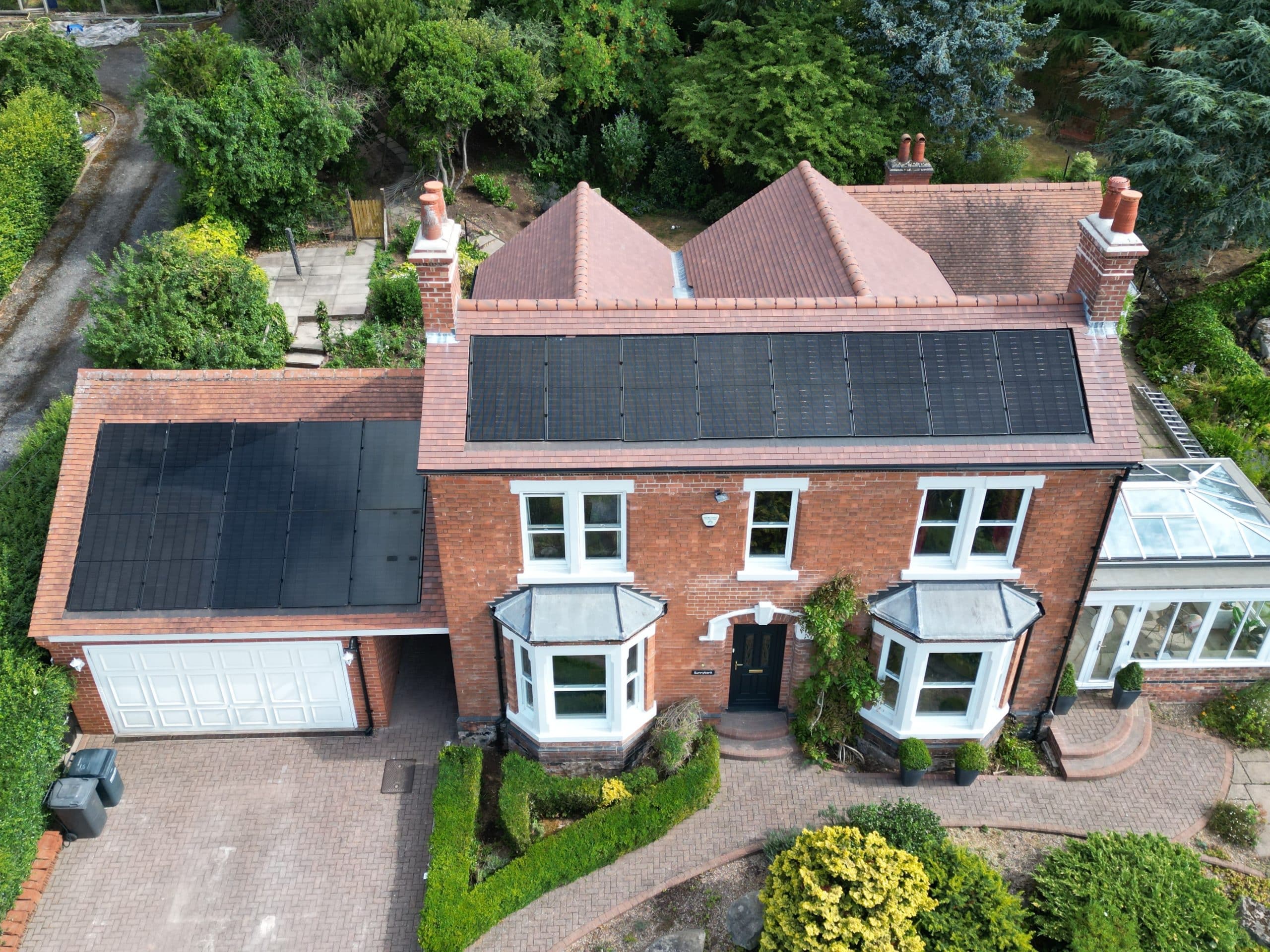
- Add a second system alongsideNew panels, own inverter, wired in parallel. The old system is untouched, which matters for warranties and FiT accreditation. The garage roof pictured is a classic candidate.
- Replace rather than extendPanel output has roughly doubled in a decade. A tired 2kW array of early panels can become 4kW or more of modern 500W panels in the same footprint, with a new hybrid inverter ready for a battery.
| Route | Best when | Watch out for |
|---|---|---|
| Extend existing inverter | Spare input and headroom exist | New and old panels should not share a string; mismatched panels drag each other down |
| Second system alongside | Inverter is full or old, roof space is free | Combined output can cross the 3.68kW per phase G99 threshold |
| Full replacement | System is 10+ years old or under 3kW | Loses FiT accreditation if you have it, so do the sums first |
The technical catches nobody mentions on the phone
1. Panels from different eras do not mix on one string
Panels wired in series behave like a chain: the weakest link sets the pace. Put new 500W panels on the same string as ten-year-old 250W panels and the new ones are dragged down towards the old ones' output. Extensions need their own string on a separate MPPT input, or their own inverter. Our panel sizes guide shows how much the hardware has moved on.
2. Your old inverter probably has no room
Inverters get sized to the array they were bought for. If yours was matched to 3.6kW of panels, it has nothing spare for six more. That is not a fault, it is how the original job was quoted, but it is why "just add a few panels" usually becomes a conversation about a second or replacement inverter.
3. Matching your existing panels is often impossible
Panel models are discontinued quickly. The visual match matters less than people fear, but the electrical match matters a lot, which again points to keeping new panels electrically separate from old ones.
4. Scaffolding costs the same for six panels as for sixteen
Access is a fixed cost. This is the honest reason small extensions can feel expensive per panel, and why we sometimes advise waiting and doing a bigger job once rather than two small ones. Extensions are priced at survey because roof, inverter and access vary so much between homes.
Grid rules: G98, G99 and your DNO
This is the part that catches DIY-minded owners out. Your connection to the grid is registered with your distribution network operator, and adding generation changes that registration. The threshold that matters is 3.68kW of inverter output per phase: at or under it, the extension can be notified after connection under G98; over it, a G99 application must be approved before the new panels are commissioned, which can take weeks. An existing 3.6kW system plus any meaningful extension crosses the line, so most extension jobs are G99 jobs. We handle the paperwork on every job, and our G98 and G99 guide explains the whole process.
On a Feed-in Tariff? Read this first
If your original system earns Feed-in Tariff payments, stop before anyone touches it. The FiT scheme closed to new entrants in 2019, but existing accreditations keep paying, and they are valuable. Added capacity does not earn FiT, and the rules on extending an accredited installation involve your FiT licensee (the energy company that pays you), typically with the extension metered separately so your accredited generation stays clean. Speak to your licensee before committing to anything, and treat any installer who waves this away as a red flag. Done properly, you keep the FiT on the old array and earn export payments on the new one.
When we advise replacing instead
Roughly a third of the extension enquiries we survey end up as replacements, and not because it is a bigger invoice. If the existing system is small, old and out of warranty, the arithmetic often favours a clean modern install: double the capacity from the same roof, one warranty, one hybrid inverter ready for battery storage, and none of the old-meets-new compromises above. Our full systems run from £8,500 all-in including a battery, and the cost guide has the complete price list. A survey tells you which side of the line your home sits on, with the numbers for both routes.
Thinking about extending your system?
Free site survey: we check your inverter, roof and grid position, then quote the extension and the replacement route side by side so you can compare. Design normally within 2 to 4 days depending on workload. Call 0115 773 7575, 8am to 8pm, Monday to Friday.
Book a feasibility assessmentFrequently asked questions
Can I add more solar panels to my existing system?
Usually yes, by one of three routes: a spare input on your current inverter, a second inverter running the new panels separately, or replacing the system with higher-output modern panels. Inverter capacity, string compatibility and grid approval rules decide which route fits, which is what a survey establishes.
Do I need permission to add solar panels?
From the planning system, rarely, the same permitted development rules as a new install normally apply. From your electricity network operator, yes: if the combined inverter output exceeds 3.68kW per phase, a G99 application must be approved before the extension is connected. Your installer should handle it.
Can new solar panels mix with old ones?
Not on the same string. Series-wired panels perform to the weakest module, so new panels wired with old ones are dragged down. New panels need their own string on a separate MPPT input or their own inverter. On the same roof, side by side, mixing generations is fine.
Will adding panels affect my Feed-in Tariff?
It can if it is done carelessly, which is why you talk to your FiT licensee first. Added capacity does not earn FiT, and extensions to accredited installations normally need separate metering so your accredited generation stays intact. Done properly you keep the FiT and add export payments on the new capacity.
Is it better to add panels or replace the whole system?
For systems over ten years old or under 3kW, replacement often wins: modern 500W panels can roughly double the capacity from the same roof area, with one warranty and a battery-ready hybrid inverter. For younger, larger systems with spare roof, extending alongside makes more sense. We quote both routes from one survey.
Related reading
- Adding a battery to an existing solar system
- How many solar panels do I need?
- G98 and G99 grid connections explained
- Solar panel sizes and outputs
- Hybrid vs string inverters
1,000+ installs, extensions included
We are Spectrum Energy Systems, MCS certified (NIC200223), installing and extending solar across the East Midlands since 2011 with our own crews and a 5-year workmanship guarantee. Call 0115 773 7575, 8am to 8pm, Monday to Friday.
Get in touch