
How Many Solar Panels Do I Need? A UK Installer's Sizing Guide
Most UK homes need 8 to 14 solar panels. With today's 500W panels, 8 panels give you a 4kWp system and 10 to 12 panels give you the 5 to 6kWp size we install most often. The right number depends on your annual electricity usage, your roof space and what you plan to add later.
In This Guide
How many solar panels you need depends on three things: how much electricity your home uses in a year, how much unshaded roof you have, and what you plan to add later, such as an EV or a heat pump. Panel counts have dropped sharply because panels have got more powerful. Most of the systems we fit now use 500W panels, so a household that needed 16 panels five years ago often needs 10 to 12 today.
We are Spectrum Energy Systems, an MCS certified installer (NIC200223) based in Bulwell, Nottingham, and we have been installing solar across the East Midlands since 2011. This guide walks through the same sizing method our team uses on real surveys, so you can get a realistic panel count before anyone visits your roof.
The quick answer: panel counts by house size and usage
Ofgem's typical domestic consumption values put a medium-use UK household at around 2,500 kWh of electricity a year (updated July 2026). Larger family homes, and any home with an EV, electric heating or a hot tub, use more, and the meter reading on your annual statement is always a better guide than the number of bedrooms. The table below shows how usage translates into system size and panel count using 500W panels.
| Home and usage | Typical annual usage | System size | Panels (500W) |
|---|---|---|---|
| 1 to 2 bed house or flat, low use | Up to around 2,000 kWh | 2.5 to 3kWp | 5 to 6 |
| 2 to 3 bed house, medium use | Around 2,500 kWh (Ofgem typical value) | 3.5 to 4kWp | 7 to 8 |
| 3 to 4 bed house, higher use | 3,500 to 4,500 kWh | 5 to 6kWp | 10 to 12 |
| 4 to 5 bed house, EV or heat pump | 5,000 kWh and above | 6 to 8kWp | 12 to 16 |
The 5 to 6kWp band is the size we install more than any other. Paired with a 16.1kWh Fogstar battery, that system is currently £9,995 all in for a typical domestic install. That figure is illustrative and based on our own recent quotes; every roof is priced from its own design. If you want the full pricing picture, our guide to real local installation prices breaks it down system by system.
How an installer actually sizes a system
Online calculators guess. We measure. Here is the method our team works through on every domestic survey, and it is the same maths you can run yourself before you speak to anyone.
Step 1: Find your real annual usage
Pull your last annual statement or add up 12 months of bills. You want the kWh figure, not the pounds. If you only have a monthly figure, multiply a spring or autumn month by 12 for a fair average rather than using a January or July extreme.
Step 2: Convert usage into system size
In the East Midlands, a well-sited system generates 900 to 1,050 kWh per kWp each year under the MCS-standard estimation methodology. Divide your annual usage by roughly 950 to get a starting system size in kWp. A home using 4,000 kWh lands at about 4.2kWp before roof constraints are applied.
Step 3: Convert system size into panels
Divide the kWp figure by the panel wattage. At 500W per panel, 4kWp is 8 panels and 6kWp is 12 panels. We drop to 450W or 475W panels where the roof dimensions cannot take full-size 500W modules, and step up to 540W panels on big roofs where fewer, larger panels make better use of the space.
Step 4: Check the roof can take it
Measure the usable, unshaded roof area and divide by the footprint of one panel plus its mounting clearances. Chimneys, velux windows, vents and shading from trees all remove usable space, which is why the survey and the 3D design matter more than the arithmetic.
Step 5: Size for where you are heading, not just today
If an EV or heat pump is on your two to three year horizon, size the array for that future usage now. Adding panels later means new scaffolding, a possible inverter change and a second round of paperwork, so extra capacity is far cheaper on day one.
This is also why we do not quote from a postcode and a bedroom count. We design your system on your actual roof in 3D, using the real dimensions, orientation and shading, then quote from that design. You see the panel layout before you commit, and the generation estimate is based on your roof rather than a national average. Design and quote normally comes back within 2 to 4 days of the survey.
How big is one solar panel?
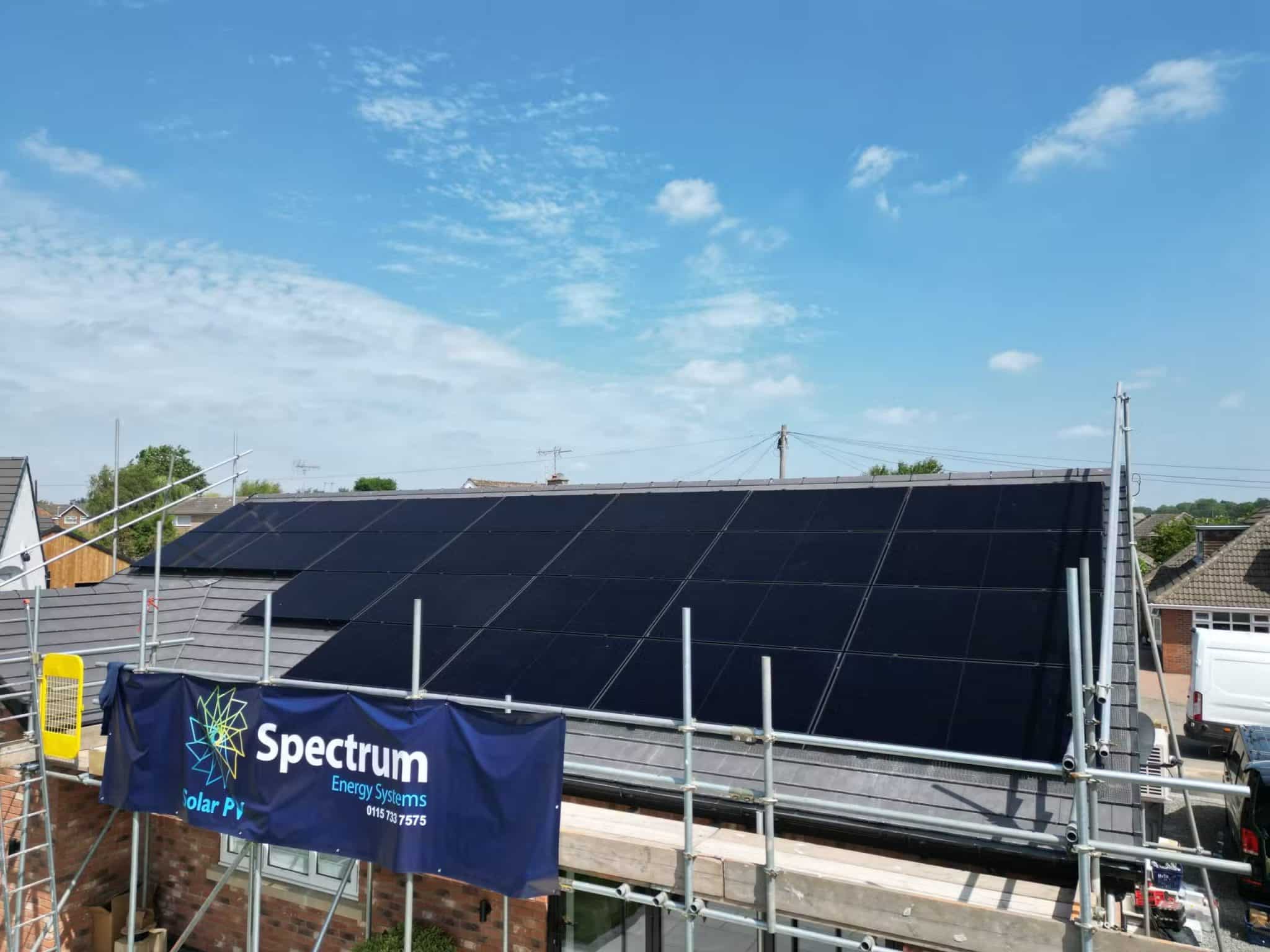
A modern 500W residential panel measures approximately 2m by 1.1m, so each panel needs roughly 2.2 square metres of roof once mounting clearances are included. Ten panels therefore want around 22 to 25 square metres of clear, unshaded roof.
The array pictured uses Longi 505W all-black panels, the format we fit as standard on most domestic roofs. All-black modules sit flush and low profile against dark tiles, which matters to most homeowners as much as the output does.
The six things that change the number
- Annual electricity consumptionYour real kWh usage sets the target. Sizing from bedrooms alone is guesswork; two identical houses can differ by thousands of kWh a year depending on who lives there and what they run.
- Usable roof areaAt roughly 2.2 square metres per panel, roof space caps the count. Hips, dormers, chimneys and velux windows all eat into the layout, which is why the 3D design stage exists.
- Orientation and shadingSouth-facing roofs generate the most, but east-west splits work well and make up a big share of our installs. Heavy shading from trees or neighbouring buildings may push us to optimised layouts, or occasionally to fewer, better-placed panels.
- Future EV or heat pump plansAn electric car or heat pump adds thousands of kWh to annual usage. Size up front rather than retrofit: extra panels on install day cost a fraction of a second visit with new scaffolding.
- Battery pairingA battery does not change the panel count directly, but it changes how much of the generation you keep, which changes the size worth installing. Our separate guide on how much solar battery storage you need covers battery sizing properly.
- Grid connection limitsThe inverter size, not the panel count, is what your network operator regulates. See the G98 and G99 section below for how that works in practice.
One number the calculators skip: what each panel actually produces over a year in UK conditions. A 500W panel does not make 500W all day. If you want the generation detail behind the sizing maths, read our guide on how many kWh a PV panel produces.
A real example: 16 panels in Sherwood, Nottingham
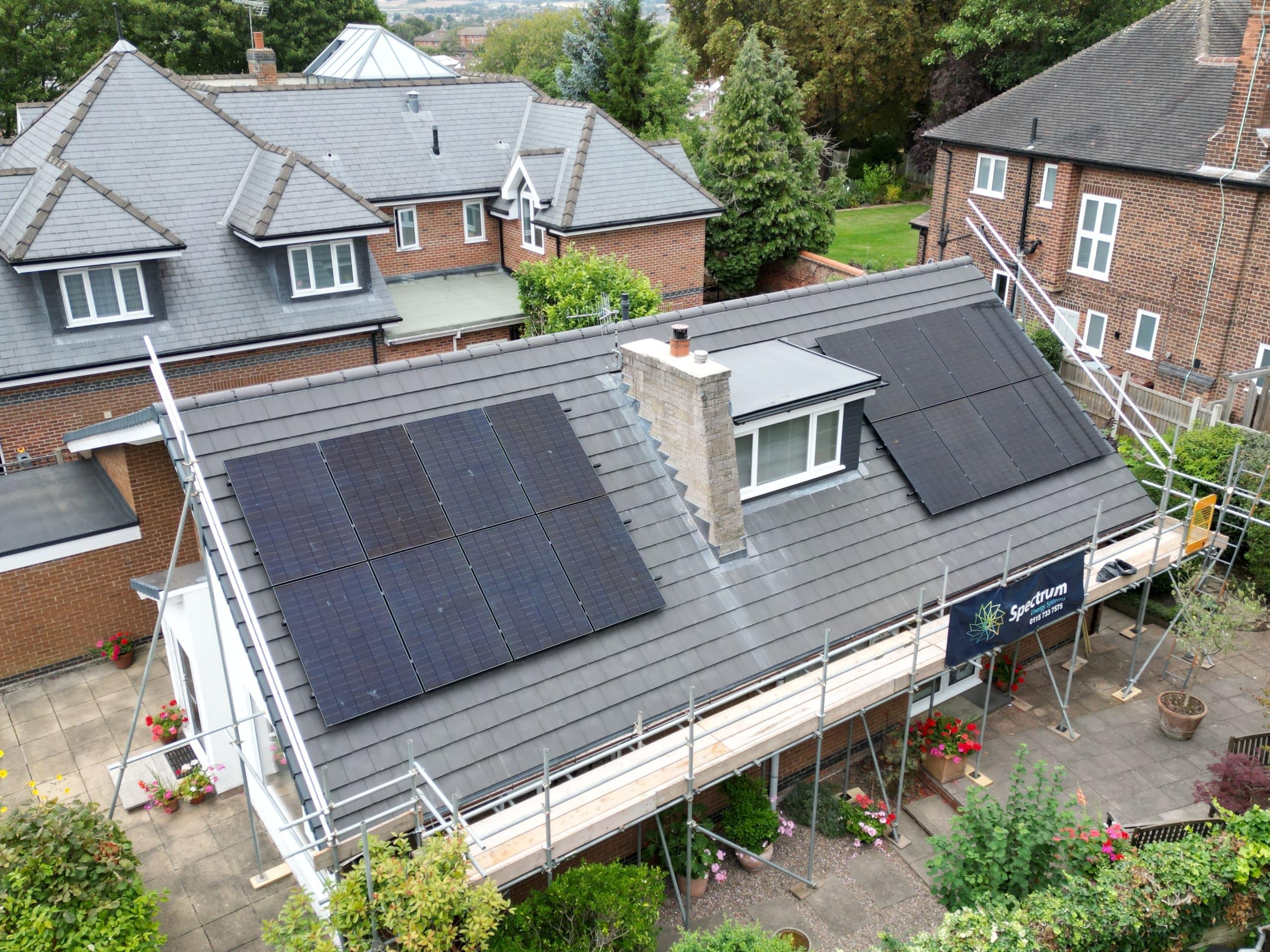
This 7.2kWp system in Sherwood uses 16 all-black 455W-class panels split across two roof faces either side of the chimney. The roof could not take full-size 500W modules in that layout, so we specified 455W panels and used the count to hit the target capacity instead.
The result covers around 80% of the home's annual electricity usage, generating an estimated 7,505 kWh a year. Another installer had turned the job down over a difficult cable route; our in-house crew completed it in four days. The full write-up is in our Sherwood installation case study.
Grid limits: what G98 and G99 mean for your panel count
Your Distribution Network Operator (National Grid Electricity Distribution across most of the East Midlands) limits how much your system can export, and the limit applies to the inverter, not the panels. Under G98, you can connect an inverter up to 16 amps per phase, which is 3.68kW on a single-phase home, and simply notify the network operator after installation. Anything larger needs a G99 application approved before the install.
In practice this rarely reduces your panel count. A 5 or 6kWp array can sit behind an appropriately configured inverter, and where a full G99 application is needed, we prepare and submit it for you as part of the job. It adds some lead time on larger systems, but it is routine work for us rather than a reason to under-size your roof.
Want a panel count for your actual roof?
Book a feasibility assessment and we will design your system in 3D from a real survey, then send a fixed all-in quote, normally within 2 to 4 days.
Request a QuoteFrequently asked questions
How many solar panels do I need for a 4 bedroom house?
Most 4 bedroom UK homes need 10 to 14 panels. Using 500W panels, that is a 5 to 7kWp system, sized for annual usage of roughly 3,500 to 5,000 kWh. If the household runs an EV or heat pump, we would usually size towards the top of that range or beyond it.
How many solar panels do I need for a 3 bedroom house?
Typically 8 to 12 panels. A medium-use 3 bed home sits near Ofgem's typical figure of around 2,500 kWh a year, which points to a 3.5 to 4kWp system of 7 to 8 panels, but many 3 bed households use more and land in the 5 to 6kWp, 10 to 12 panel band.
How much roof space do 10 solar panels need?
Roughly 22 to 25 square metres of clear, unshaded roof. A modern 500W panel measures approximately 2m by 1.1m, so each one needs about 2.2 square metres once mounting clearances are allowed for. Chimneys, velux windows and shading reduce the usable area, which is what the survey confirms.
Can I add more solar panels later?
Usually yes, but it costs more than doing it once. Extending an array means new scaffolding, possibly a larger inverter, and fresh network operator paperwork if the inverter size changes. If an EV or heat pump is on your horizon, it is almost always cheaper to size the system for it now.
Do more panels mean I need a bigger battery?
Not automatically. Battery size follows your evening and overnight usage plus your tariff, rather than your panel count. Many of our installs pair a 5 to 6kWp array with a 16.1kWh Fogstar battery because that combination stores a full day's surplus. Battery sizing is a separate calculation with its own guide.
Is there a limit on how many solar panels I can install in the UK?
There is no legal cap on panels, but your network operator regulates the inverter. Up to 16 amps per phase (3.68kW single phase) connects under G98 with simple notification. Larger inverters need G99 approval before installation, which we handle as part of the job on bigger domestic systems.
Do solar panels have to face south?
No. South-facing roofs produce the most over a year, but east-west arrays perform well and spread generation across morning and evening, which suits how most households actually use electricity. A large share of the systems we install in the East Midlands are east-west splits, sized accordingly.
Want a sizing designed for your actual roof? Our solar panel installers in Leicester survey and design across Leicestershire.
Related reading
- How much solar battery storage do I need?
- How many kWh does a PV panel produce?
- Solar panel installation prices in Nottingham
- 7.2kW residential installation in Sherwood, Nottingham
For the wider picture on system options for your home, start with our domestic solar overview.
Speak to Spectrum Energy Systems
MCS certified (NIC200223), installing across the East Midlands since 2011, with in-house crews working from our Bulwell HQ. You get one survey, one 3D design and one fixed all-in price.
Book a Feasibility Assessment