

Weighing up what this kit means for your own building? Our commercial solar panel installation page covers costs, payback and grid applications for business systems.
New Solar Panel Technology Trends for 2026: 10 Innovations Changing Solar Energy
Every year the solar industry promises revolutionary new technology. Most of it is incremental. A few things in 2026 are actually worth knowing about- perovskite-silicon tandem cells finally entering commercial supply, Aiko's All-Back-Contact modules pushing efficiency higher, and automated tariff dispatch via Predbat and Home Assistant turning your battery from a cost centre into a revenue asset. For the panel-side of this trend - tracking, self-optimising and robotic systems - see our guide to automated solar panels.
This guide is the honest installer's version. Written by Spectrum Energy Systems- MCS-accredited (MCS #NIC200223), NICEIC Approved (Reg. 3182878), RECC member (#00080159), 10MW+ connected across the East Midlands since 2011. We tell you what's mature enough to install, what's worth waiting for, and what we actually fit on our own quotes.
In This Guide
- #1 Perovskite Solar Cells
- #2 Tandem Solar Cell Technology
- #3 Bifacial Solar Panels
- #4 Advanced Energy Storage (Fogstar & Pylontech)
- #5 Building-Integrated PV (BIPV)
- #6 Predbat, Home Assistant & Real Tariff Automation
- #7 Ultra-High Efficiency Silicon (TOPCon, HJT, Aiko ABC)
- #8 Lightweight and Flexible Solar
- #9 Manufacturing Innovations
- #10 Smart Panel Technology (SolarEdge MLPE)
- Recycling and End-of-Life
- Wait or Install Now?
- UK Climate Considerations
- Frequently Asked Questions

This guide explores the ten most significant solar energy trends 2026 is bringing to market, examining which innovations are ready for deployment versus those still in development. Whether you're a homeowner exploring residential solar innovations or a business evaluating commercial solar technology 2026 options, the answer to "should I install now?" almost always comes back the same: yes, with proven kit, and stop waiting for technology that's two years away from mass production.
What's changed for 2026 specifically - and what's genuinely worth your attention - is automated tariff dispatch. Our setup on Solis hybrid systems pairs Fogstar or Pylontech LFP batteries with Predbat running on Home Assistant. It charges your battery from cheap off-peak electricity overnight, discharges it (or exports it) into the late-afternoon peak when Octopus Shape Shifters: Export pays multiples of the flat SEG rate. That's currently our biggest commercial differentiator and it's covered properly in section #6.
Explore the Latest Solar Technology for Your Property
Our MCS-accredited engineers will recommend the right kit for your roof, your load profile and your tariff. Solis hybrid inverters, Fogstar or Pylontech batteries, tier-1 panels. Honest payback ranges.
Request a Feasibility Assessment Speak to Our Engineers#1 Perovskite Solar Cells Enter Commercial Production
Perovskite solar cells 2026 represent the most significant breakthrough in photovoltaic technology since the development of crystalline silicon. Named after their crystal structure rather than the mineral, these cells use compounds that can be manufactured at lower temperatures using simpler processes than traditional silicon.
What Makes Perovskite Technology Revolutionary
Unlike silicon cells requiring energy-intensive manufacturing, perovskite materials can be deposited from solution onto various substrates, including flexible materials. Laboratory cells have achieved efficiencies exceeding 26% for single-junction designs, with perovskite-silicon tandem configurations reaching 33.9% in research settings.
The real excitement in 2026 centres on tandem cells combining perovskite with silicon. UK-based Oxford PV has begun commercial production of tandem cells achieving 24-27% module efficiency - significantly higher than the 20-23% typical of standard monocrystalline panels. Laboratory cells have demonstrated even higher potential, with records exceeding 33%.
Commercial Reality Check (Spectrum view)
Perovskite-tandem panels look impressive on paper but the commercial supply is still limited and the warranty terms (typically 20 years) lag behind tier-1 silicon (25-30 years). For 99% of the East Midlands installs we quote in 2026, proven JA Solar, Aiko or Longi monocrystalline panels at 500W+ deliver better real-world value. We'll quote perovskite-tandem on premium space-constrained jobs where every percentage point counts - ask us if you think your roof qualifies.
#2 Tandem Solar Cell Technology Reaches Market Maturity
Tandem solar cells layer different photovoltaic materials to capture broader light spectrum portions than single-junction designs. Each layer absorbs different wavelengths, dramatically improving overall efficiency. In 2026, this technology moves from laboratory curiosity to commercial reality.
How Tandem Cells Achieve Higher Efficiency

Standard silicon cells have a theoretical efficiency limit around 29% (the Shockley-Queisser limit). Tandem cells overcome this by stacking materials with different bandgaps - the top layer captures high-energy photons whilst lower layers capture wavelengths that would otherwise pass through unused.
Perovskite-silicon tandems dominate current commercial development. All-perovskite tandems and III-V compound configurations remain primarily in research phases.
Efficiency Achievements and Real-World Performance
Commercial tandem cells in 2026 typically achieve 24-28% efficiency under standard test conditions. Compared to conventional panels at 20-23%, this represents 15-25% more electricity from identical roof space. For understanding how solar panel efficiency impacts your installation, this difference becomes significant over a system's 25+ year lifespan.
| Technology Type | Efficiency Range | Commercial Status | Spectrum's Default Use |
|---|---|---|---|
| Standard Monocrystalline (PERC) | 20-23% | Widely available | Most domestic installs |
| TOPCon Premium (JA Solar, Longi) | 22-24% | Mainstream availability | Standard domestic & commercial |
| Aiko N-Type ABC | 23-25% | Available, premium | Where customer asks or roof is tight |
| HJT (Heterojunction) | 24-26% | Available, premium | On request - excellent UK climate fit |
| Perovskite-Silicon Tandem (Oxford PV) | 24-28% | Limited availability | Premium / space-constrained projects only |
| III-V Compound Tandem | 32-35% | Specialist only | Aerospace / concentrated PV (not domestic) |
Technology Selection Considerations
Tandem cells offer 15-25% efficiency improvement over standard panels, meaning equivalent power generation from fewer panels - particularly valuable when roof space limits system size. Our guide to choosing the right solar battery covers the related kit decisions in detail.
#3 Bifacial Solar Panels Become Standard
Bifacial solar panels 2026 have fully transitioned from premium option to mainstream technology. Designed to capture sunlight from both front and rear surfaces, bifacial designs now represent an increasing proportion of new installations, particularly for commercial and ground-mounted systems.
Understanding Bifacial Technology
Traditional monofacial panels have opaque backsides, wasting light reflected from surrounding surfaces. Bifacial panels feature transparent back layers, allowing them to capture albedo (reflected) light from ground surfaces, snow, or light-coloured roofing materials. This dual-sided capture typically boosts output by 5-30% depending on installation configuration.
For agricultural solar installations, bifacial panels enable continued land use beneath whilst maximising generation. On our standard domestic designs we default to all-black bi-facial panels where the roof suits- the aesthetic benefit is meaningful for residential customers and the modest performance uplift is a bonus.
Optimal Applications for Bifacial Panels
Ground-Mounted Arrays
Elevated mounting over reflective surfaces maximises rear-side capture. Ideal for agricultural land and open spaces.
- 15-30% efficiency boost typical
- Best with white gravel/grass
- Requires elevated mounting
Flat Commercial Roofs
Light-coloured roofing membranes reflect significant light to panel rears. Suits warehouse and commercial buildings.
- 10-20% efficiency boost typical
- White EPDM membranes ideal
- Enhanced with tilted mounting
Domestic All-Black Bi-Facial
Standard pitched-roof installs - minimal rear-capture benefit but a strong aesthetic choice for visible roofs.
- Modest output uplift
- Stronger aesthetic appeal
- Our default where roof allows
#4 Advanced Energy Storage: Fogstar & Pylontech
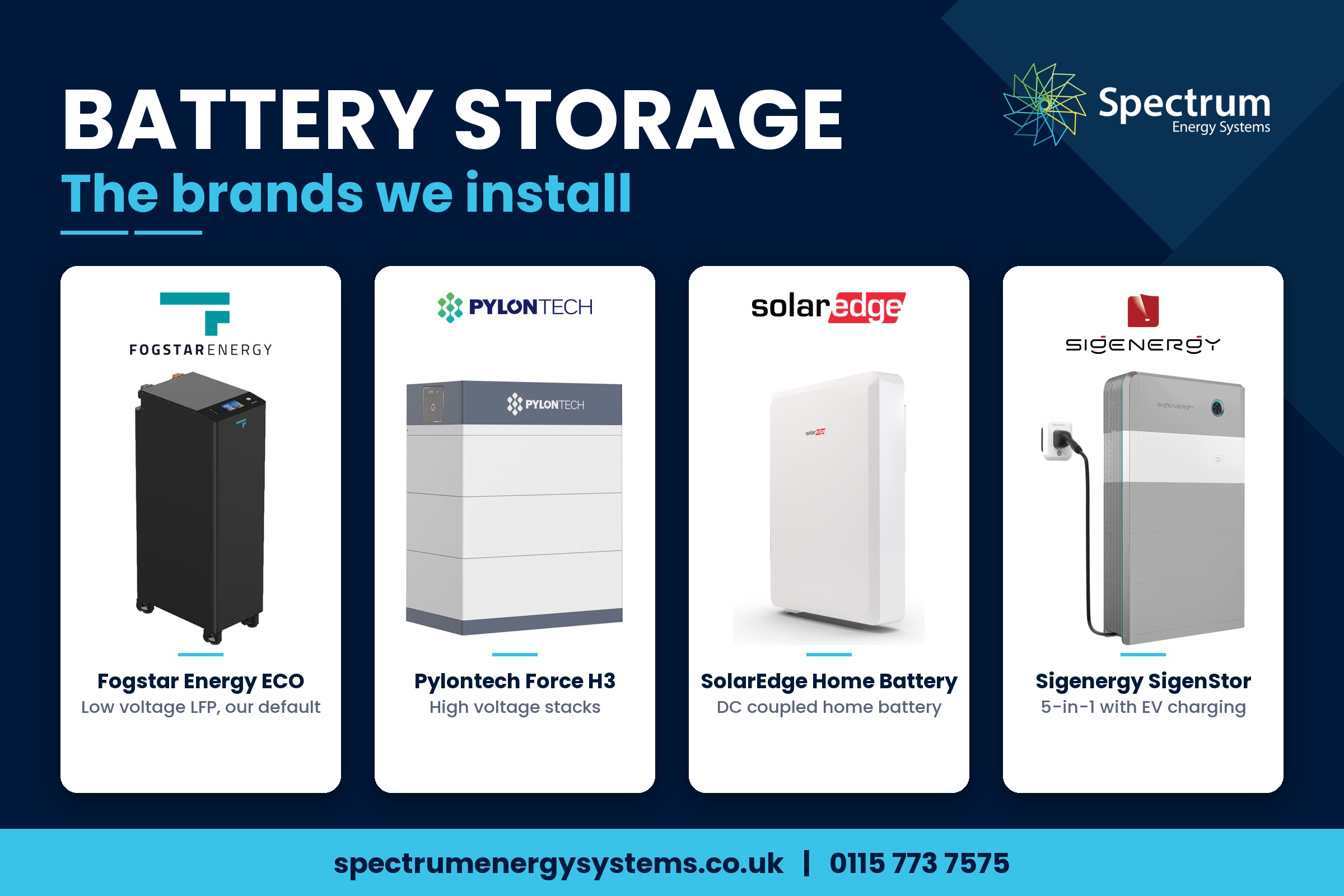
Solar energy storage in 2026 has evolved from optional add-on to integral system component. Improvements in battery technology, smart integration, and all-in-one solutions are transforming how solar systems capture and utilise generated energy.
Why LFP Chemistry Won
Lithium iron phosphate (LFP) chemistry now dominates residential and commercial storage. Both Fogstar (our default domestic battery) and Pylontech (our default commercial battery) use LFP cells. The reasons:
- 6,000+ cycle life- 15-20+ years of daily cycling vs ~3,000 cycles for older NMC chemistry
- Safer chemistry- LFP doesn't suffer the thermal runaway risks that affected earlier NMC products
- Capacity retention- typically 70%+ at year 10, with manufacturer warranties to match
- UK climate friendly- LFP performs well across the temperature range we see in East Midlands utility rooms, lofts and garages
The Solis Voltage-Class Rule (Important)
Why Fogstar and Pylontech Aren't Interchangeable
Spectrum's default inverter is Solis hybrid. Solis splits into low-voltage (up to 15kW AC) and high-voltage (above 15kW). Fogstar pairs with low-voltage Solis (most domestic). Pylontech Force H3 pairs with high-voltage Solis (larger commercial). Get the voltage class wrong and the battery won't talk to the inverter. We confirm this at design stage every time.
Our Standard Battery Range
Fogstar (domestic default): 10kWh, 16.1kWh and 32kWh single units, plus the 48.3kWh modular stack. The 16.1kWh is our most-fitted size on typical 3-4 bed family homes. UK-assembled LFP cells, 10-year warranty.
Pylontech Force H3 (commercial default): Modular stack up to 50kWh+ in a single cabinet. We recently fitted a 51.2kWh Pylontech stack alongside a 49.68kWp solar array on a manufacturing site - £37,000+VAT all-in, 4-year payback when sized for export arbitrage on Octopus Shape Shifters: Export rather than just self-consumption.
Understanding the benefits of solar panel battery storage helps evaluate whether storage suits your energy profile.
All-in-One Solis Hybrid Inverters
Solis hybrid inverters combine solar PV management with battery control in a single unit. The battery connects DC-side via a dedicated Solis DC plug. One piece of kit, one app, one warranty path. Also: Solis hybrid inverters accept up to 150% of rated AC output in DC from panels - so a 6kW Solis hybrid handles 9kWp of panels, useful when sizing system upgrades. For businesses, commercial battery storage solutions incorporate backup power capability, keeping operations live during grid outages.
#5 Building-Integrated Photovoltaics (BIPV) Expansion
Building-integrated photovoltaics - solar technology incorporated directly into building materials rather than mounted on surfaces - continues maturing in 2026. From solar roof tiles to photovoltaic facades, BIPV addresses aesthetic concerns that sometimes limit traditional panel adoption.
Solar Roof Tiles Evolution
Solar roof tiles have improved significantly, with several manufacturers offering products combining attractive aesthetics with reasonable efficiency (15-18%). Whilst still less efficient than standard panels (20-23%), tiles appeal to heritage properties, conservation areas, or design-conscious homeowners where traditional panels might face planning objections or aesthetic resistance.
For new builds or full re-roofs, integrated solar tiles provide both weather protection and energy generation from a single product - reducing total project cost vs separate roof and PV installation.
Commercial BIPV Applications
Office buildings, retail developments, and property development projects increasingly incorporate solar facades and glazing elements. Transparent and semi-transparent BIPV panels for windows and atriums achieve 10-15% efficiency whilst maintaining light transmission.
UK Regulatory Drivers
The Future Homes Standard and net-zero building requirements increasingly incentivise BIPV adoption. New developments must meet stringent energy efficiency targets, making integrated renewables attractive for planning approvals. For new construction projects, early BIPV specification enables optimal integration with building design.
#6 Predbat, Home Assistant & Real Tariff Automation
This is the section most "solar trends 2026" articles get wrong. AI optimisation doesn't make your panels themselves generate more power - what it does is make sure every kWh you generate, store and export earns you the maximum amount of money.
The Tariff Arbitrage Opportunity
UK electricity pricing is now half-hourly settled. Octopus Flux charges customers cheap rates overnight (~12p/kWh), standard during the day, expensive in the 4-7pm peak (~30p+). Octopus also pays elevated export rates during that same peak window. For commercial customers, Octopus Shape Shifters: Export goes further - tracking wholesale prices half-hourly with peaks routinely hitting 40-60p/kWh.
A battery that charges from cheap overnight electricity and discharges (or exports) into the peak window can lift annual returns 20-40% above basic solar self-consumption. The catch: you need the dispatch to be automated. Manually scheduling charge/discharge cycles against tomorrow's tariff and tomorrow's weather forecast isn't realistic for most owners.
The Spectrum USP: Predbat on Home Assistant
Octopus Intelligent Flux auto-schedules battery charge/discharge for SolarEdge, Tesla, FoxESS and Alpha inverters - but Solis isn't on the auto-list. Predbat closes that gap.
Predbat is an open-source optimiser that runs on Home Assistant, supports Solis hybrid inverters natively, and pulls the next-day Octopus tariff plus the solar forecast to automate battery dispatch decisions. For customers who take the add-on, it runs on a small Mac mini or Raspberry Pi at the customer's home. It sits in the corner of the utility room and quietly earns money.
For commercial customers running Solis hybrid + Pylontech on Octopus Shape Shifters: Export, this setup is currently our biggest competitive differentiator. Most installers don't size the battery for export arbitrage, and even fewer set up automated dispatch to make it work.
AI-Powered Performance Monitoring
Beyond tariff automation, modern monitoring platforms use machine learning to establish baseline performance for each install, immediately flagging deviations indicating potential issues. Rather than waiting for obvious failures, AI systems detect subtle degradation, soiling effects, or component issues before they significantly impact generation. Particularly valuable for solar panel maintenance planning - systems can flag inverter issues before complete failure occurs.
Smart Energy Management for Commercial
For businesses, AI integration extends to demand-side management - coordinating solar generation with production schedules, HVAC systems, and EV fleet charging. Manufacturing facilities and office buildings particularly benefit from these load-matching capabilities, layered on top of triad avoidance and export arbitrage strategies covered in our commercial battery storage guide.
#7 Ultra-High Efficiency Silicon (TOPCon, HJT, Aiko ABC)
Whilst emerging technologies attract headlines, silicon-based cells continue improving through advanced manufacturing techniques. TOPCon, Heterojunction (HJT), and Aiko's N-Type ABC (All-Back-Contact) modules now achieve efficiencies approaching theoretical limits, offering proven reliability with premium performance.
TOPCon - The Current Mainstream
Tunnel Oxide Passivated Contact (TOPCon) cells have rapidly gained market share. JA Solar and Longi- two of the tier-1 brands we install - have largely transitioned production to TOPCon. Panels typically achieve 22-24% efficiency, a meaningful improvement over standard PERC at 20-21%.
For UK conditions, TOPCon's temperature coefficients (-0.30% to -0.32% per °C) mean better performance during summer months. This advantage compounds over system lifetime, delivering measurably higher total energy harvest.
Aiko N-Type ABC - The 2026 Standout
Aiko's N-Type All-Back-Contact modules are one of the genuine 2026 efficiency stories. By moving all electrical contacts to the rear of the cell, ABC panels eliminate the busbar shading that costs a small percentage of output on conventional panels. Aiko panels routinely hit 23-25% efficiency with exceptional low-light performance - ideal for diffuse UK conditions. We fit Aiko by default when customers want a premium panel and on roofs where every percentage point of yield matters.
HJT - Premium UK Performance
HJT cells combine crystalline silicon with thin amorphous silicon layers, achieving 24-26% efficiency with exceptional low-light and high-temperature performance. The technology's superior temperature coefficient (-0.24% to -0.26% per °C) makes it particularly suitable for UK conditions. HJT is available on request from our standard tier-1 suppliers.
Technology Comparison for UK Installations
| Silicon Technology | Efficiency | Temp Coefficient | UK Suitability |
|---|---|---|---|
| Standard PERC | 20-21% | -0.35% to -0.40%/°C | Good - legacy tech, declining share |
| TOPCon (JA Solar, Longi) | 22-24% | -0.30% to -0.32%/°C | Excellent - current mainstream |
| Aiko N-Type ABC | 23-25% | -0.27% to -0.30%/°C | Excellent - premium aesthetic + yield |
| Heterojunction (HJT) | 24-26% | -0.24% to -0.26%/°C | Excellent - premium UK performance |
| IBC (Interdigitated Back Contact) | 24-25% | -0.29% to -0.32%/°C | Good - aesthetic advantage |
#8 Lightweight and Flexible Solar Solutions
Not all roofs can support traditional panel weight, and not all surfaces are flat. New solar panel materials in 2026 address these constraints, with lightweight and flexible solar technologies expanding viable installation locations.
Thin-Film Technology Advances
Thin-film panels using CIGS (Copper Indium Gallium Selenide) or CdTe (Cadmium Telluride) technologies achieve 12-18% efficiency at significantly lower weight than crystalline silicon. Typical thin-film panels weigh 3-5kg compared to 18-22kg for standard panels, reducing structural loading by 75-80%.
This weight advantage proves critical for older buildings with limited load capacity, temporary installations, or mobile applications. Whilst lower efficiency requires more surface area for equivalent output, locations with abundant space but weight restrictions find thin-film compelling.
Applications for Flexible Solar
Building Retrofits
Aging structures that cannot support conventional panels gain solar capability through lightweight options. Listed buildings and heritage properties may find flexible solutions more acceptable for planning purposes.
Curved Surfaces
Industrial buildings with curved roofs, vehicles, and boats can utilise flexible panels conforming to non-planar surfaces where rigid panels cannot mount.
Temporary Installations
Events, construction sites, and disaster relief benefit from rapidly deployable, lightweight systems. Portable power without infrastructure requirements expands off-grid capabilities.
#9 Manufacturing and Supply Chain Innovations
Beyond cell technology, manufacturing advances continue driving quality improvements and supply chain resilience. Regional production expansion, automated manufacturing, and sustainable practices reshape the industry landscape in 2026.
European and UK Manufacturing Growth
Concerns over supply chain concentration have accelerated European manufacturing investment. New factories in Germany, Italy, and emerging UK facilities aim to provide domestically produced panels, reducing transportation emissions and supply vulnerabilities. Whilst Asian production still dominates volume, regional options improve for projects prioritising local sourcing or shorter lead times.
Sustainable Manufacturing Practices
Low-carbon solar panel certification schemes gain traction as buyers differentiate based on manufacturing emissions. Some manufacturers now produce panels with embodied carbon below 300kg CO₂ per kWp - significantly lower than industry averages around 400-500kg. For organisations with sustainability targets, these certified options align solar procurement with broader environmental commitments. For businesses exploring solar financing options, contact our team for current guidance.
#10 Smart Panel Technology and Module-Level Power Electronics
Individual panel intelligence - through integrated electronics and connectivity - enables unprecedented monitoring granularity and performance optimisation. In 2026, smart panel features become increasingly standard rather than premium additions.
Module-Level Power Electronics (MLPE)
MLPE - either microinverters or DC optimisers - maximise individual panel output regardless of array-wide conditions. SolarEdge is the dominant DC optimiser brand and a key part of our toolkit for shaded or complex multi-orientation installations. Where a Solis string inverter would lose efficiency from one underperforming panel dragging the rest down, a SolarEdge system with per-panel optimisers keeps each panel earning at its own maximum. Our comparison of micro inverters vs string inverters explores these options in detail.
When We Fit SolarEdge vs Solis
- Solis hybrid (default): Clean, unshaded roof. Single or two-aspect array. Most domestic and standard commercial installs.
- SolarEdge with optimisers: Heavy shading from chimneys or trees. Mixed orientations (E/W or multi-pitch). Complex roof shapes where panels won't all see the same sun pattern.
IoT Connectivity and Cloud Monitoring
Connected systems transmit real-time performance data to cloud platforms accessible via mobile apps, enabling system owners to monitor generation anywhere. Automated alerts notify of performance issues, whilst historical analytics help identify long-term trends. For commercial solar maintenance, remote diagnostics reduce site visits whilst improving response times.
Cybersecurity Considerations
Connected solar systems require appropriate security measures. Reputable manufacturers (Solis, SolarEdge, Fogstar, Pylontech) implement encrypted communications, secure firmware updates, and industry-standard authentication protocols. When evaluating smart panel systems, enquire about security certifications and update policies.
Solar Panel Recycling and End-of-Life Advances
As early solar installations reach end-of-life, recycling infrastructure and technology have matured significantly. In 2026, improved recovery processes achieve 95%+ material reclamation, supporting circular economy principles.
Enhanced Recovery Processes
Modern recycling facilities separate aluminium frames, glass, silicon, and metals for reuse in new products. Advanced processes recover silver and other valuable materials previously lost. UK regulations mandate responsible disposal, with producer responsibility schemes funding collection and processing infrastructure.
Design for Recyclability
Manufacturers increasingly design panels considering end-of-life processing. Simplified material combinations, mechanical fastening systems replacing adhesives, and standardised component specifications improve recyclability. Some manufacturers now offer take-back guarantees, ensuring panels return to appropriate facilities when decommissioned.
Should You Wait for New Technology or Install Now?
The perpetual question facing solar buyers: should you wait for better technology? Our experience installing systems across the East Midlands since 2011 says: waiting rarely makes sense.
Why Acting Now Makes Sense
Every month without solar means purchased electricity from the grid at 28-35p/kWh instead of self-generated solar. Waiting 12 months for theoretical 5% efficiency improvements foregoes significant energy generation that those improvements would take years to repay.
Current technology is mature, reliable, and well-supported. A typical Spectrum domestic install today - 6kWp tier-1 panels + Solis hybrid inverter + 16.1kWh Fogstar battery - comes in around £9,995 no VAT with an 8-10 year payback. That payback clock starts the day we commission, not the day perovskite tandems become mainstream.
Technology Maturity Assessment
Ready for deployment now: Tier-1 monocrystalline panels (JA Solar, Aiko, Longi at 20-25%), TOPCon and HJT premium variants (22-26%), Aiko N-Type ABC modules, bifacial panels, LFP battery storage (Fogstar, Pylontech), Solis hybrid inverters, SolarEdge MLPE, Predbat tariff automation. All carry mature warranties and proven field data.
Emerging but available: Perovskite-silicon tandem cells from Oxford PV reaching commercial availability with limited supply. Suitable for efficiency-focused projects where maximum performance per square metre is the priority.
Future developments: All-perovskite tandems, solid-state batteries, transparent PV with higher efficiency - these remain 3-5+ years from mainstream commercial availability and shouldn't delay current decisions.
UK Climate Considerations for New Technology
The UK's maritime climate - characterised by frequent cloud cover, moderate temperatures, and variable conditions - influences technology selection differently than sunnier locations.
Low-Light Performance Matters Most
Panels with strong low-light performance deliver proportionally more energy in UK conditions. Technologies like HJT and Aiko's N-Type ABC maintain efficiency better under diffuse light, translating to meaningful yield advantages across our typical 1,500-1,700 annual sunshine hours. For installations across Nottinghamshire, Derbyshire, Leicestershire, Lincolnshire, Staffordshire and South Yorkshire, optimised technology selection maximises local resource capture.
Temperature Coefficient Advantages
UK panels rarely experience the high temperatures that degrade performance in hotter climates. However, panels with better temperature coefficients maintain closer to rated efficiency across our temperature range - an advantage for overall yield. The mild UK climate actually favours solar performance compared to Mediterranean conditions where high temperatures significantly reduce output during peak sunshine hours.
Environmental Impact of New Technologies
Solar panel environmental credentials continue improving through manufacturing advances and material innovations.
Carbon Footprint Improvements
Energy payback time - how long panels must operate to generate the energy consumed in their manufacture - now averages under 2 years for UK installations. Over 25-30 year lifespans, panels produce 10-15 times the energy embedded in their manufacture, representing significant net carbon benefit.
Manufacturing emissions per panel continue declining through efficient processes and renewable energy use at production facilities. Low-carbon certified panels now achieve embodied carbon below 300kg CO₂ per kWp. Understanding the key benefits of solar panels includes these environmental contributions.
Sustainable Materials Development
Research into lead-free perovskite formulations addresses environmental concerns with some emerging technologies. Reduced rare earth element requirements and increased recycled content in manufacturing further improve sustainability profiles.
Ready to Explore 2026 Solar Technology?
Our MCS-accredited engineers can assess your property and recommend optimal technology choices balancing innovation with proven reliability. Solis hybrid inverters, Fogstar or Pylontech batteries, tier-1 panels, Predbat automation on request.
Request Your Site Assessment Call 0115 773 7575Navigating Solar Technology Choices in 2026
The future of solar 2026 offers more options than ever, from proven high-efficiency silicon panels to breakthrough perovskite tandems. Understanding these technologies helps make informed decisions aligned with your specific circumstances and goals.
Key Takeaways
For most domestic installs: Tier-1 monocrystalline panels (JA Solar, Aiko or Longi) with TOPCon or N-Type ABC technology, paired with a Solis hybrid inverter and 10-16.1kWh Fogstar battery. Honest 8-10 year payback, 25-30 year panel warranty, proven kit.
For commercial: Solis three-phase hybrid (40kW+) with Pylontech Force H3 stack, sized for export arbitrage on Octopus Shape Shifters: Export rather than just self-consumption. 4-7 year payback typical.
For premium efficiency / tight roofs: Aiko N-Type ABC or HJT panels, or Oxford PV perovskite-silicon tandem on request.
For all installs: Predbat automation on Home Assistant for Solis customers wanting hands-off tariff scheduling.
Your Next Steps
At Spectrum Energy Systems, established in 2011, we've installed over 10MW of solar capacity across Nottinghamshire, Derbyshire, Leicestershire, Lincolnshire, Staffordshire and South Yorkshire. Our standard kit list is short and deliberately chosen: Solis or SolarEdge hybrid inverters, Fogstar (domestic) and Pylontech (commercial) LFP batteries, tier-1 panels from JA Solar, Aiko or Longi. Sunsynk and Sigenergy available on request.
MCS-accredited (MCS #NIC200223), NICEIC Approved (Reg. 3182878), RECC member (#00080159), QANW Insurance-Backed Guarantee on every install.
Browse our case studies to see completed installations, explore our technical articles for deeper insights, or contact our team to discuss your specific requirements.
Frequently Asked Questions: Solar Technology 2026
Yes - but in limited supply and primarily as perovskite-silicon tandem cells, not standalone perovskite panels. UK-based Oxford PV leads commercial production, with tandem cells achieving 24-28% module efficiency (lab cells exceed 33%). For most UK installs in 2026 we still recommend proven silicon - JA Solar, Aiko or Longi at 500W+, tier-1 monocrystalline - because the warranty terms, supply chains and field data are mature. Perovskite-tandem makes sense on space-constrained premium projects where every percentage point of efficiency matters.
Install now. Every month you wait is a month of grid electricity at 28-35p/kWh instead of self-generated solar. Current tier-1 monocrystalline panels at 21-23% efficiency, paired with a Solis hybrid inverter and a Fogstar or Pylontech battery, deliver 25-30 year warranties and 8-10 year payback for typical East Midlands homes. The technologies coming next are incremental improvements (3-5% better efficiency), not paradigm shifts - they will take a decade to pay back the energy you'd have generated in the meantime.
Perovskite-silicon tandem cells lead at 24-28% commercial efficiency. For mainstream installs, the leaders are Aiko's N-Type ABC (All-Back-Contact) modules and HJT (Heterojunction) panels at 22-26%. TOPCon panels (JA Solar, Longi) offer 22-24% with proven reliability. For most UK homes, a tier-1 monocrystalline at 21-23% delivers excellent performance - the marginal efficiency gain on premium panels rarely justifies the price uplift unless your roof is severely space-constrained.
Yes, but not in the way most articles describe. The real gains come from automated tariff scheduling- charging the battery from cheap off-peak electricity and discharging it (or exporting it) into expensive peak windows. On Solis hybrid inverters we use Predbat (open-source optimiser) running on Home Assistant on a small always-on host at home, pulling next-day tariff data and solar forecasts. It can lift annual savings 20-40% above basic self-consumption. For commercial customers on Octopus Shape Shifters: Export, the battery becomes a revenue-generating asset, not just storage.
Predbat is an open-source battery optimiser that runs on Home Assistant. It supports Solis hybrid inverters natively. Octopus Intelligent Flux auto-schedules battery charge/discharge for SolarEdge, Tesla, FoxESS and Alpha inverters - but Solis isn't on the auto-list. Predbat closes that gap. It pulls tomorrow's Octopus tariff prices and solar forecast, then automates battery decisions to maximise revenue or savings. For customers who want it, we set it up on a small Mac mini or Raspberry Pi at the customer's home as an optional add-on to the install. For commercial customers on Octopus Shape Shifters: Export, this is currently our biggest competitive differentiator.
Tier-1 monocrystalline panels with low temperature coefficients (-0.3% to -0.35% per °C) - JA Solar, Aiko and Longi all sit in this band. HJT and Aiko's N-Type ABC modules perform exceptionally well in the UK's variable, often-overcast conditions because they hold efficiency under diffuse light. Bifacial panels add 5-15% on ground-mount or flat commercial roofs where rear-side reflection is meaningful. For most domestic UK roofs, a 500W+ all-black tier-1 panel paired with a Solis hybrid inverter and Fogstar battery is the sweet spot.
Tier-1 panels installed in 2026 typically carry 25-30 year performance warranties guaranteeing 87-90% output at end of warranty, with real-world degradation around 0.3-0.4% annually. LFP batteries (Fogstar, Pylontech) deliver 6,000+ cycles, equivalent to 15-20+ years of daily cycling. Solis hybrid inverters we fit carry a 10-year warranty, extendable to 20 years. With Spectrum's 5-year workmanship warranty and the QANW Insurance-Backed Guarantee on top, a system installed today will generate clean energy well into the 2050s.
Transform Your Property with Latest Solar Technology
From proven high-efficiency panels to cutting-edge innovations, our expert team designs optimal solutions for every property type. MCS #NIC200223, NICEIC Reg. 3182878, RECC #00080159.
Request Your Solar Assessment Learn About Our ExpertiseAbout Spectrum Energy Systems: Established in 2011, MCS-accredited solar installers (MCS #NIC200223) serving Nottinghamshire, Derbyshire, Leicestershire, Lincolnshire, Staffordshire, South Yorkshire and the wider East Midlands. NICEIC Approved Contractor (Reg. 3182878), RECC member (#00080159), QANW Insurance-Backed Guarantee on every install. Over 10MW of solar capacity connected. Standard kit: Solis or SolarEdge hybrid inverters, Fogstar and Pylontech LFP batteries, tier-1 panels from JA Solar, Aiko or Longi. Predbat tariff automation on Solis systems. Explore our next-generation solar technology capabilities or contact us to discuss your requirements.