How Solar Panels Are Installed in the UK: The Full Process From Enquiry to Sign-Off
Solar panels are installed in a fixed order in the UK: enquiry, design and quote, acceptance, site survey, grid application, scaffold, a one to two day install, commissioning, then the paperwork that signs the job off: network operator confirmation, MCS certificate, building control notification, handover pack and your Smart Export Guarantee registration. On our domestic jobs that is usually inside three weeks where no grid approval is needed first, and four to eight weeks where it is.
In This Guide
Most guides to how solar panels are installed describe the roof work and stop. This one covers the whole job as we run it from Bulwell, Nottingham: what we ask you for, who designs the system and when, where the network operator fits, what you sign and pay, and which documents you should hold at the end. A UK solar installation is only finished when three bodies have their paperwork: the distribution network operator (DNO), MCS, and the electricity supplier that pays for what you export.
The process at a glance
| Stage | What happens | Who | Typical timing |
|---|---|---|---|
| 1. Enquiry | Address, roof view, annual kWh, unit rate, usage pattern | You | Day 1 |
| 2. Design and quote | Layout from the roof view, checked, priced, one all-in quote | Us | Normally within 48 hours |
| 3. Acceptance | Contract, deposit, letter of authority, MPAN | You | When you are ready |
| 4. Site survey | Roof, loft, cable route, consumer unit, battery location | Us | After acceptance |
| 5. Grid application | G98: after the install. G99: DNO approval before we connect | Us | G99 reply 2 to 4 weeks, up to 6 |
| 6. Scaffold | Up before, down a few days after | Our scaffold team | 1 to 2 days before |
| 7. Install and commissioning | Panels, inverter, battery, wiring, tests, walkthrough | Our crew | 1 to 2 days on site |
| 8. Sign-off paperwork | DNO confirmation, MCS certificate, building control, handover pack | Us | Within about a month |
| 9. Smart Export Guarantee | Application in your name to a SEG supplier | You, with our help | Supplier dependent |
Before the install: enquiry to survey
The design comes before the physical survey because the quote is priced from the design. The grid application comes after the survey so the paperwork matches what gets fitted.
Step 1: Your enquiry and the details we need
The first reply asks for your full address, a roof screenshot if the aerial view is unclear, your annual electricity use in kWh, what you pay per kWh, and how the house uses power: occupants, home working, an EV, a heat pump. We also ask whether you are happy with panels on the front of the house. On a new build, check your deeds for covenants first.
Step 2: The design
A designer draws the layout from the aerial view of your roof and your consumption figures; we check it and price it in house. Our standard kit is Tier 1 panels, a Solis hybrid inverter and a Fogstar battery, and the software models your pitch, orientation and local weather data.
Step 3: The quote
One all-in price, normally within 48 hours, marked subject to site survey. It includes scaffolding, nesting bird protection, all labour, the grid application, handover paperwork, the commissioning documents for the Smart Export Guarantee and the MCS certificate. There are never any hidden extras with us.
Step 4: Acceptance, contract and deposit
You sign the contract of sale and pay a deposit; the balance is staged, with a payment when materials arrive and the final payment at commissioning. We also send a link to sign a letter of authority and give us the MPAN from your electricity bill, which lets us deal with the DNO for you and starts the grid application.
Step 5: The site survey
The physical survey comes after acceptance and confirms the design. We check the roof covering and structure, the loft, the cable route, the consumer unit and meter, and where the inverter and battery will live, and adjust the design before the grid application goes in.
Where the DNO fits: G98 or G99
Every grid-connected system is registered with the distribution network operator, which for most of Nottinghamshire, Derbyshire, Leicestershire and Lincolnshire is National Grid Electricity Distribution. The dividing line is 16 amps per phase, 3.68kW of inverter output on a normal single-phase house supply. Up to that figure the connection is G98: the system is installed and switched on, and the DNO is notified within 28 days of commissioning. Above it the connection is G99: an application goes in first, with a single line diagram and your letter of authority, the DNO must approve it before we connect anything, and a commissioning confirmation follows within 28 days of switch-on. Most systems we fit now, with a 5kW or 6kW hybrid inverter and a battery, are G99 jobs.
National Grid Electricity Distribution usually replies to a domestic G99 within two to four weeks, and it can stretch to six. There may be a network study fee, typically £153 plus VAT, which we flag up front. We book the install date only once approval is in.
If you want to extend an existing system, most installers will not touch the grid application without a full install contract. We submit it as a standalone service for £500, no VAT. If the DNO refuses the extension, you can still split your existing array across a second roof face and the £500 goes towards that work; if you do nothing, you have spent £500. Ask through our contact page; our G98 and G99 guide goes deeper.
Not sure which grid route your roof falls under?
Send us your address, a roof view and your annual electricity use. We will design the system, tell you whether it is G98 or G99, and quote it, normally within 48 hours.
Start with a design and quote
The install itself
The scaffold goes up a day or two before the crew arrives, as in the photo, and comes down a few days after the panels are on. It is in the price, as is the bird mesh under the array. Lead time from approval to install is normally three to five days; the crew is on site for one to two days on a typical house. Our crews are employed by us; we do not subcontract.
Roof and electrical work run in parallel, your power is off only briefly at connection, and commissioning fills the last hour: strings tested, inverter configured, generation checked against the design, monitoring app on your phone, walkthrough. Be home for that hour. The full day is in our installation day guide, including a four-day 7.2kW job in Sherwood where the cable route had put another installer off.
After the install: paperwork and sign-off
This is the stage most guides skip.
Network operator confirmation. Within 28 days of switch-on we send the commissioning document to the DNO, or the G98 notification for a smaller system. The DNO replies with a letter confirming the connection, and that letter comes to you; SEG suppliers usually ask for it.
MCS certificate. MCS covers solar PV up to 50kWp, so it applies to every domestic install. We register your system on the MCS database and the certificate is issued in your name; allow up to 30 days. Above 50kWp there is no certificate and none is needed, which is why our 56kW Jacksons Nurseries and 67kW Linear Insulation jobs were commissioned under G99 alone.
Building control. Connecting a solar system adds a new circuit, which is notifiable electrical work under Part P of the Building Regulations. As a NICEIC Approved Contractor (3182878) we self-certify the work and the notification to your council goes through the scheme, so you do not apply to building control yourself.
Handover pack and Smart Export Guarantee. The pack holds the system schematic, test results, datasheets, warranty details and user instructions. The SEG application is made in your name to any supplier offering a SEG tariff and needs the MCS certificate, the DNO confirmation and a meter capable of half-hourly export readings, in practice a smart meter. We supply the documents and help with the form.
The work carries our 5-year workmanship guarantee, with a QANW insurance-backed guarantee certificate issued in your name so the guarantee is honoured if we were ever to stop trading.
Your sign-off checklist
- DNO confirmation letter, or the G98 notification receipt
- MCS certificate in your name
- Electrical installation certificate and building control compliance certificate
- 5-year workmanship guarantee and the QANW certificate
- Smart Export Guarantee application submitted to your chosen supplier
Professional installation vs doing it yourself
Behind many searches for how solar panels are installed is whether a competent person could do it themselves. The comparison turns on what the system is worth afterwards.
✓ MCS certified installer
- One all-in price: scaffold, bird mesh, labour, grid application, certification
- G98 or G99 handled with the DNO, commissioning confirmation included
- MCS certificate, which SEG suppliers ask for
- Part P self-certified: no building control application or fee
- 5-year workmanship guarantee plus an insurance-backed guarantee
- Trained, insured crews on a proper scaffold
✗ Doing it yourself
- No MCS certificate, so suppliers can decline to pay for your exports
- The connection still needs a registered electrician or a building control application and fee
- G98 notification or G99 approval still required, in your own name
- Manufacturer warranty terms often require a qualified installer
- Roof work and DC wiring without scaffold, training or insurance
- No installer will certify a system they did not fit, us included
Can you install solar panels yourself in the UK?
You can legally fix panels to your own roof, and permitted development applies to you as it does to an installer. The electrical connection is where it stops being a DIY job. Connecting an inverter to your consumer unit is a new circuit, which Part P makes notifiable: a registered competent person does and certifies the work, or you notify building control first and pay for their inspection. The DNO still has to be told under G98, or asked first under G99, in your name. Without an MCS certificate, suppliers can decline you for the Smart Export Guarantee, because government guidance requires the installation and installer to be MCS certified or a recognised equivalent.
We are often asked to sign off self-installed systems for MCS. The answer is no from every certified installer, because the certificate covers design, supply and installation as one job; the MCS helpdesk is the place to ask. For the same reason we do not fit kit bought elsewhere.

How long does the whole process take?
It depends on the grid route. On a G98 system, design and quote within 48 hours, a survey once you accept and a three to five day lead time mean switch-on can be inside three weeks of your first email. On a G99 system the same job waits two to four weeks for the DNO, sometimes six, so four to eight weeks from enquiry to switch-on is the honest range. Certificates follow within about a month, then SEG registration at your supplier’s pace.
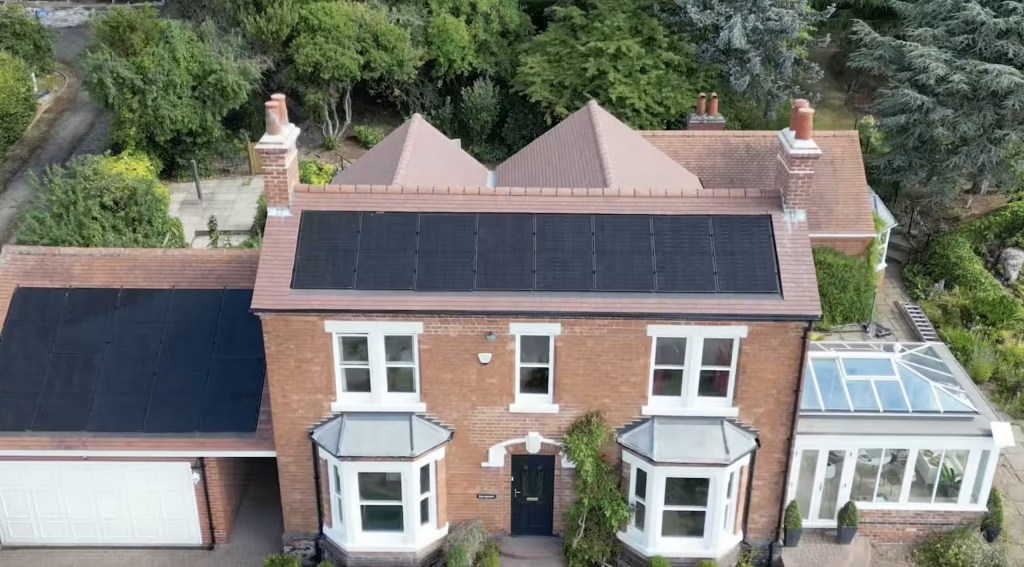
The 7.2kW Sherwood job pictured ran to four days on site because of the cable route, yet it was quick end to end because the grid approval was in hand before the scaffold went up. Complete details with the enquiry, a promptly signed letter of authority and an early survey shorten the calendar more than anything on the roof.
One date matters. The 0% VAT rate on domestic solar and battery installs runs until 31st March 2027, then returns to 5%. The rate is set by when the job is installed and invoiced, not when it is quoted, so a G99 job should start a few months ahead of that date. Prices are in our installation cost guide.
Frequently asked questions
Do I need planning permission to have solar panels installed?
Usually not. Panels on a house roof in England are permitted development if they project no more than 200mm from the roof slope and sit no higher than the highest part of the roof, excluding the chimney. Listed buildings are excluded and conservation areas add limits; our planning permission guide covers the exceptions.
What is the difference between G98 and G99?
G98 covers inverters up to 16 amps per phase, 3.68kW on a single-phase supply: the system is installed first and the network operator notified within 28 days. G99 covers anything larger: the application is approved before connection, and a commissioning confirmation goes to the network operator within 28 days of switch-on.
Who applies for the Smart Export Guarantee?
You do, to any supplier offering a SEG tariff, not necessarily the one you buy from. The application needs your MCS certificate, the network operator confirmation and a meter capable of half-hourly export readings. We provide the documents; the contract is between you and the supplier.
Can I install solar panels myself and still get paid for exporting?
Almost certainly not. Government guidance for the Smart Export Guarantee requires the installation and the installer to be MCS certified or a recognised equivalent, and no certified installer will certify a system they did not fit. Fixing the panels is legal; the electrical connection is notifiable under Part P and the grid rules still apply.
Will Spectrum handle the DNO application if I already have solar?
Yes. For an existing system you want to extend, we submit the grid application as a standalone service for £500, no VAT, using your MPAN and current inverter details. If the network operator refuses the extension, the £500 goes towards reconfiguring the existing array. If you do nothing further, that is all you have spent.
Related reading
- Solar panel installation day: what to expect
- Solar grid connection: G98 vs G99 explained
- Solar panels and planning permission in the UK
- Solar panel installation cost in the UK
- Installing solar panels on the ground in the UK
For what we fit and how, see our domestic solar overview.
Speak to Spectrum Energy Systems
Send us your address, a roof view and your annual electricity use and we will design and quote the system, normally within 48 hours, as one all-in price. MCS certified (NIC200223), NICEIC Approved Contractor (3182878), RECC member (00080159), installing across the East Midlands from Bulwell, Nottingham since 2011. Call 0115 773 7575.
Request a feasibility assessment