
Do I Need Planning Permission for Solar Panels? UK Rules Explained
Most UK homes do not need planning permission for solar panels. Rooftop solar counts as permitted development in England if the panels sit no more than 20cm above the roof slope and no higher than the ridge. Listed buildings, some conservation area installs, flats and larger ground mounted arrays are the main exceptions.
In This Guide
The Permitted Development Rules for Rooftop Solar
Permitted development is the set of rights that lets homeowners in England carry out certain works without applying for planning permission. Roof mounted solar panels are covered, which is why the vast majority of the systems we install across the East Midlands go ahead with no planning application at all. The rules come from Part 14 of the General Permitted Development Order (legislation.gov.uk) and are summarised in plain English on the Government's Planning Portal.
To qualify as permitted development on a pitched roof, the panels must project no more than 200mm from the roof slope and no part of the installation can sit higher than the highest part of the roof, excluding the chimney. On a flat roof, the equipment can be up to 600mm above the highest part of the roof. The equipment also has to be sited, so far as practicable, to minimise its effect on the look of the building, and removed when it is no longer needed.
Why almost every normal install passes
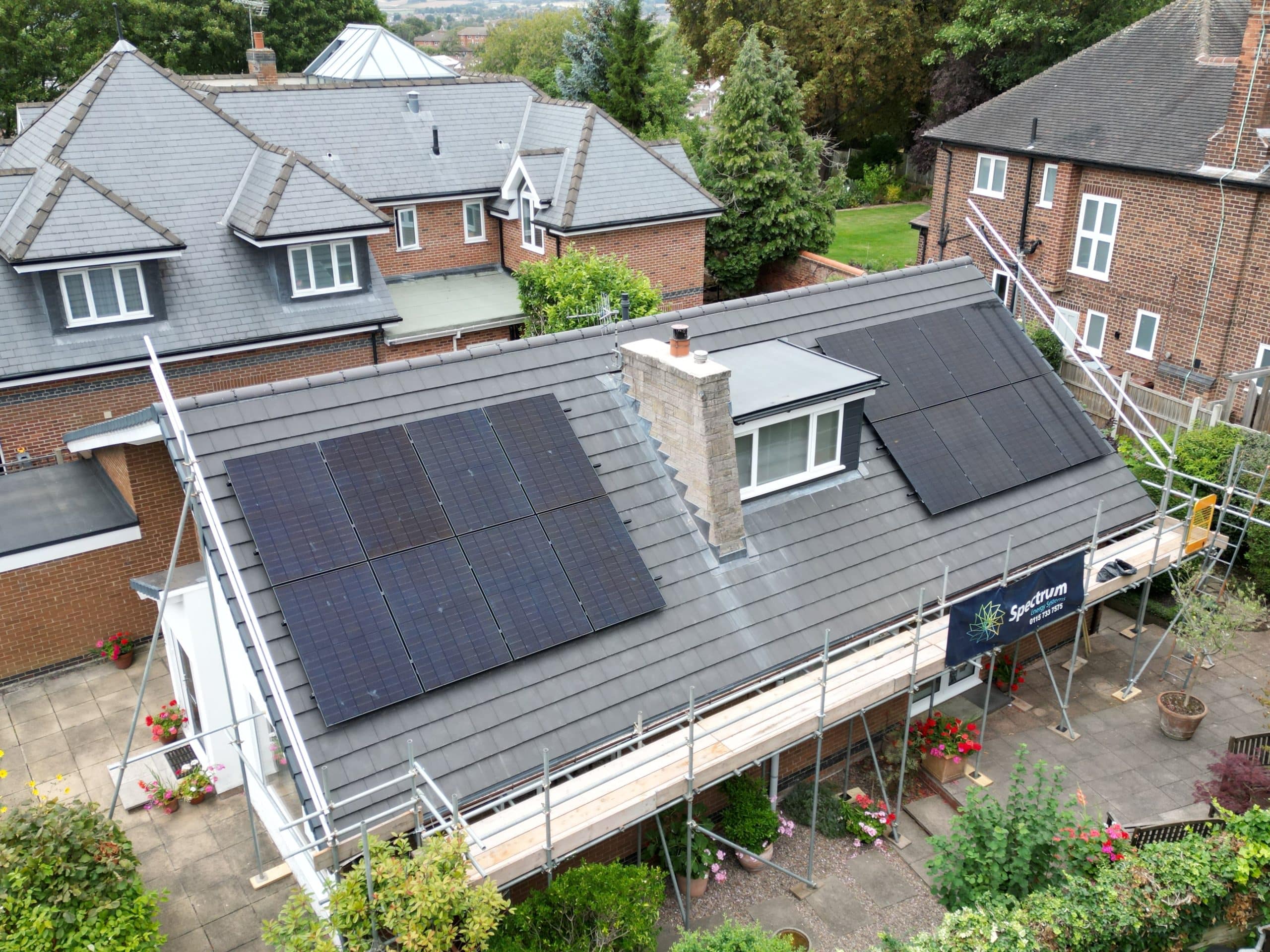
A standard on-roof system sits on rails fixed to the rafters, with the panels roughly 10 to 15cm above the tiles. That is comfortably inside the 20cm limit, and no competent installer designs an array that pokes above the ridge. This Nottingham install is typical: all black panels, below the ridge line, flush to the roof plane.
In practice, if you own a house that is not listed and not in a protected area, your solar installation will almost certainly be permitted development. There is no application to make and no fee to pay.
When You DO Need Planning Permission
The exceptions are specific, and they catch people out because installers who do not survey properly never mention them. These are the situations where a planning application, or another form of consent, comes into play.
You may need permission or consent if any of these apply
- Your home is a listed building Solar is not permitted development on a listed building, or on a building within the grounds of one. You will need consent from your council before anything goes on the roof.
- You live in a conservation area or World Heritage Site Roof mounted panels are still generally allowed, but panels on a wall fronting a highway are not. Councils also look harder at visual impact here.
- You live in a flat or maisonette The rules for blocks of flats differ from houses, and leaseholders normally need the freeholder's consent on top of any planning question. Always check before committing.
- Your panels would break the limits Anything above the ridge line, or projecting more than 20cm from the roof slope, needs a planning application.
- You want a large ground mounted array Stand alone arrays over 9 square metres, taller than 4m, within 5m of your boundary, or a second array, all need permission.
- Your property sits on a scheduled monument site Rare, but absolute: no permitted development rights apply.
One more thing worth knowing: permitted development rights can be removed on individual properties or estates by something called an Article 4 direction, and new build estates sometimes carry planning conditions that restrict changes. Neither is common, but it is exactly the sort of thing we confirm with the local planning authority rather than assume.
Listed Buildings, Conservation Areas and How We Deal With Them
We install across Nottinghamshire, Derbyshire, Leicestershire and Lincolnshire, which means plenty of conservation villages and period properties. That does not put solar out of reach, but it does change how we design.
In-roof solar: the planner friendly option
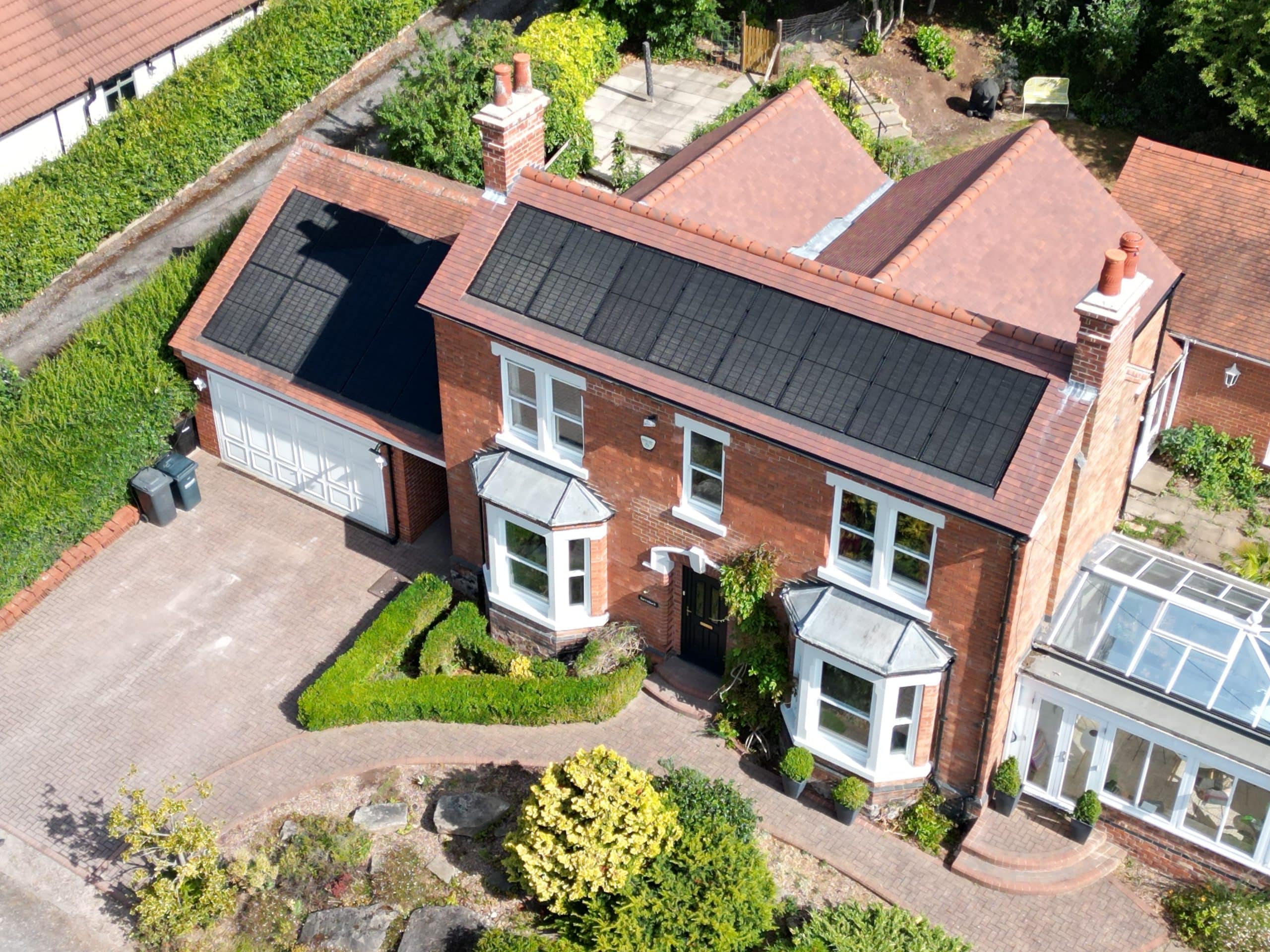
An in-roof system replaces a section of tiles entirely, so the panels sit flush within the roof plane rather than on top of it. Visually it reads as part of the roof, which is why it goes down far better with planning officers in sensitive settings.
The house pictured is our 8.1kW in-roof installation in Woodborough, a Nottinghamshire conservation village. The GSE in-roof trays keep the whole array flush with the tile line across the main house and garage. That is the kind of design that satisfies both the permitted development limits and a planning officer's view of the street scene.
For listed buildings, consent is a genuine hurdle and approval depends on your council and the building itself. Options like panels on a detached outbuilding, a ground mounted array positioned out of sight, or in-roof panels on a rear elevation all stand a better chance than a rack of panels on the principal roof. We have written a separate guide to solar panels in conservation areas that covers the design side in more detail.
Ground Mounted Solar: the 9 Square Metre Rule
Stand alone solar in your garden has its own permitted development limits, and they are much tighter than the rooftop ones. Under the Planning Portal's published rules, a ground mounted array is only permitted development if all of the following hold:
- Maximum 9 square metres of array No more than 9m² in total, and no single dimension over 3m. That is roughly four modern panels, so most serious ground mounted systems need a planning application.
- Maximum 4m high No part of the installation may exceed 4 metres above ground.
- At least 5m from the boundary The array must sit 5 metres or more from the edge of your property.
- First array only Only the first stand alone installation is permitted development. A second one needs permission regardless of size.
- Extra limits in protected areas In a conservation area, an array closer to the highway than the house must not exceed 2m in height, and nothing is permitted within the boundary of a listed building.
If you have the land and want more than four panels' worth, a planning application is usually the route, and approval rates for well sited domestic arrays are good. Our guide to installing solar panels on the ground in the UK covers the practical side, and the flat roof guide covers ballasted roof systems, which follow the 60cm height rule above.
What We Check at the Site Survey
You should not have to become a planning expert to put panels on your own roof. When we survey a property, the planning position is one of the things we settle before you see a quote.
Step 1: Listed status and designations
We check whether the property is listed, in a conservation area, or affected by an Article 4 direction. This takes minutes against the public registers and tells us immediately whether a standard install can proceed.
Step 2: The physical limits
We measure the roof and design the array below the ridge and within the projection limits, so the finished system sits inside permitted development by design rather than by luck.
Step 3: The right mounting system
On a sensitive property we will propose in-roof mounting or an alternative roof face. On a standard home, rail mounted panels are quicker and cost less. The survey decides which fits your situation.
Step 4: The grid side
Planning is only one half of the paperwork. Every install also needs a G98 or G99 notification to the electricity network operator, which we handle as standard. Our guide to G98 and G99 grid connections explains the difference.
The survey is free, and after it we design your system and quote from the design, normally within 2 to 4 days depending on workload.
Not Sure Where Your Home Stands?
Book a feasibility assessment. We check the planning position, the roof and the grid connection before you commit to anything.
Request a QuoteIf You Do Need Permission: Timeline and Who Applies
A householder planning application is not the ordeal people imagine. Councils aim to decide most householder applications within eight weeks of validation, and your local planning authority publishes its current fees and timescales. Where consent for a listed building is involved, timescales depend on the council and the case, so we advise on that property by property rather than promising a number.
Either the homeowner or an agent acting for them submits the application. Where a Spectrum design needs permission, we supply the drawings, panel specifications and roof plans the application needs, because a well documented application with a sympathetic design is what gets approvals through. What we will not do is fit a system that breaches the rules and leave you to argue with an enforcement officer later, because panels installed without required consent can have to come down.
Commercial Rooftop Solar and Planning
Commercial buildings have their own permitted development rights for rooftop solar, and most of the warehouse and factory systems we install proceed without a full planning application. Larger commercial arrays can require prior approval from the council. The practical answer for a business owner is the same as for a homeowner: the planning check happens at the start, and we confirm the current rules for your specific building with the local planning authority before the design is priced. Our commercial solar team handles this alongside the DNO application.
Frequently Asked Questions
Do I need planning permission for solar panels on my house?
Usually not. Roof mounted solar panels are permitted development on most houses in England, provided they project no more than 20cm from the roof slope and sit no higher than the ridge. Listed buildings, some conservation area situations and flats are the main exceptions, which a proper site survey confirms before you commit.
Do I need planning permission for a solar battery?
No planning permission is normally needed for a solar battery. Batteries are typically installed inside a garage, loft or utility space, or against an external wall, and do not change the building in a way planning law controls. Listed building consent can be relevant for internal works on listed properties, so we check that at survey.
Can my council stop me installing solar panels?
Not if your installation meets the permitted development conditions, because those rights come from national legislation rather than council policy. A council can only intervene where the rules do not apply: listed buildings, an Article 4 direction, a restrictive planning condition, or an install that breaches the limits. Outside those cases, no application is needed.
Do I need planning permission for solar panels in a conservation area?
Roof mounted panels are still generally permitted development in a conservation area, but wall mounted panels fronting a highway are not, and ground mounted arrays face extra height limits. Many homeowners choose an in-roof system anyway because it sits flush with the tiles and keeps the street scene intact.
Do I need planning permission for ground mounted solar panels?
Only above the permitted development limits. A single garden array up to 9 square metres, no more than 4m tall and at least 5m from your boundary needs no permission. Anything bigger, closer to the boundary, or any second array requires a householder planning application to your local council.
Do the same solar planning rules apply in Scotland and Wales?
No. Planning is devolved, so Scotland and Wales run their own permitted development regimes, which are similar in spirit but differ in detail. The rules in this guide are for England. If your property is outside England, check your national planning guidance or ask your installer to confirm the position.
What happens if solar panels are installed without planning permission?
If the install needed permission and did not get it, the council can take enforcement action, and in the worst case the panels have to be removed. You can apply for retrospective permission, but there is no guarantee it will be granted. It is far cheaper to check first, which is why the planning position is part of our survey.
Related reading
- Solar panels in conservation areas: what you can and cannot do
- How to install solar panels on the ground in the UK
- Solar panels on a flat roof: 10 things to know
- G98 and G99 grid connections explained
For a wider look at home systems, visit our domestic solar overview.
Speak to Spectrum Energy Systems
MCS certified (NIC200223), installing across the East Midlands since 2011, including conservation villages like Woodborough. Call 0115 773 7575 or request a feasibility assessment.
Request a Quote