
Calculating Solar Power: How to Work Out What a Solar System Will Generate
Understanding how to calculate solar power output transforms solar investment from guesswork into informed decision-making. Whether you're evaluating quotes for a domestic solar installation or assessing feasibility for a commercial solar project, knowing the calculation methodology helps you evaluate proposals accurately and set realistic expectations for returns.
This guide breaks down solar power calculations into clear, practical steps—covering the key variables, formulas, and worked examples you need to make confident decisions about solar investment in the UK.
In This Guide
- 1. Why Calculating Solar Power Output Matters
- 2. The Key Variables in Any Solar Calculation
- 3. The Basic Solar Power Calculation Explained
- 4. Calculating Self-Consumption and Export
- 5. Calculating Financial Returns from Solar
- 6. Why Online Calculators Only Tell Part of the Story
- 7. How Professionals Calculate Solar Power
- 8. Frequently Asked Questions
Want Accurate Numbers for Your Property?
Online estimates provide useful starting points, but professional site assessments deliver bankable projections based on your specific roof, consumption patterns, and local conditions.
Request a Free Solar AssessmentWhy Calculating Solar Power Output Matters
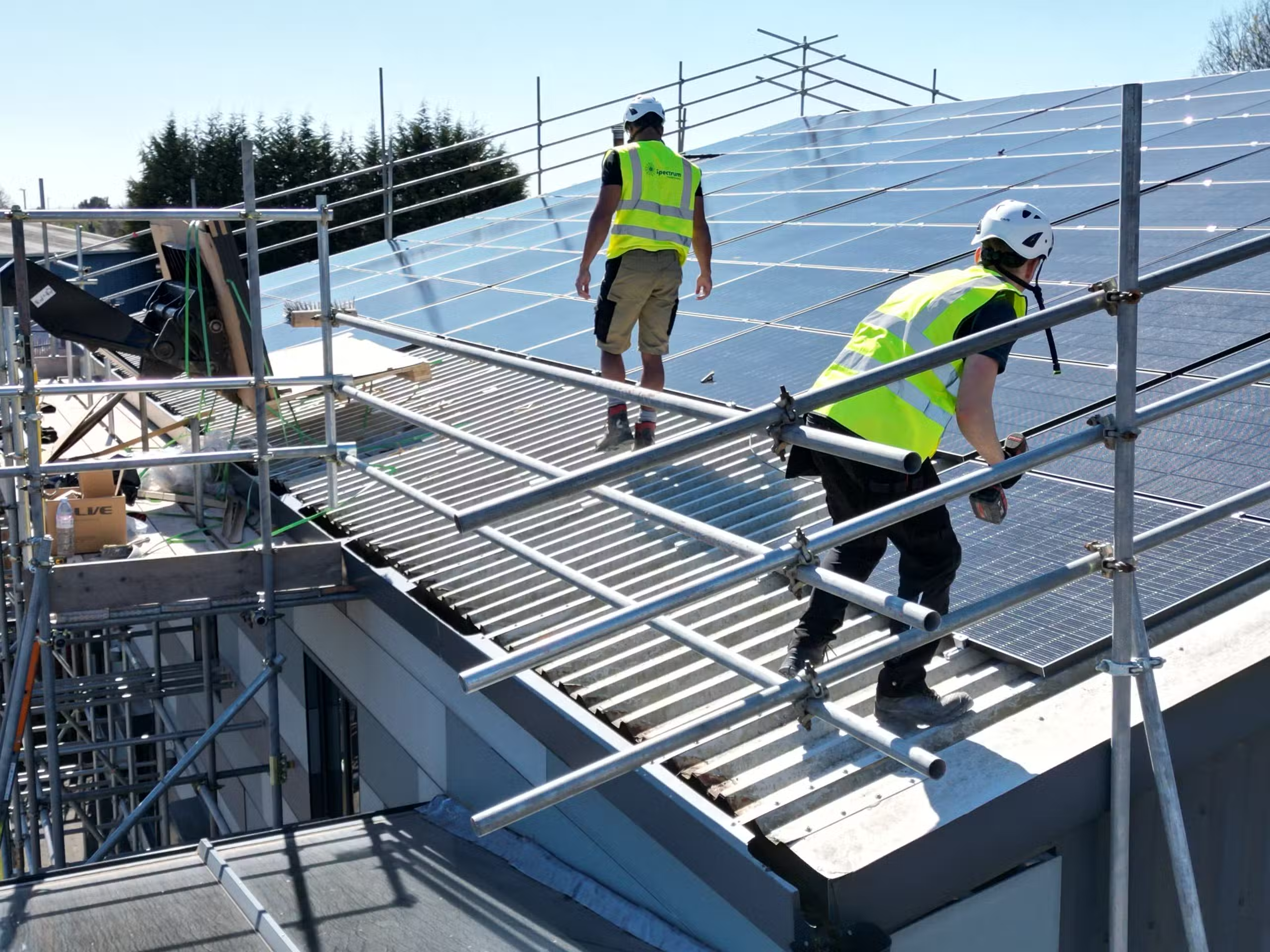
Understanding solar power calculations protects you from inflated claims and unrealistic savings projections. Whether you're looking for a solar power calculation for home UK properties or need to calculate solar energy generation for a commercial building, the methodology is the same. When an installer quotes generation figures, you should be able to verify whether those numbers make sense for your location, roof orientation, and system size. This knowledge forms the foundation of any credible solar business case.
Accurate calculations matter because they directly affect your payback period projections and return on investment estimates. A system generating 20% less than projected takes proportionally longer to pay back—turning what seemed like a 6-year payback into a 7.5-year wait. Professional installers use detailed calculations precisely because the numbers must withstand financial scrutiny.
The Difference Between System Capacity and Actual Output
Before calculating solar power, you need to understand two essential measurements that often cause confusion:
kWp (kilowatt peak) measures your system's rated capacity under ideal laboratory test conditions—25°C panel temperature, 1,000 W/m² irradiance, and specific spectral distribution. This is the nameplate rating you see on proposals: "4kWp system" or "200kWp installation." Think of it as what your system could produce in perfect conditions.
kWh (kilowatt hours) measures actual energy generated over time. This is what flows through your meter and determines your savings. A 4kWp system does not produce 4kW continuously—real-world conditions rarely match laboratory ideals.
Key insight: A 10kWp system in the UK typically generates 8,000-11,000 kWh per year—not 87,600 kWh (10kW × 24 hours × 365 days). Understanding this gap is essential for realistic financial planning. Our guide to solar panel efficiency explains the factors affecting this conversion.
The Key Variables in Any Solar Power Calculation
Several factors determine how much electricity your solar panels will actually generate. Understanding each variable helps you assess whether generation estimates are realistic for your specific situation.
Solar Irradiance and Peak Sun Hours in the UK
Any solar irradiance UK calculation starts with measuring the power of sunlight reaching your panels, expressed in kilowatt hours per square metre per year (kWh/m²/year). The UK receives between 850 and 1,100 kWh per kWp annually, depending on location—southern England typically achieves the higher end, whilst northern Scotland sits lower.
Despite Britain's reputation for grey skies, these figures support commercially viable solar generation. The UK receives approximately 60-70% of the solar irradiance that southern Spain enjoys, yet UK solar installations deliver excellent returns due to higher electricity prices and favourable installation economics.
System Size (kWp)
Proper solar system sizing UK projects require understanding total generation capacity. One of the most common questions we receive is "how many solar panels do I need UK homes or businesses?" The answer depends on your energy consumption and available roof space. System size is calculated by multiplying panel count by individual panel wattage:
Residential systems typically range from 3kWp to 6kWp. A 4kWp system might comprise 10 panels rated at 400W each. Larger homes or those with EV charging requirements often benefit from 5-6kWp systems.
Commercial systems range from 50kWp on smaller business premises to 1MW+ on large commercial buildings and manufacturing facilities. Available roof space typically caps maximum system size—our 67kW commercial installation in Nottingham demonstrates what's achievable on standard warehouse roofing.
Panel Efficiency and Technology
Panel efficiency determines how much electricity each square metre of roof space generates. Modern monocrystalline panels typically achieve 20-23% efficiency, meaning they convert 20-23% of incoming solar energy into electricity.
Higher efficiency matters most when roof space is constrained. A 22% efficient panel generates approximately 10% more power per square metre than a 20% panel—potentially adding an extra kWp to systems where every panel position counts. For properties with ample roof space, the efficiency difference becomes less critical than overall system economics.
Roof Orientation and Tilt Angle
Orientation and angle significantly affect generation. UK solar calculations typically use south-facing at 30-40° pitch as the baseline (100% performance), with adjustments for other configurations:
| Orientation | Optimal Tilt | Relative Output | Notes |
|---|---|---|---|
| South-facing | 30-40° | 100% | UK optimum baseline |
| South-east/South-west | 30-40° | 95-97% | Minimal reduction |
| East or West | 30-40° | 80-85% | Lower peak, flatter curve |
| Flat roof (mounted at 10-15°) | 10-15° | 85-90% | Depends on mounting angle |
| North-facing | Any | 50-65% | Generally not recommended |
Swipe or scroll to view full table
East/west configurations, whilst producing less total energy, generate power across a longer daily period—potentially improving self-consumption for businesses operating morning and afternoon shifts. Our complete business solar guide explores how orientation affects commercial project economics.
Shading and System Losses
Even partial shading dramatically affects solar output. A shadow across 10% of a panel can reduce that panel's output by 30-50%, and in string inverter systems, one shaded panel can drag down an entire string's performance.
Common shading sources include chimneys, satellite dishes, ventilation equipment, neighbouring buildings, and trees. Professional shading analysis using horizon profiling tools identifies potential losses and informs system design decisions—such as specifying microinverters or optimisers for partially shaded arrays.
Beyond shading, all systems experience inherent losses from inverter conversion (typically 3-5%), wiring resistance (1-2%), and soiling (2-5% depending on environment and cleaning frequency). Combined, these system losses typically reduce output by 15-25% from theoretical maximum—accounted for in the performance ratio.
The Basic Solar Power Calculation Explained
With the key variables understood, the core solar power generation calculation UK installers use becomes straightforward. Learning how to work out solar panel output follows this formula, which provides reliable estimates for most UK locations:
Performance Ratio accounts for all system losses and typically ranges from 0.75 to 0.85 (75-85%). Well-designed systems with quality components achieve 0.80-0.85; systems with shading issues or older equipment may fall to 0.75.
Worked Example: Residential Installation
This residential solar calculation UK example demonstrates how to determine solar panel annual output for a typical home:
Scenario: Detached Home in the East Midlands
A south-facing roof suitable for a domestic solar installation:
For context, a typical UK household consumes 2,700-3,500 kWh annually. This system would generate 90-100% or more of average household electricity consumption. Actual self-consumption depends on when electricity is used—adding battery storage increases the proportion used directly.
Worked Example: Commercial Installation
For larger projects, commercial solar power calculation UK methods follow the same formula but with additional considerations for orientation and scale:
Scenario: Warehouse in Spalding, Lincolnshire
A large flat roof with east/west mounting orientation for a commercial solar installation:
For a warehouse consuming 200,000 kWh annually, this system would offset approximately 65% of electricity costs—with actual savings depending on daytime consumption alignment and battery storage integration.
Monthly and Seasonal Variation
UK solar generation varies significantly by season, making solar energy output per day UK estimates highly variable. Expect summer months (May-August) to generate 3-4 times more than winter months (November-February). A system producing 3,200 kWh annually might generate 400-450 kWh in June but only 100-120 kWh in December.
This seasonality affects financial modelling—especially for businesses with consistent year-round consumption versus seasonal operations. Understanding monthly patterns helps size battery storage appropriately and set realistic expectations for winter performance.
Calculating Self-Consumption and Export
Knowing how much energy your system generates is only half the equation. Accurate solar self-consumption calculation UK households and businesses use determines actual financial returns, which depend heavily on how much you consume directly versus export to the grid.
What Is Self-Consumption?
Self-consumption refers to the proportion of solar generation used directly on-site at the moment it's generated. This delivers maximum value because each kWh self-consumed replaces grid electricity at your full import rate—which is significantly higher than export tariff rates.
Without battery storage, typical self-consumption rates are 25-50% for residential properties (higher if someone is home during the day) and 50-70% for commercial properties with daytime operations. Adding appropriately sized battery storage can increase self-consumption to 70-90%.
Calculating Export Revenue
Energy not consumed on-site exports to the grid under the Smart Export Guarantee (SEG). Export tariff rates vary significantly between suppliers—shopping around for the best rate can substantially increase your export income. Whilst export revenue contributes to overall returns, it's worth considerably less than self-consumption value.
Why self-consumption matters more than export: A home generating 3,200 kWh annually with 40% self-consumption uses 1,280 kWh directly and exports 1,920 kWh. Because your import electricity rate is typically 2-3 times higher than export tariff rates, the value from self-consumed energy far exceeds export income.
Increasing self-consumption from 40% to 70% (with battery storage) can improve your total financial return by 30% or more from the same generation—making battery storage a worthwhile consideration for many installations.
Calculating Financial Returns from Solar Power
Simple Payback Period
Payback period—the time taken for cumulative savings to equal initial investment—provides a straightforward measure of solar economics:
Annual financial benefit includes both self-consumption savings (kWh × import rate) and export revenue (kWh × SEG tariff). Typical payback ranges are 4-7 years for commercial installations and 7-12 years for residential—depending on system size, self-consumption rates, and electricity costs.
Commercial installations typically achieve faster payback due to higher daytime consumption alignment, better economies of scale, and often higher electricity unit rates. Our solar funding guide explores how different financing options affect effective payback calculations.
Lifetime Return on Investment
Payback period captures only part of the picture. Solar panels carry 25-30 year warranties and typically operate effectively for 30+ years with appropriate maintenance. Post-payback generation represents essentially free electricity for 15-20+ years.
Conservative lifetime projections account for panel degradation (typically 0.5% annually) and make reasonable assumptions about future electricity price changes. Even with modest inflation assumptions, a system with 7-year payback typically delivers 300-400% return on investment over 25 years.
Why Online Calculators Only Tell Part of the Story
A solar PV system size calculator UK website or solar panel wattage calculator UK tool serves a useful purpose—providing ballpark estimates and initial feasibility indications before committing to professional consultations. They help you understand relationships between system size, location, and expected output.
However, online calculators cannot account for critical site-specific factors:
- Actual shading: Nearby buildings, trees, chimneys, and equipment visible only through site inspection
- Roof structural capacity: Whether your roof can physically support the proposed system weight
- Available mounting area: Obstructions, vents, skylights, and access requirements that reduce usable space
- Grid connection constraints: Local network capacity and any export limitation requirements
- Your specific consumption profile: When you use electricity affects self-consumption calculations significantly
Professional system design using specialist software like PVsyst incorporates meteorological data, detailed shading analysis, and half-hourly consumption matching to produce estimates typically accurate within 5-10%—versus 15-25% variance common with generic online tools.
Get Accurate Numbers for Your Property
Our MCS-accredited team provides detailed feasibility assessments including professional shading analysis, consumption matching, and bankable generation projections—at no cost or obligation.
Request Your Free Assessment Speak to Our TeamHow Professionals Calculate Solar Power for Your Site
Site Survey and Data Gathering
Calculating solar panel requirements UK properties need accurately starts with comprehensive site data collection—roof orientation and pitch measurement, usable area mapping, shading analysis using horizon profiling tools, and structural assessment. We also review electricity bills to understand consumption patterns and identify opportunities to maximise self-consumption.
For commercial projects, this includes detailed load profiling to match generation patterns against operational requirements. A manufacturing facility with consistent weekday demand presents different optimisation opportunities than a retail operation with seasonal peaks.
What a Professional Feasibility Report Includes
A comprehensive solar feasibility report from Spectrum Energy Systems covers:
Generation Projections
- Annual kWh output estimate
- Monthly generation breakdown
- Performance ratio assumptions
- Weather data sources used
Financial Analysis
- Self-consumption modelling
- Annual savings projection
- Export revenue estimate
- Payback period calculation
Technical Specification
- Panel type and quantity
- Inverter selection
- Mounting system details
- Grid connection requirements
Long-term Projections
- 25-year ROI analysis
- Degradation assumptions
- Maintenance considerations
- Warranty coverage details
This level of detail ensures you can make investment decisions with confidence, understanding exactly what to expect from your solar system. Explore our case studies to see real-world examples of professional system design delivering projected results.
Frequently Asked Questions
Accurate Calculations Lead to Better Solar Decisions
Understanding how solar power output is calculated transforms you from a passive quote recipient into an informed decision-maker. The core formula—system size multiplied by irradiance multiplied by performance ratio—is straightforward, but site-specific variables make professional system design essential for accurate, bankable projections.
Accurate calculations protect you from inflated proposals and unrealistic return projections. When you understand the methodology, you can evaluate whether quoted generation figures make sense for your location, roof orientation, and consumption patterns.
Spectrum Energy Systems has provided professional solar feasibility assessments across the East Midlands since 2011. Our MCS-accredited engineers deliver detailed generation modelling, consumption analysis, and transparent financial projections—helping homeowners and businesses make confident solar investment decisions.
Get Your Professional Solar Assessment
Request a no-obligation feasibility report including detailed generation projections, consumption matching, and accurate financial analysis tailored to your property.
Request Your Free Assessment Call 0115 773 7575About Spectrum Energy Systems: Established in 2011, we're MCS-accredited solar installers serving Nottingham, Derby, Leicester, Lincoln and the wider East Midlands. Our experienced engineers design and install tailored solar solutions for homes and businesses, ensuring maximum performance and return on investment. Learn more about our expertise or explore our completed projects. We specialise in installations for commercial buildings, agricultural properties, schools and colleges, and office buildings.