Solar Panel Installation Day: What Actually Happens
Most domestic solar panel installations take one to two days on site. Scaffolding goes up a day or two before, the crew arrives around 8am, roof work and electrical work run in parallel, and your power is only off briefly at connection, typically under an hour. Paperwork follows within weeks.
In This Guide
The solar panel installation process is far less disruptive than most homeowners expect. You keep your electricity for almost the whole job, and the mess is limited to a bit of drilling dust and a scaffold on the lawn for a week or so.
Our in-house crews work out of our Bulwell HQ in Nottingham and install domestic systems every week across the East Midlands. We do not use subcontractors, and every install is signed off under one MCS certification (NIC200223) with NICEIC Approved Contractor status (3182878) behind the electrical work. This guide walks through what those crews do, in the order they do it.
Before install day: the scaffold goes up first
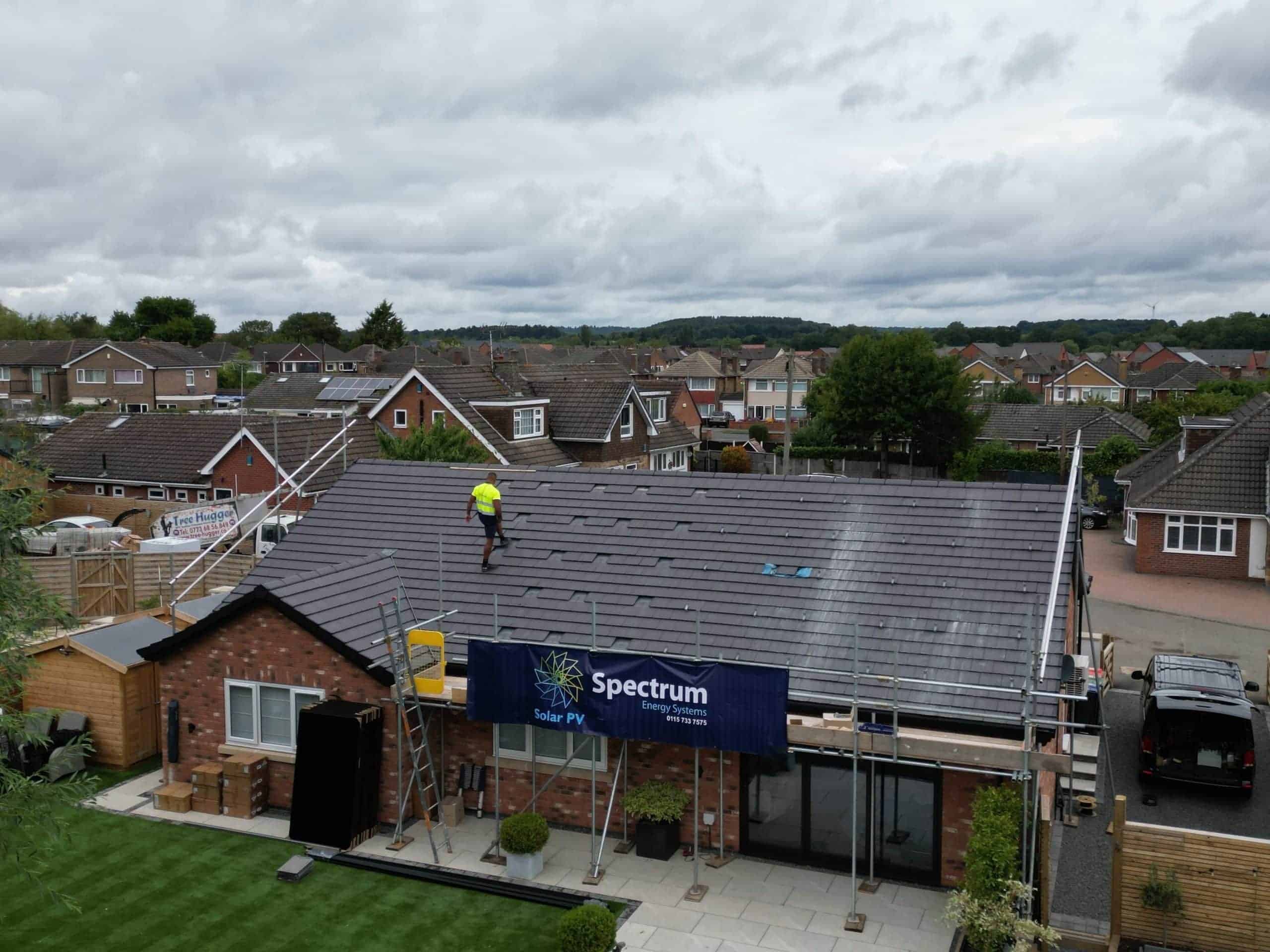
Scaffolding is normally erected one to two days before the installation itself. A scaffold team arrives, puts up access along the working elevations of your roof, and leaves. It takes a few hours and you do not need to be home, as long as they can reach the walls they need.
The scaffold is there for safe working at height, and it stays up until after the install is finished, usually coming down a few days after the panels go on once we are sure no return visit to the roof is needed.
The install day, hour by hour
Every home is different, but a typical one day domestic install follows the same rhythm. Here is the shape of the day our crews work to.
Around 8am: arrival and walkthrough
The crew arrives and walks the job with you: where the inverter and battery are going, where cables will run, which rooms they need access to. They then unload the kit and protect floors along the internal cable routes.
Morning: roof work begins
The roofers go up the scaffold and start setting out the array. On a standard tiled roof that means lifting tiles, fixing roof hooks to the rafters, and bolting the mounting rails to the hooks. On an in-roof system, sections of tile come off and weatherproof trays go in flush with the roofline instead.
Morning, in parallel: the electrician starts inside
While the roofers work above, the electrician works below. They mount the inverter and battery in the agreed spot, usually a garage, utility room or loft, run the DC cabling from the roof, fit the AC and DC isolators, and prepare the connection at your consumer unit.
Early afternoon: panels go on
With rails or trays fixed and cabling in place, the panels are carried up and clamped down one by one, then plugged together into strings. This is the fastest looking part of the job. A typical 10 to 12 panel domestic array is panelled in a few hours.
Mid afternoon: connection and the brief power cut
The electrician connects the system to your consumer unit. Your electricity is switched off for this, typically for under an hour. It is the only planned interruption of the day. Once the connection is made and tested, power comes straight back on.
Late afternoon: commissioning, walkthrough and app setup
The system is energised, tested and commissioned. The installer checks generation, sets up battery charging behaviour, connects the inverter to your Wi-Fi, and gets the monitoring app working on your phone. You get a walkthrough of what everything does before the crew tidies up and leaves.
What happens on the roof
Roof work is where the time goes, and it is where installer quality shows. The fixings are the part of the job you will never see again, so they have to be right first time.
On a standard on-roof system, the crew locates your rafters, fixes stainless steel roof hooks directly to them, and refits the tiles over the hooks so the roof stays weathertight. Aluminium rails bolt to the hooks, and the panels clamp to the rails. Nothing load bearing hangs off the tiles themselves.
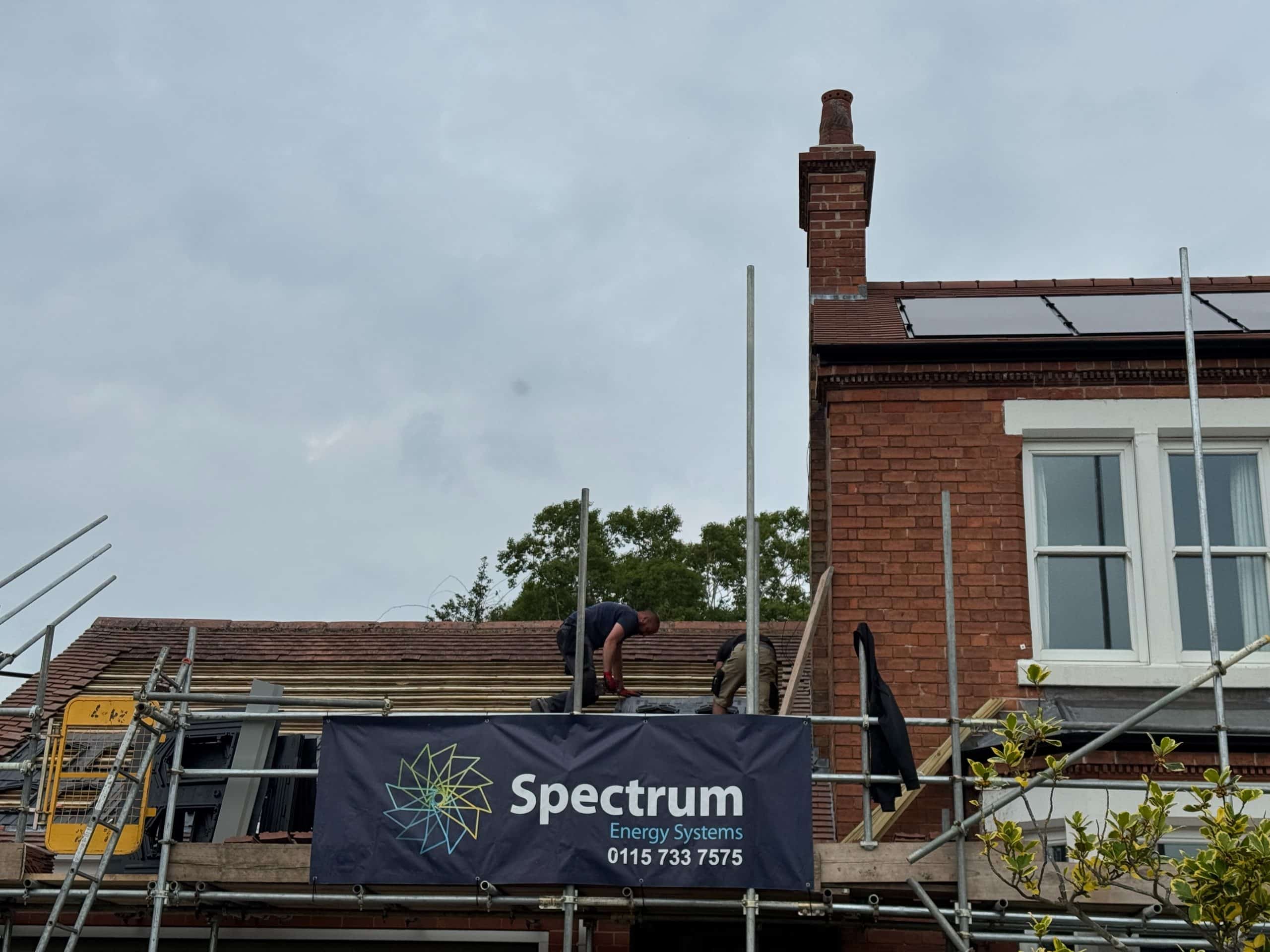
In-roof systems, like the GSE tray installation our crew is preparing here, take a different route. Tiles come off the array area entirely, weatherproof trays are fixed to the battens, and the panels sit in the trays flush with the roofline. It is a neater finish, popular on new builds and reroofs, and it adds roughly half a day to a day of roof work compared with an on-roof array.
Either way, the crew leaves the roof weathertight at the end of every working day. A half finished array is never left open overnight.
The electrical side of the job
The wiring is the half of the solar panel installation process nobody photographs, but it is the half that MCS and NICEIC standards care most about. While the roof team fixes panels, the electrician is doing four things:
- Inverter and battery mounting The hybrid inverter and battery go on a wall in the agreed location. We plan this at the survey, not on the day, so there are no surprises about where kit ends up.
- DC cable runs The cables from the roof strings are routed down to the inverter, clipped and contained neatly, not draped through the loft.
- Isolators AC and DC isolation switches are fitted so the system can be safely shut down for maintenance on either side of the inverter.
- Consumer unit connection The system is connected to your consumer unit on its own protected circuit, which is the step that needs the brief power shutdown.
Commissioning, walkthrough and app setup
Commissioning is the formal switch-on. The installer tests the system, records string voltages and generation readings, configures the inverter and battery settings for your tariff, and registers the system for its warranties. Then comes the part worth being home for: the handover walkthrough.
You will be shown where the isolators are, what the inverter display is telling you, and how the monitoring app works on your phone. If you are planning to move to a smart tariff, this is also when we show you the time of use settings in the SolisCloud app so you can set the charging windows for your tariff.
What you need to do before and during the install
Homeowner prep checklist
- Clear the loft access The electrician usually needs to get into the loft for cable routing. Move the boxes away from the hatch before the crew arrives.
- Leave driveway space The crew needs somewhere close to unload panels, rails and the battery. Leave a parking space or drive clear if you can.
- Clear the inverter wall If the inverter and battery are going in a garage or utility room, clear a working space around that wall.
- Be home for the final hour You do not need to be in all day, but be there for the walkthrough, the app setup and any questions at handover.
- Expect a brief power cut Plan around roughly an hour without electricity mid afternoon. Working from home is fine for the rest of the day.
Want to Know What Your Roof Could Take?
We survey your roof and usage, design the system, then send your design and quote, normally within 2 to 4 days. The site survey costs nothing and there is no obligation.
request an assessmentA real four day install: 7.2kW in Sherwood, Nottingham
Not every job is one or two days, and it is worth seeing what a longer one looks like. Our 7.2kW installation in Sherwood, Nottingham ran to four days including scaffolding, because the cable route was awkward enough that another installer had refused the job outright.
Day one covered scaffolding and planning the cable containment. Days two and three put 16 JA Solar 455W all-black panels onto a split array across two roof sections. The final day was all electrical: hybrid inverter, 9.5kWh battery, commissioning and tariff configuration. The system now covers around 80% of the household's usage, with payback at circa 7 years based on the savings recorded on that job. What matters is that the four day timeline was agreed with the customer before work started, rather than discovered halfway through.
If you are still working out what size system your roof and usage justify, start with our guide to how many solar panels you need, and see real installed prices in our Nottingham installation cost guide.
After the crew leaves: scaffold down and paperwork
The install is done, but the job is not quite finished. Here is what happens in the days and weeks after:
A few days later: scaffold comes down
The scaffold team returns and strikes the scaffold, usually within a few days of completion. Lawns and drives go back to normal.
DNO notification
Your system has to be registered with the local electricity network operator, which for most of the East Midlands is National Grid Electricity Distribution. Smaller systems are notified after connection under G98; larger systems need G99 approval before the install, which we arrange during the design stage. Either way, we handle it.
MCS certificate
We register the installation on the MCS database and your MCS certificate is issued. You need this document to apply for Smart Export Guarantee payments, so keep it safe with your handover pack.
Handover pack and warranty registration
Your handover pack includes the system schematics, test results, product documentation and warranty details. Panel and battery warranties are registered with the manufacturers, and every Spectrum install carries our 5 year workmanship guarantee backed by QANW insurance, so the guarantee stands even independently of us.
Frequently asked questions
How long does solar panel installation take?
Most domestic solar panel installations take one to two days on site, plus scaffolding erected a day or two beforehand and taken down a few days after. Larger or more complex jobs, such as split arrays or difficult cable routes, can run to three or four days. Your installer should confirm the timeline before work starts.
Do I need to be home during the installation?
Not for most of it. Once the crew has access to the loft, the inverter location and the consumer unit, you can go about your day. You should be home for the final hour for commissioning, the handover walkthrough and monitoring app setup, because that is when you learn how your system works.
Will my electricity be off during the install?
Only briefly. Your power stays on for almost the whole job. The one planned shutdown happens when the electrician connects the system to your consumer unit, typically for under an hour in the afternoon. Power comes back on as soon as the connection is made and tested.
Does it matter if it rains on install day?
Light rain rarely stops a job; crews work through normal British weather. High winds or heavy, persistent rain can pause roof work for safety, which is one reason installs are scheduled with a little slack. The roof is always left weathertight at the end of each working day, whatever the forecast.
How much mess does a solar installation make?
Less than most building work. Expect some drilling dust where cables pass through walls, packaging from panels and kit, and boot traffic along the internal cable route. Crews protect floors, tidy as they go and take packaging away. Outside, the scaffold is the only thing left behind, and only for a few days.
Can I use my solar panels straight away?
Yes. Once the system is commissioned on the final afternoon it is generating and, if you have a battery, storing energy immediately. The one thing you must wait for is your MCS certificate, which you need before you can apply for Smart Export Guarantee payments on the electricity you export.
Who tells the electricity network about my system?
Your installer does, and it is a legal requirement, not an optional extra. Smaller domestic systems are notified to the network operator after connection under G98. Larger systems need G99 approval before installation, which we secure during the design stage so the install date never depends on paperwork still in flight.
This is exactly how our solar panel installers in Derby run installation days across Derbyshire.
Related reading
- How many solar panels do I need? A UK sizing guide
- Solar panel installation cost in Nottingham: real prices
- Solar panel maintenance: the complete UK guide
Ready to look at your own roof? Start with our domestic solar overview.
Speak to Spectrum Energy Systems
Our in-house crews install across the East Midlands from our Bulwell HQ, with one MCS certification behind every job and a QANW insurance-backed guarantee on every install. Ask us for a feasibility assessment for your home.
Speak to Our Team