How Much Are Solar Panels for a 3-Bed House in the UK?
Solar panels for a 3-bed house in the UK typically cost £9,000 to £9,995 all-in during 2026, including a battery, scaffolding, labour and 0% VAT. That buys a 4 to 6kWp system of 10 to 12 panels. These are real installed prices from our own jobs, not national averages.
In This Guide
Real 2026 prices for a 3-bed house
A typical 3-bed semi in the UK takes a 4 to 6kWp solar system. That is 10 to 12 panels at 500W each, which is what most 3-bed roofs can physically hold once you work around chimneys, velux windows and roof edges. Here are the prices we actually install at, fully fitted:
| System | All-in installed price | Best suited to |
|---|---|---|
| 4kWp east west split + 10kWh battery | £9,000 | Semis where the roof faces east and west rather than south |
| 5 to 6kWp + 16.1kWh battery | £9,995 | Most 3-bed homes. This is our most installed system |
Every figure is a single all-in price. There is no VAT to add because domestic solar and battery installations carry 0% VAT until 31 March 2027 under the government's energy saving materials relief (gov.uk). There are no hidden extras for scaffolding or electrical work either. The price you are quoted is the price you pay.
If you want the wider national picture across every house size, our UK solar cost guide for 2026 covers the full range from small terraces to large detached homes.
What the all-in price includes
When we quote £9,995 for a 3-bed house, that figure covers the whole job:
- Tier 1 solar panels10 to 12 panels with 25-year performance warranties, mounted on-roof or in-roof depending on your preference.
- Hybrid inverterA Solis hybrid inverter that manages both the panels and the battery from one unit.
- Battery storage10kWh or 16.1kWh of storage so evening and overnight use runs on stored solar or cheap-rate electricity.
- ScaffoldingFull access scaffold, erected and taken down. On some quotes this line alone varies by hundreds of pounds.
- All electrical workDC and AC isolation, generation meter, bonding and any consumer unit work agreed at survey.
- MCS certification and DNO paperworkYour MCS certificate (we are certified installer NIC200223), the grid notification and the handover pack, which you need to claim export payments.
Our workmanship is covered by a 5-year guarantee, backed by a QANW insurance-backed guarantee, and Spectrum has been installing since 2011.
Panels only or panels plus battery
You can fit panels without a battery and the upfront cost drops by a few thousand pounds. For most 3-bed households we do not recommend it, and the reason is simple arithmetic.
Ofgem's typical household electricity use is 2,500 kWh a year (July 2026 Typical Domestic Consumption Values update). A 5.7kWp system in the East Midlands generates roughly 5,100 to 6,000 kWh a year, so the panels produce around double what the house uses. Without a battery, most of that surplus exports at a low rate while you buy electricity back at full price every evening. A battery captures the surplus for evening and overnight use, and on a two-rate tariff it can also charge cheaply overnight in winter. That is why the panels-only option is cheaper up front but usually pays back worse over the life of the system.
Our guide to home battery storage explains the sizing logic in more detail.
What pushes a 3-bed quote up or down
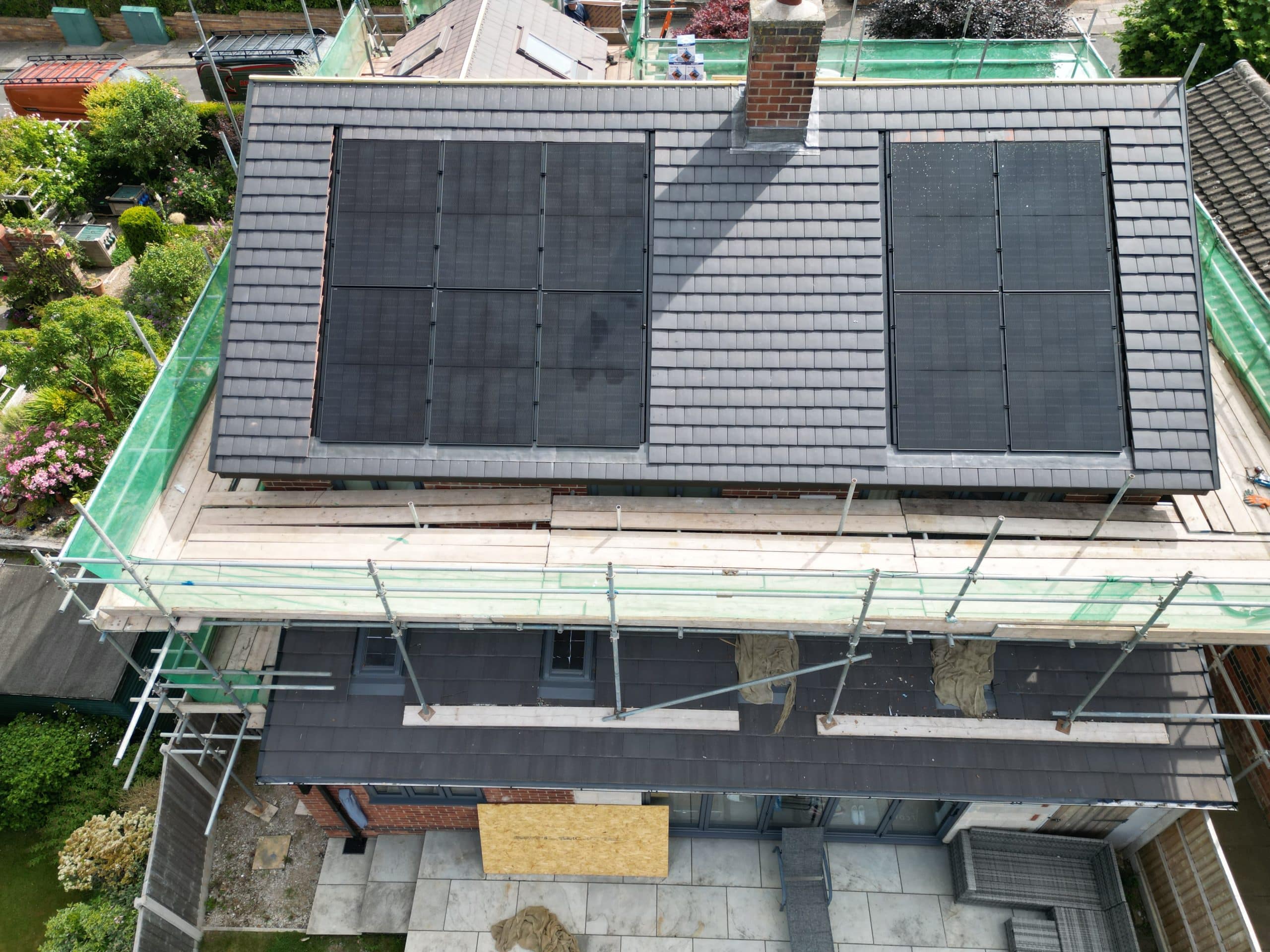
Two identical 3-bed semis can get different quotes. The photo shows why: this Nottinghamshire home needed full scaffold to two elevations plus panels split across two roof faces. The main factors we price at survey are:
- Roof shape and facesA single south-facing roof is the cheapest layout. Splitting panels across east and west faces, or working around dormers and velux windows, adds mounting and labour.
- Roof coveringSlate takes longer and needs more care than concrete tile, so slate roofs carry a labour premium.
- Scaffold accessA conservatory, an extension below the roof line or a shared alley can force extra scaffold lifts.
- Consumer unit conditionAn older fuse board may need upgrading before the system can be safely connected. We flag this at survey, never on install day.
- In-roof or on-roofIn-roof panels sit flush within the roof covering and look cleaner, but the trays and weatherproofing add cost compared with standard on-roof mounting.
Payback: a worked example
Here is an illustrative payback for the £9,995 system, with every assumption stated. At the Ofgem price cap unit rate of 26.11p per kWh (July to September 2026 cap) and East Midlands generation of 900 to 1,050 kWh per kWp per year (MCS-standard methodology), a 5.7kWp system with a 16.1kWh battery typically returns its cost in circa 8 years. That combines the electricity you stop buying with export payments on the surplus.
The honest caveats: your actual saving depends on how much electricity you use, when you use it, your tariff and your roof. These figures are illustrative, not guaranteed, and unit rates change with each Ofgem price cap review. What we can say is that the battery and the export payments do the heavy lifting, because the panels generate roughly twice what a typical 3-bed household consumes. Try your own numbers on our solar savings calculator.
A real installed job for comparison
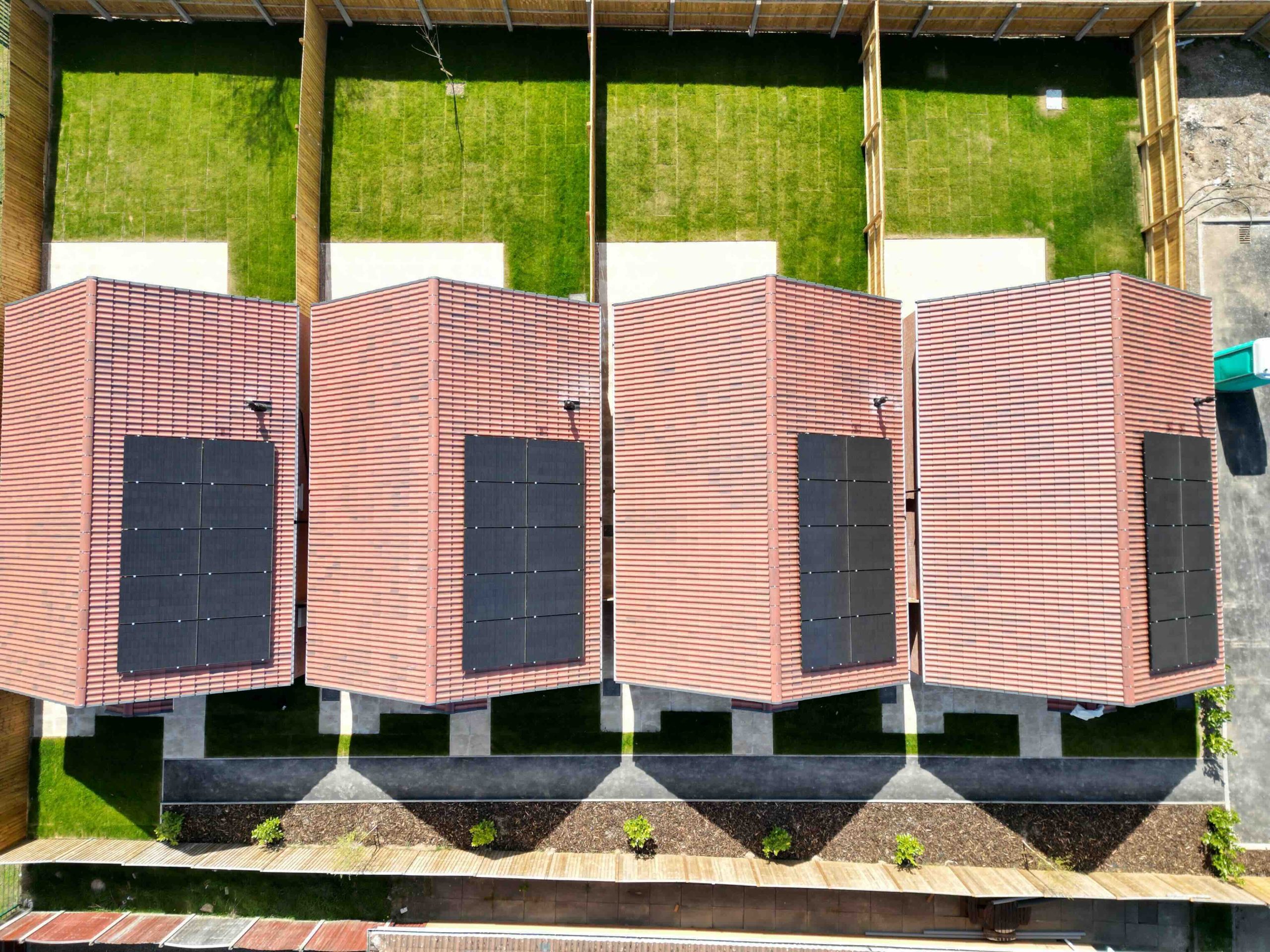
Numbers on a page are one thing. Here is a real one. Our Sherwood, Nottingham installation paired 7.2kW of all-black JA Solar panels with a 9.5kWh battery. That system is slightly larger than a typical 3-bed would take, closer to 4-bed scale, but the result shows what the technology does: the homeowner's electricity bill dropped by 96%, the system covers around 80% of their annual energy use, and payback works out at circa 7 years.
Scale that back to a 5 to 6kWp system on a 3-bed roof and the pattern holds. The bill does not vanish entirely, but the bulk of it goes.
How we design and quote
We do not price 3-bed houses off a rate card. After a site survey, we model your actual roof in 3D, place the panels on it panel by panel, and quote from that design. You see exactly how many panels fit, which faces they sit on and what the system will generate before you commit. Design and quote normally takes 2 to 4 days.
That matters for a 3-bed house more than most, because the difference between squeezing 10 panels on and fitting 12 changes both the price and the generation. If you want to dig into the sizing question first, read our guide on how many solar panels you need.
See What Your 3-Bed Roof Can Do
Book a feasibility assessment and we will design your system on your actual roof in 3D, then send a single all-in price with nothing added on later.
Request a QuoteFrequently asked questions
How many panels does a 3-bed house need?
Most 3-bed houses take 10 to 12 panels at 500W each, giving a 5 to 6kWp system. The exact count depends on roof size, orientation and obstructions like chimneys and velux windows, which is why we design each system on a 3D model of the actual roof before quoting.
Is a battery worth it for a 3-bed house?
Usually, yes. A 3-bed household typically uses around 2,500 kWh a year (Ofgem), while a 5 to 6kWp system generates roughly double that. Without a battery the surplus exports at a low rate. With one, you store it for evening use and can charge cheaply overnight in winter, which normally improves lifetime payback.
Can I get solar panels for a 3-bed house without a battery?
Yes. A panels-only installation costs a few thousand pounds less up front and still cuts your daytime electricity use. We quote it when asked. For most 3-bed households it pays back worse over the system's life, because the majority of generation exports at a low rate instead of offsetting full-price evening usage.
Does a 3-bed solar quote include scaffolding and electrical work?
Ours does. The all-in price covers panels, inverter, battery, scaffolding, all electrical work, MCS certification and the grid paperwork. Some installers quote a headline price and add scaffolding later, so when comparing quotes always ask whether the figure is genuinely all-in before judging it.
Is there VAT on solar panels for a house?
No. Domestic solar panel and battery installations carry 0% VAT until 31 March 2027 under the government's energy saving materials relief, confirmed on gov.uk. The prices in this guide are the full amounts payable. Commercial installations are different and carry VAT at the standard rate.
How long does installation take on a 3-bed house?
The roof and electrical work on a typical 3-bed house is normally completed in one to two days once scaffolding is up. Our in-house crews handle the whole job from Bulwell, Nottingham. Design and quote normally takes 2 to 4 days after the site survey.
Related reading
- How much do solar panels cost in the UK in 2026
- How many solar panels do I need?
- Solar panel installation cost in Nottingham
For the full picture on home systems, start with our domestic solar overview.
Speak to Spectrum Energy Systems
MCS certified installer NIC200223, installing across the East Midlands since 2011. One all-in price for your 3-bed home, designed on your actual roof.
request an assessment