
Solar Panels for Warehouses UK: Why They Are Britain's Best Solar Roofs
Warehouses are the best solar roofs in Britain: large, unshaded, single-plane metal roofs that take panels quickly and cheaply, above a building that uses power all day. Warehouse solar typically costs £850 to £1,100 per kWp installed, ex-VAT. Spectrum has installed warehouse systems up to 177kWp.
In This Guide
Why warehouse roofs suit solar better than almost anything else
Solar panels for warehouses work so well because everything that makes a domestic roof awkward is absent. A warehouse roof is one big plane, usually metal, usually unshaded, with no chimneys, dormers or velux windows to design around. We can run long, uninterrupted rows of panels, which is the cheapest and fastest way to build a solar array. Our largest installs, including the 177kWp system at Spalding, all sit on roofs like this.
The second half of the case is what happens under the roof. Most warehouses draw power through the working day: lighting, conveyors, compressors, charging for forklifts and materials handling equipment, offices, sometimes refrigeration. That daytime load lines up with when the panels generate, so a high share of the energy gets used on site at your full import rate rather than exported for pennies. Self-consumption is what drives warehouse solar payback, and warehouses are naturally good at it.
Warehouse roof types and the right mounting for each
Nearly every UK warehouse roof we survey is one of three types, and each one takes a different mounting system. Match the mounting to the roof correctly and most of the engineering risk disappears.
| Roof type | How panels fix to it | Notes |
|---|---|---|
| Trapezoidal metal sheet | Short rails or brackets screwed to the raised ribs, e.g. Renusol MetaSole | The most common warehouse roof and the cheapest to panel. Fixings go into the crown of the rib, not the drainage trough. |
| Standing seam metal | Clamps that grip the seam itself, no penetrations | Keeps the roof warranty intact because nothing pierces the sheet. Seam spacing dictates the panel layout. |
| Flat roof (membrane or felt) | Ballasted mounting, e.g. Esdec, weighed down rather than fixed | No penetrations through the waterproofing. Panels usually sit east-west at a shallow tilt to maximise coverage and reduce wind load. |
On our Jacksons Nurseries project in Bagnall we fixed Renusol MetaSole rails straight to the trapezoidal sheet before clamping 56kW of panels to them. On the flat roof at Johns of Nottingham we used an Esdec ballasted system instead, so the membrane was never punctured. Same company, same crews, different roof, different answer. If you want the wider tour of mounting hardware, our guide to the types of solar panel mounting systems covers each in more depth.
The structural check comes first
A solar array adds roughly 12 to 20kg per square metre depending on the mounting route, and ballasted flat-roof systems add more than clamped metal-roof systems. Portal-frame buildings are usually designed with spare capacity, but "usually" is not a design basis. Before we finalise any warehouse layout we check the roof build-up and, where the margins are tight or the building is older, we ask a structural engineer to confirm the loading. It is a modest cost against a six-figure asset sitting on top of your stock.
Purlin condition matters as much as the frame. The fixings carry the array into the purlins, so corroded or undersized purlins change the fixing schedule. This is the sort of thing a proper site survey picks up and a desktop quote does not.
Three installed warehouse projects, not stock photos
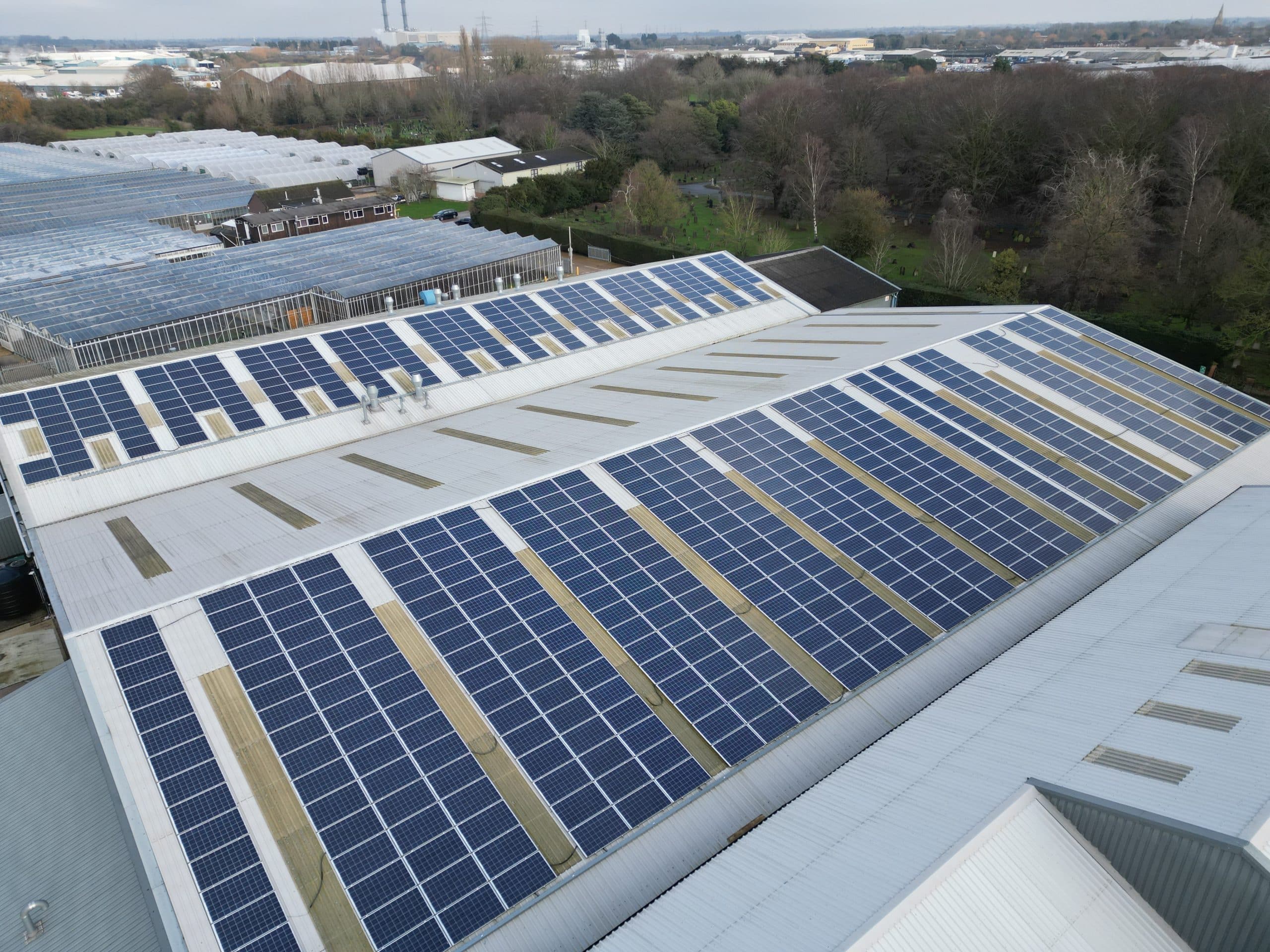
Elsoms Seeds, Spalding: 177kWp
Our largest recent warehouse installation, spread across the metal roofs of a busy seed-processing site in Lincolnshire. Six Solis 25kW string inverters run the array from a single plant room, and the job involved extensive cable routing through a working warehouse under strict health and safety procedures. The building kept operating throughout the install. Read the full write-up on our case studies page.
Two more completed warehouse and industrial-unit jobs that show the range:
- Linear Insulation, Nottingham: 66.85kW 147 JA Solar 455W panels in an east-west layout across a metal portal-frame roof, paired with a Solis 50kW inverter. The system generates over 55,500kWh a year and covers around 39% of the business's electricity use. On-site installation took five days.
- Johns of Nottingham: 35kW 70 JA Solar all-black panels on a flat commercial roof in Mapperley, mounted east-west on an Esdec ballasted system with no roof penetrations, generating around 23,000kWh a year alongside battery storage.
What install week actually looks like
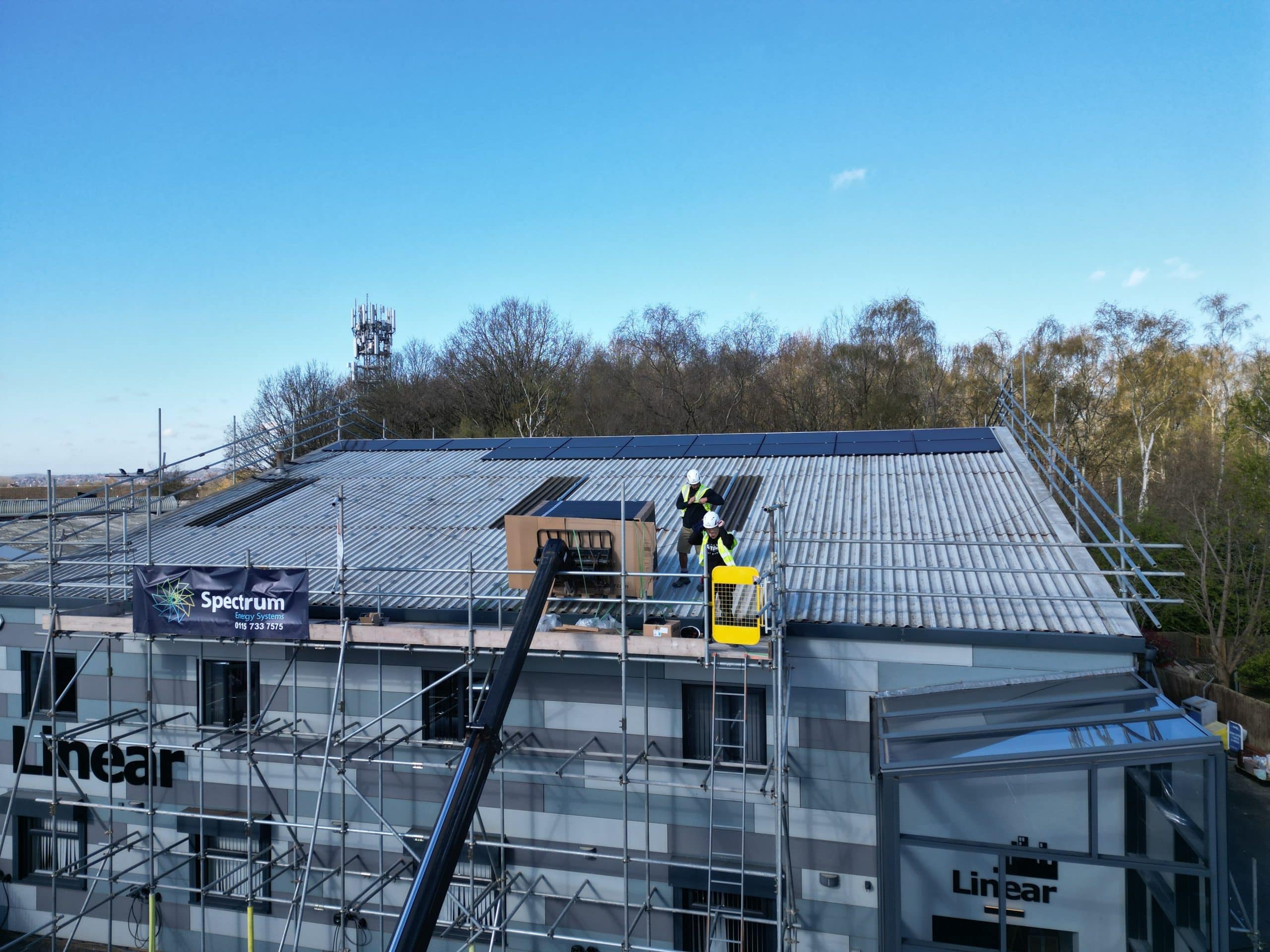
Panels arrive on pallets and get craned or lifted to roof level, as here at Linear Insulation. Scaffolding and edge protection go up first, then rails or ballast trays, then panels, then the DC cabling runs back to the inverters. Our in-house crews work from our Bulwell HQ, and on most warehouse jobs the business keeps trading underneath us for the whole install.
Inverters, plant rooms and the G99 grid application
Warehouse systems use string inverters, usually several of them, mounted in a plant room or on an internal wall close to the incoming supply. Splitting a large array across multiple inverters, as with the six Solis 25kW units at Spalding, keeps each string manageable and means one fault never takes the whole array offline. We fit Solis inverters as standard on commercial work.
Almost every warehouse install needs a G99 application to the local distribution network operator before connection, because the inverter capacity exceeds the small G98 limit. For most of the East Midlands that operator is National Grid Electricity Distribution. Warehouses are three-phase as a rule, which helps: three-phase supplies accept far more generation than single-phase. We handle the G99 paperwork inside every commercial project, and we also offer a standalone £500 DNO application service if you want the grid answer before committing to anything; if you proceed with the install the £500 is credited against the project. The full background is in our guide to G98 and G99 grid connections.
What warehouse solar costs in 2026
Warehouse installations price between £850 and £1,100 per kWp installed, ex-VAT, based on Spectrum quotes and installed projects through 2026. Big simple metal roofs sit at the bottom of that band because scaffolding, design and mobilisation are spread across more panels. Those figures are illustrative and quote-dependent; your roof, access and supply arrangement move the number. The full size-by-size breakdown, including a real £37,000 quote line by line, is in our guide to commercial solar panel costs in the UK.
Two things soften the headline figure. Solar PV qualifies for capital allowances, so part of the spend comes back through your corporation tax position; the mechanics are covered in our guide to solar PV capital allowances, and your accountant should confirm your own treatment. And on recent Spectrum commercial quotes, modelled paybacks have typically come out at circa 4 to 6 years including export income. Every payback figure we give is illustrative, drawn from our own site-specific modelling, and never guaranteed.
The roof condition caveat nobody should skip
One honest warning before you get quotes. A solar array will sit on your roof for 25 years or more, and taking it off again to re-sheet the roof underneath is expensive. If your warehouse roof is due for replacement within the next five years or so, recover the roof first and panel it afterwards. We would rather tell you that at survey stage than install onto a roof that fails in year four. On sound metal roofs with decades left in them, which is most of the warehouse stock we survey, this is a non-issue.
How a warehouse solar project runs
Step 1: Survey and consumption review
It starts with a free remote roof and energy assessment, so we can see what fits and give you an idea of costs. Prefer us to visit first? We can do that too. A site survey covering the roof type, structure, purlins, incoming supply and your half-hourly consumption data where available. The consumption profile decides the system size more than the roof does.
Step 2: Design and fixed quote
We design the system from the survey and quote from the design: one all-in figure, ex-VAT, with projected generation and payback modelling. Design and quote normally follows within 2 to 4 days of the survey.
Step 3: G99 application
We submit the grid application to the DNO and deal with any export limitation requirement before installation is booked, so there are no surprises after the panels are up.
Step 4: Installation and commissioning
Scaffolding, mounting, panels, cabling, inverters and commissioning by our in-house crews, typically with the warehouse operating throughout. We are MCS certified (NIC200223) and NICEIC approved (3182878), and every install carries our 5-year workmanship guarantee.
If your building is more factory than shed, with heavy plant and process loads, the same principles apply with a different consumption model; our industrial solar panels page covers manufacturing and industrial sites specifically. For the broader commercial picture across offices, retail and agriculture, start with our commercial solar overview.
Frequently asked questions
Are warehouses good for solar panels?
Warehouses are among the best buildings in the UK for solar. They combine large, unshaded, single-plane metal roofs with steady daytime electricity use, so panels install quickly and most of the generation is consumed on site. That combination is why warehouse solar paybacks are typically shorter than domestic ones.
How much do solar panels for a warehouse cost?
Warehouse solar costs £850 to £1,100 per kWp installed, ex-VAT, in 2026, based on Spectrum Energy Systems installed project pricing. A 100kWp warehouse system therefore lands around £82,000 to £100,000. Figures are illustrative and quote-dependent; large simple metal roofs price at the bottom of the band.
Can solar panels go on a metal warehouse roof?
Yes. Trapezoidal metal sheet takes rail systems such as Renusol MetaSole fixed to the rib crowns, and standing seam roofs take clamps that grip the seam with no penetrations. Metal warehouse roofs are the cheapest roof type to panel, which is why so many large UK arrays sit on them.
Does a warehouse need planning permission for solar panels?
Most roof-mounted commercial solar in England falls under permitted development, so full planning permission is usually not needed. Exceptions apply near listed buildings, in conservation areas and where an array would face certain highways. We check the planning position for every warehouse project during the survey stage.
What is a G99 application and does my warehouse need one?
G99 is the application made to your distribution network operator for permission to connect generation above the small G98 threshold. Almost every warehouse solar system needs one. Warehouses normally have three-phase supplies, which accept much more generation, and Spectrum handles the G99 process within every commercial installation.
Will the warehouse have to close during installation?
No, not normally. Nearly all the work happens at roof level from scaffolding, with cable routing and inverter works planned around your operations. Our 177kWp Spalding installation was completed inside a busy working seed warehouse, and the 147-panel Linear Insulation system took five days on site while the business traded.
What if the warehouse roof is old?
If the roof covering is due for replacement within roughly five years, recover the roof before installing solar, because removing and refitting an array later costs real money. On sound metal roofs the array itself causes no harm, and standing seam and ballasted systems avoid penetrating the covering at all.
We install warehouse systems across the East Midlands - see solar panels Leicester for local coverage.
Related reading
- Commercial solar panels cost UK: real project numbers
- Solar PV capital allowances in the UK
- Solar for cold storage facilities in the UK
- Battery storage and commercial solar PV efficiency
For systems, sectors and the full installation service, head to our commercial solar overview.
Put your warehouse roof to work
A site survey, a system designed from your actual consumption, and one fixed all-in price. Design and quote normally within 2 to 4 days.
Request a Warehouse Solar Quote