
Solis vs SolarEdge Inverter: Which Is Better for UK Homes?
Solis hybrid inverters are the right choice on the majority of UK homes - cheaper, simpler, and excellent at pairing with Fogstar or Pylontech batteries. SolarEdge wins where the roof has significant shading (chimneys, dormers, neighbouring trees) because per-panel optimisation recovers production that string inverters lose. We fit both. The question isn’t which is better - it’s which is right for your roof.
The inverter is the brain of your solar PV system. It converts DC from the panels into the AC your home and the grid use, and on a hybrid setup it also manages battery charging and discharging. The choice between Solis (string hybrid) and SolarEdge (optimiser system) is one of the biggest decisions on a typical UK solar quote.
What each one actually is
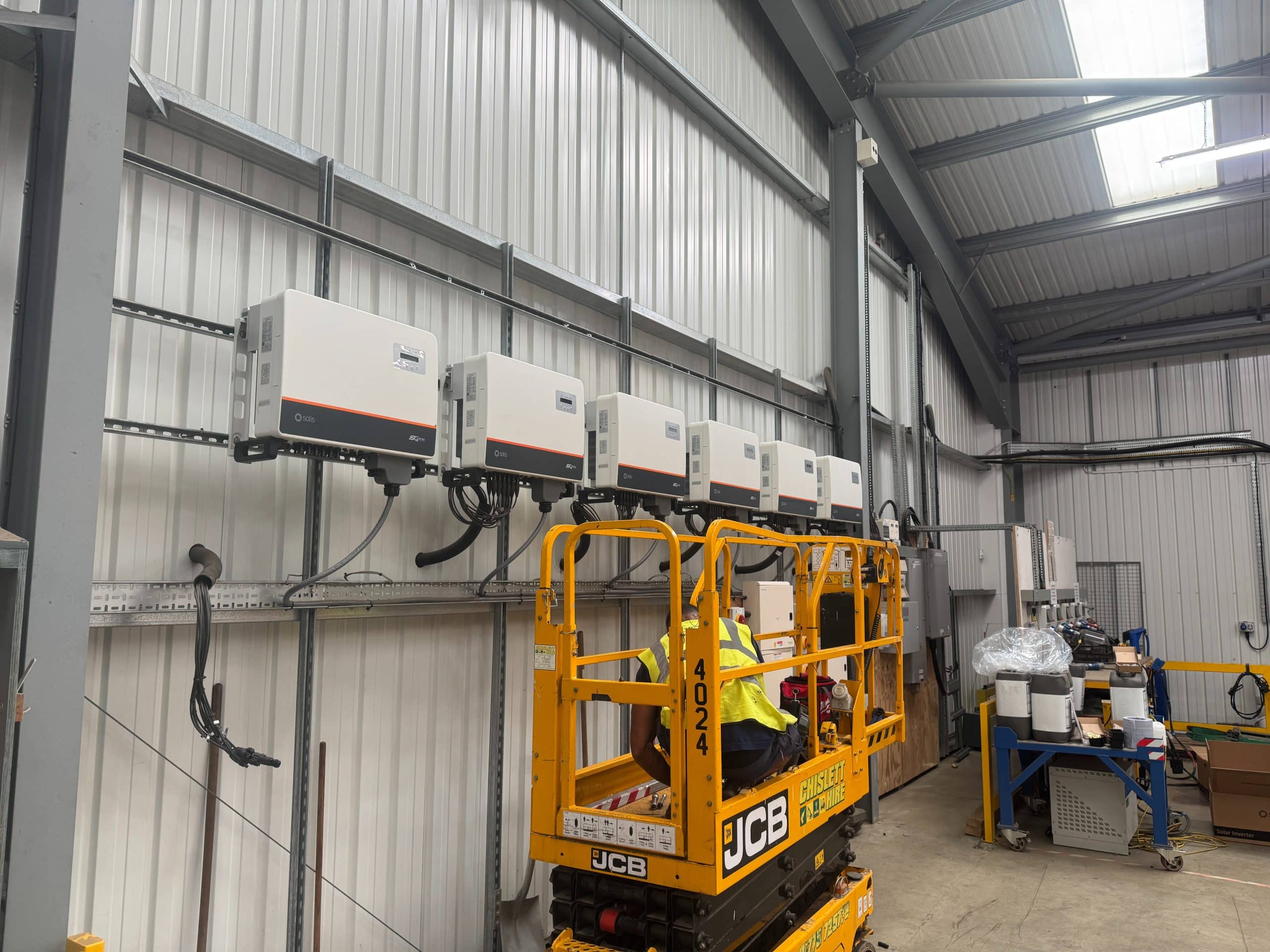
Solis hybrid string inverter. A single inverter at the bottom of the array converts DC from all panels (wired together in strings) into AC. The hybrid version also manages battery charge/discharge. Simple architecture, fewer components on the roof, cheaper.
SolarEdge. A small DC-DC power optimiser is bolted under each panel. Each optimiser handles its own panel’s maximum power point tracking (MPPT), then sends standardised DC to a central inverter. Per-panel monitoring, per-panel optimisation, and the central inverter is simpler than a Solis because the MPPT work happens at panel level.
The shading problem
String inverters track maximum power point at the string level, not panel level. If one panel is shaded for an hour at 3pm, the inverter pulls down the entire string’s output to match. Lose 20% on one panel and you can lose 15% on the string. On an unshaded roof this is fine because no panel is ever shaded. On a roof with a chimney that throws an afternoon shadow over two panels, you lose a meaningful chunk of generation.
SolarEdge optimisers solve this by handling each panel’s MPPT independently. The shaded panel underperforms; the rest of the array carries on at full output. Annual generation recovery typically 5-15% on a roof with real shading.
When we fit Solis
- Clean roof, no obstructions (chimneys, dormers, vent pipes, neighbouring trees within shadow range)
- Standard 4-15kW domestic hybrid install
- Battery storage required (Fogstar LV or Pylontech HV)
- Customer wants Predbat / Home Assistant integration for Octopus Agile
- Cost-conscious customer where the savings from string-inverter pricing outweigh the optimiser’s shading-recovery upside
Solis is our default. Most UK roofs are unshaded enough that string-inverter losses are negligible, and the price-per-watt and battery-pairing advantages are real.
When we fit SolarEdge
- Significant shading (an afternoon shadow over more than 1-2 panels for more than 1 hour/day on average)
- Multiple roof faces with different orientations / pitches (each face wants its own MPPT and a SolarEdge optimiser handles this cleanly)
- Customer specifically wants per-panel monitoring for fault diagnosis
- Customer plans to extend the array later (SolarEdge handles mixed-generation strings better)
Head-to-head
| Metric | Solis Hybrid LV/HV | SolarEdge + Optimisers |
|---|---|---|
| Architecture | String inverter, one box | Optimiser per panel + central inverter |
| Shading tolerance | Limited (string-level MPPT) | Excellent (panel-level MPPT) |
| Monitoring granularity | System level (SolisCloud) | Per-panel (mySolarEdge) |
| Battery compatibility | Fogstar (LV), Pylontech (HV) | SolarEdge Home Battery, LG RESU |
| Predbat / Home Assistant | Excellent native support | Partial via API |
| Indicative inverter cost | £1,000 - £1,800 (5-10kW) | £1,300 - £2,200 (5-10kW) + £50 - £80 per optimiser |
| Warranty (inverter) | 10 yr as supplied by Spectrum, extendable to 20 yr | 12 yr standard, extendable to 25 yr |
| Warranty (optimiser) | n/a | 25 yr standard |
| Fire-safety rapid shutdown | String-level | Per-panel (regulatory benefit in some EU markets) |
Not sure which one your roof needs?
We’ll do a shading analysis at site survey and tell you whether SolarEdge’s shading recovery actually pays back the cost premium on your roof.
Request a QuoteThe shading-payback maths
SolarEdge typically costs £800 - £1,500 more than a Solis for an equivalent system - mostly because of the optimisers. The question is whether the shading-recovery savings pay back that premium over system life.
Worked example: a 5kWp system generating 4,750 kWh/year on a Solis would generate ~5,200 kWh/year with SolarEdge on the same partially-shaded roof (10% recovery). Extra 450 kWh/year at ~22p/kWh self-consumed value is £99/year. Premium of £1,200 / £99 = 12 year payback on the SolarEdge premium alone. On a system with a 25-year design life, that’s defensible. On a clean roof with no shading there’s nothing to recover and SolarEdge doesn’t make sense.

Why we’re kit-loyal to Solis on most installs
Two practical reasons. First, the Predbat / Home Assistant integration on Solis is the most mature on the UK market - it’s what unlocks Octopus Agile’s real upside. Second, the LV/HV split between Solis and Fogstar (LV) or Pylontech (HV) is engineered to talk to each other cleanly - we don’t see commissioning headaches that we sometimes see when crossing between different inverter and battery brands. Spectrum’s domestic installs across Nottinghamshire, Derbyshire, Leicestershire and Lincolnshire are predominantly Solis-based.
Hybrid vs DC-coupled vs AC-coupled
Spectrum’s default Solis specification is a DC-coupled hybrid - one box that handles both PV and battery, with the battery on the same DC bus as the panels. This is slightly more efficient than AC-coupling (no double conversion) and is the cleanest commissioning path. For retrofits where there’s already a string inverter and we’re adding battery, we sometimes AC-couple the battery via a separate hybrid - works fine but adds a piece of kit.
FAQs
Is SolarEdge worth the extra cost?
Worth it on roofs with significant shading (chimneys, dormers, neighbouring trees), worth it on multi-orientation roofs, worth it where per-panel fault diagnosis matters. On a clean south-facing roof with no shading, no - Solis delivers the same energy at lower cost. We do shading analysis at site survey to give an honest answer per roof.
Does Solis work with Octopus Agile?
Yes - the Solis hybrid is the inverter we fit most often on Agile-bound homes. Pairs cleanly with Home Assistant running Predbat, which schedules battery charge/discharge against the half-hourly Agile price curve. This is the strongest setup for Agile arbitrage, and we offer Predbat as an optional add-on for Agile-arbitrage maximisation.
Can SolarEdge work with a battery?
Yes - SolarEdge sell their own Home Battery (LFP) that integrates natively, and third-party batteries (LG RESU, BYD) also work via SolarEdge’s storage interfaces. Per-panel monitoring carries over to the battery. The cost premium versus Solis-plus-Fogstar is typically £1,500 - £2,500 on like-for-like usable capacity.
What happens if one SolarEdge optimiser fails?
Only that one panel goes offline. The rest of the array carries on at full output. The monitoring portal shows the fault immediately, optimisers carry a 25-year warranty, replacement is a sub-1-hour job for an MCS installer. This is the kind of resilience that string-inverter systems can’t match.
How long do Solis and SolarEdge inverters last?
Solis hybrid inverters we fit come with a 10-year warranty, with extension to 20 years available. SolarEdge inverters are warranted 12 years standard, extendable to 25 years. Both are designed for 25-year operational life. Replacement at year 12-15 of system life is normal regardless of brand - inverters age faster than panels.
Can I retrofit SolarEdge to an existing solar system?
Possible but rarely cost-effective. You’d add an optimiser per existing panel, replace the string inverter with a SolarEdge central inverter, and recommission. Most retrofits make more sense as a Solis hybrid upgrade if the goal is adding battery storage. We’d advise comparing both paths at site survey.
Which has better monitoring?
SolarEdge’s mySolarEdge portal shows per-panel performance, fault states and lifetime production granularly. SolisCloud shows whole-system performance with less per-panel detail. For installers diagnosing faults, SolarEdge wins. For homeowners who want to glance at a daily generation chart, both are fine.
Related reading
- Hybrid vs string inverter explained
- JA Solar vs Aiko vs Longi: best solar panels UK 2026
- Fogstar vs Pylontech: which solar battery is right for you?
For the full Spectrum service overview see domestic solar overview.
Speak to Spectrum Energy Systems
MCS NIC200223. We fit Solis on the majority of installs and SolarEdge where shading or multi-orientation roofs make it the right call. Honest spec, no upsell.
Request a Quote