
Can Solar Panels Heat Your Water? Diverters Explained
Yes. A solar diverter, such as the myenergi eddi or Solar iBoost, sends the surplus electricity your panels are not using into your immersion heater, giving you a tank of hot water from sunshine. You need a hot water cylinder for it to work. Whether it beats simply exporting the surplus depends on your tariff, and we will show you the honest sums.
In This Guide
How a solar diverter works
Your solar panels generate DC electricity, your inverter turns it into AC, and your home uses what it needs. A diverter sits at your consumer unit watching the flow at the meter. The instant it sees electricity about to export to the grid, it redirects that surplus into your hot water cylinder's immersion heater instead. It modulates second by second, so it only ever uses genuine spare power and never draws from the grid to heat water unless you tell it to.
The result on a decent summer day: your cylinder reaches temperature by mid afternoon on nothing but sunshine, and your boiler or immersion does not fire that evening. Think of it as a thermal battery. The cylinder stores the energy as hot water rather than electrons.
What your home needs
The requirements are short but strict:
- A hot water cylinder with an immersion heaterThis is the dealbreaker. A combi boiler home has no cylinder, so there is nowhere to store the heat. Combi homes should look at battery storage instead.
- Solar PV with meaningful surplusA diverter earns its keep on systems around 3kWp and up. Smaller arrays rarely have enough spare to matter.
- A day pattern that leaves surplusIf a battery or daytime usage already soaks up your generation, there is less left to divert.
What a diverter saves
An installed diverter typically costs a few hundred pounds: the Solar iBoost+ generally lands around £350 to £500 fitted and the myenergi eddi around £550 to £750 fitted, based on published installer pricing. Against a £100 to £250 annual saving, payback works out at circa 4 years. All these figures are illustrative: your actual saving depends on how much hot water your household draws, what currently heats it, and how much surplus your panels produce.
Diverting vs exporting: the catch nobody mentions
Here is the honest bit that most diverter sales pages skip. Every kWh you divert into the cylinder is a kWh you did not export, and on an MCS certified system export payments are real money. So the true value of diverting is not the full price of the electricity, it is the cost of the heating you avoided minus the export payment you gave up.
- Electrically heated water: the diverter wins comfortablyIf your water is heated by an immersion at grid rates, every diverted kWh replaces electricity at the full unit rate, currently 26.11p at the Ofgem cap. Giving up a much smaller export payment for that is an easy trade.
- Gas heated water: the margin narrowsGas heats water cheaply per kWh. If you are also on one of the stronger export tariffs, the export payment you sacrifice can eat most of the gain. On a weak export rate the diverter still wins.
- No export tariff signed up: divert everythingIf you have not sorted a SEG tariff, your surplus is currently leaving for free. Fix the tariff either way, but a diverter turns that giveaway into hot water immediately.
This is exactly the kind of sum we run for customers at the design stage, because the right answer genuinely differs house to house. It is also why we would rather you asked us than believed a one-size-fits-all claim.
Diverters and batteries together
The two get on fine, with a pecking order. A sensibly configured system fills the home's live demand first, then the battery, and the diverter takes what is still left over. In summer a 5 to 6kWp array regularly fills a 16.1kWh battery and a hot water cylinder on the same day. In winter there is rarely enough surplus for the diverter to see much action, which is why we treat it as a bonus layer rather than a core saving. If you are choosing between the two with a fixed budget, the battery does far more for your bill across the year: our battery storage guide explains why, and the sizing guide covers capacities.

The kit: eddi, iBoost and others
Three names dominate the UK market, and all three do the core job well:
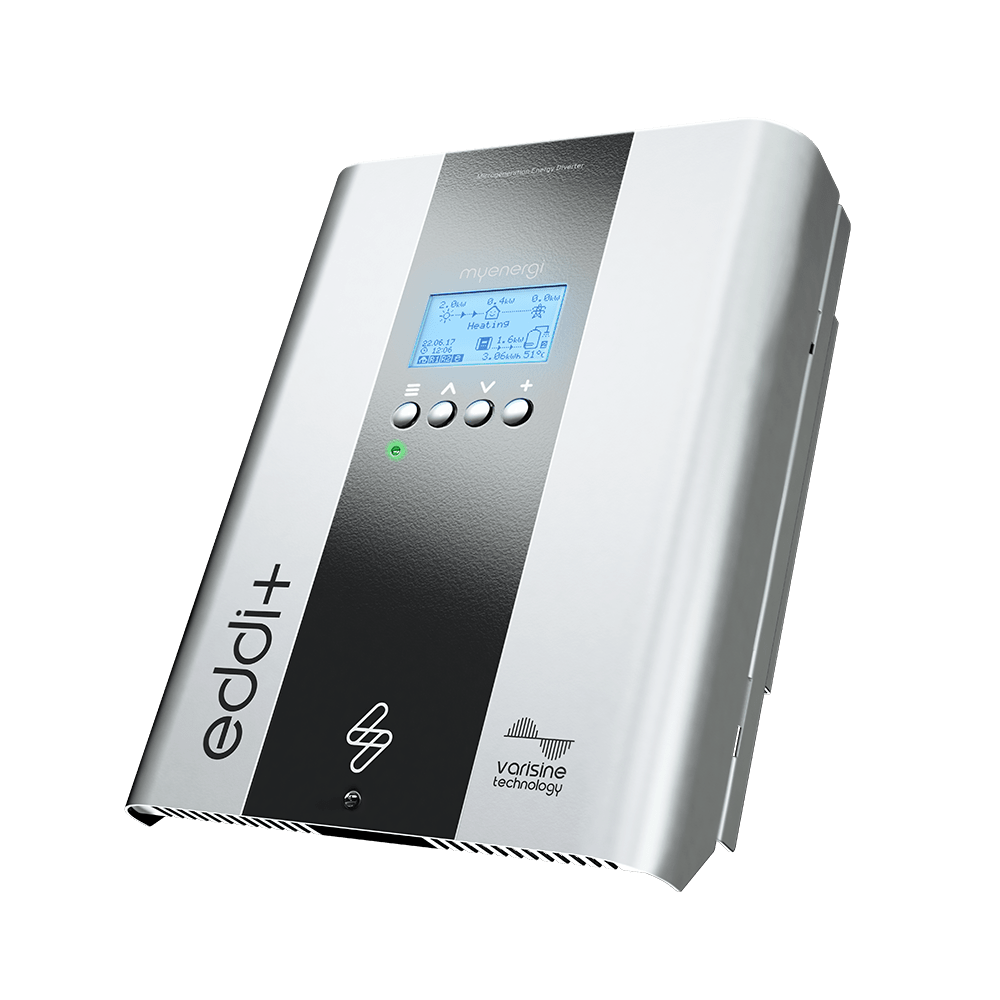
- myenergi eddiThe premium option, made in Britain. Plays nicely with the zappi EV charger and the myenergi app, and handles two heaters.
- Marlec Solar iBoost+The value pick. Simpler display, solid track record, cheapest installed price.
- Solic 200A no-frills fit-and-forget unit at the budget end.
We fit diverters as an add-on during solar installs and as a retrofit to existing systems, and we will tell you plainly if your setup will not generate enough surplus to justify one.
Want the sums run for your house?
Tell us how you heat your water and what your roof looks like. A feasibility assessment covers panels, battery and diverter together, with the honest answer on which combination pays. Over 1,000 installs across the East Midlands since 2011.
Book a feasibility assessmentFrequently asked questions
Can solar panels heat water directly?
Solar PV panels generate electricity, and a diverter routes the surplus into your cylinder's immersion heater, so the water is heated by your own solar electricity. That is different from solar thermal, which heats water in roof-mounted collectors. For most homes today, PV plus a diverter is the more flexible route.
Do solar diverters work with a combi boiler?
No. A combi heats water on demand and has no cylinder, so there is nothing for the diverter to fill. If you have a combi and solar panels, battery storage does the equivalent job of banking your surplus, storing it as electricity for the evening rather than as hot water.
How much does a solar diverter cost installed?
Typically a few hundred pounds. Published installer pricing puts the Solar iBoost+ around £350 to £500 fitted and the myenergi eddi around £550 to £750 fitted. Fitted alongside a new solar install it is cheaper than as a standalone visit, which is worth planning at the design stage.
Is a solar diverter worth it if I get paid for export?
It depends what heats your water. Replacing immersion heating at the full unit rate comfortably beats any export payment. Replacing cheap gas heating while giving up a strong export rate can be a near wash. The honest answer needs your tariff and your boiler type, which is a five minute conversation.
Will a diverter heat all my hot water in winter?
No, and be wary of anyone who says otherwise. Winter generation mostly gets used by the house itself, leaving little surplus to divert. From spring to autumn a 3kWp-plus system regularly heats a full tank. Across the year, treat diverted hot water as a strong seasonal bonus, not a year-round replacement.
Can I have a diverter and a battery?
Yes. Configure the battery to fill first and the diverter to take the remaining surplus. In summer both fill on good days. With a fixed budget and a choice of one, take the battery: it works all year and shifts far more of your bill than hot water alone.
Related reading
- Solar thermal vs solar PV: which heats water better?
- The benefits of solar battery storage
- Best SEG rates compared for 2026
- Solar PV with a heat pump: the full pairing guide
- How much do solar panels cost in the UK in 2026?
Straight answers on solar hot water
We are an MCS certified installer (NIC200223) based in Bulwell, Nottingham. Diverters, batteries or both, designed around how your home actually uses energy. Call 0115 773 7575, 8am to 8pm, Monday to Friday.
Get in touch