What Happens to Solar Panels in a Power Cut? (And How to Keep the Lights On)
A standard grid-tied solar system shuts down in a power cut. That is deliberate safety behaviour, not a fault. With a battery and an automatic changeover switch it does not: your home switches to battery power and the lights stay on. Spectrum fits whole-home backup for circa £1,500, or essential circuits for circa £400.
In This Guide
Why your solar panels switch off the moment the grid does
It surprises almost everyone. The roof is covered in panels, the sun may well be shining, and yet when the street loses power your house goes dark with everyone else’s.
The reason is a safety feature called anti-islanding protection. Every grid-connected inverter sold in the UK must disconnect automatically when it loses the grid, under the Energy Networks Association’s engineering recommendations G98 and G99. If your inverter kept exporting during a cut, it would energise a section of the local network that engineers believe is dead. Someone working on the line to restore your street’s power could be seriously hurt.
So a standard solar system, with no battery and no backup wiring, gives you nothing during a power cut. The panels are fine. The inverter is fine. It is simply doing what the regulations require: waiting for a stable grid signal before it reconnects, which it does automatically a few minutes after power is restored.
What happens second by second when the power goes off
Here is the sequence in a home with a standard solar system and no backup:
Second 0: the grid fails
A fault upstream cuts the supply to your street. Your lights go out along with everyone else’s.
Under a second later: the inverter disconnects
The inverter detects the loss of grid voltage and frequency and shuts its output down. That is the anti-islanding protection doing its job.
During the cut: nothing generates
The panels still produce DC energy in daylight, but the inverter will not convert or supply it. Your home has no power at all.
Power restored: automatic reconnection
Once the inverter sees a stable grid again it waits a short observation period, then reconnects and resumes generating on its own. No reset needed.
Now the same event in a home with a battery system and an automatic changeover switch:
Second 0: the grid fails
The changeover switch detects the loss of mains immediately.
Moments later: the house switches to battery
The changeover switch disconnects your home from the grid and connects it to the inverter’s backup output. There is a brief interruption while it changes over, long enough to notice, so it is not a seamless computer-grade UPS, but the lights, fridge and router come straight back.
During the cut: you run on stored energy
The battery supplies the house within its power and capacity limits. Because your home is safely isolated from the grid, this does not endanger network engineers.
Power restored: back to normal
The switch returns the house to mains supply and the system goes back to its everyday routine of solar charging and grid trading.
What you need to keep the lights on: battery plus the right switching
Panels alone will not do it. To ride through a power cut you need two things: a battery system with backup capability, and the switching that safely isolates your home from the grid while it runs.
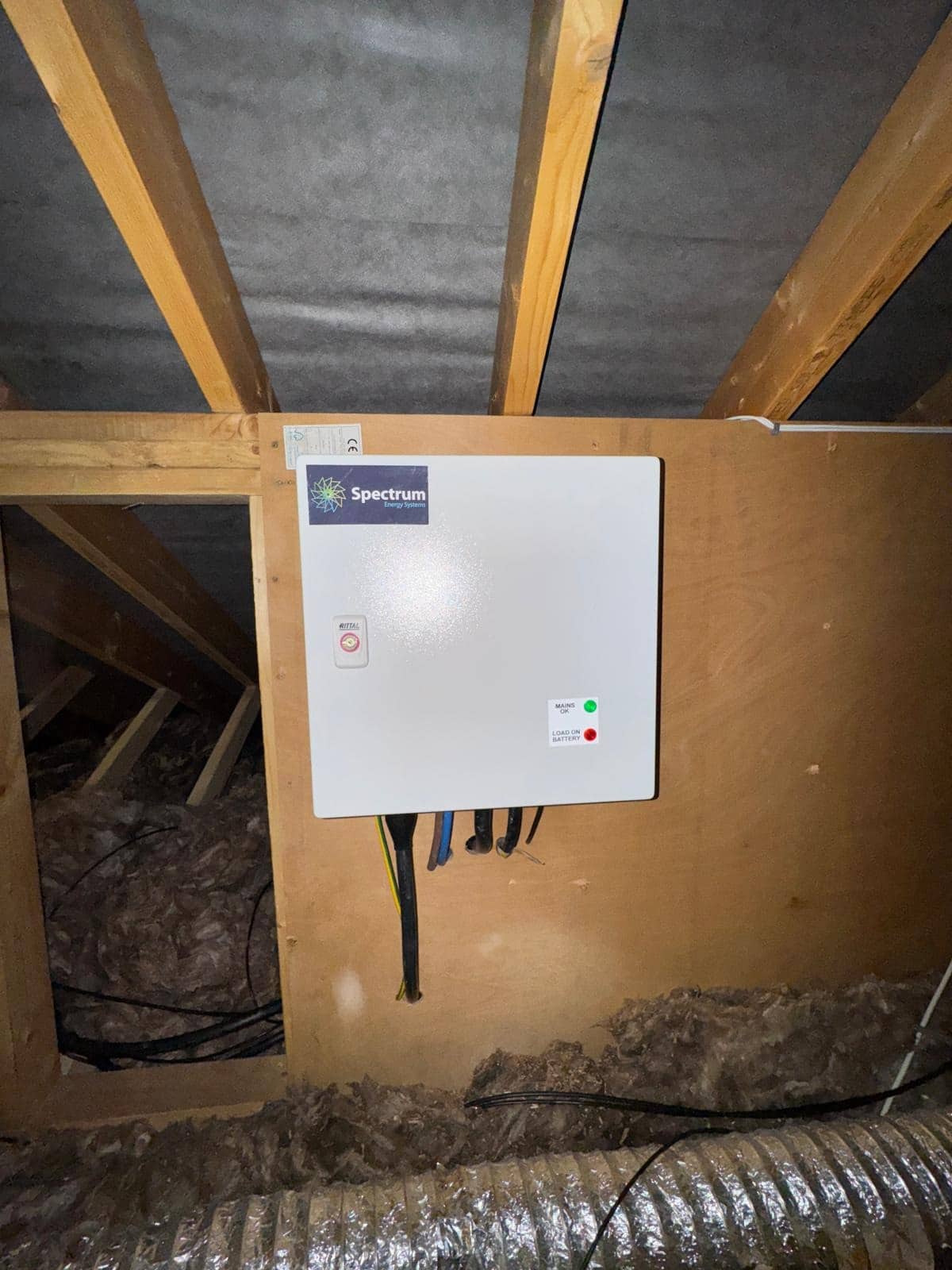
The automatic changeover switch
This is the whole-home option, pictured here in a customer’s loft with its two indicator lights: green for mains OK, red for load on battery. When the grid fails, the switch isolates the house and feeds every circuit from the battery instead. Spectrum supplies and installs the automatic changeover switch for circa £1,500 as a typical add-on to a battery installation.
The cheaper route is a dedicated essential-circuits backup at circa £400. Instead of backing up the whole house, we wire selected circuits, usually lights, fridge-freezer, boiler and router, to the inverter’s backup output. Those circuits stay on; everything else waits for the grid.
On the hardware side, our standard hybrid inverter and battery setup supports backup output when specified at design stage. Tell us backup matters to you before we design the system: it affects the inverter configuration and the wiring at the consumer unit, and it is far cheaper to include on install day than to retrofit later.
Want backup designed in from day one?
Tell us which circuits need to stay on and we will design the battery system and switching around it. Design and quote normally within 2 to 4 days.
Request a QuoteCan solar panels power a whole house in the UK?
Yes, during a power cut a solar and battery system can power a whole house in the UK, provided it has an automatic changeover switch fitted and you stay within the battery’s limits. The changeover switch feeds every circuit in the home from the battery, so nothing is off limits in principle. In practice, two numbers decide what you can actually run: the battery system’s power output and its stored capacity.
That is why the honest answer is “yes, within limits” rather than a flat yes. A battery that happily runs lights, fridge, boiler and television all evening will still trip out if you switch a 9kW electric shower on during a cut. Whole-home backup means every circuit is available, not that every appliance can run at once.
kW vs kWh: how much at once, and for how long
Two units get mixed up constantly, and they answer different questions:
- kW (kilowatts): how much at onceThe power the system can deliver at any moment. A kettle draws about 3kW while it boils. If the inverter’s backup output is 5kW, you can run about 5kW of appliances simultaneously before it cuts out.
- kWh (kilowatt-hours): how long forThe energy stored in the battery. One kWh runs a 1kW load for one hour. A 16.1kWh battery holds 16.1 of those units when full.
A worked example, illustrative rather than a promise. Say a power cut hits in the evening and your 16.1kWh battery is around 80 per cent full, so roughly 13kWh available. Your essentials, being the fridge-freezer, LED lights, broadband router, a laptop and the television, might average 400 to 500 watts between them. At that rate, 13kWh keeps the essentials running for more than 24 hours. Add an electric oven for an hour and you take a 2kWh bite out of the reserve; boil the kettle and it barely registers. The battery is rarely the thing that fails you in a UK power cut. Most cuts are over in minutes or hours, and even a long one gives a 16.1kWh battery a comfortable margin on essentials.
| Typical load during a cut | Approximate draw | Runtime on 13kWh available |
|---|---|---|
| Essentials only (fridge-freezer, lights, router, TV) | 0.4 to 0.5kW | Over 24 hours |
| Essentials plus gas boiler pump and controls | 0.5 to 0.6kW | Around a day |
| Essentials plus electric cooking | 2 to 3kW while cooking | Hours of cooking, days of essentials |
Figures are illustrative, based on typical appliance consumption; your own loads will differ. For choosing the right battery size for everyday savings rather than backup, see our guide to how much solar battery storage you need.
Power cuts are rare in the UK. Who should still plan for them?
Most UK homes see less than an hour of unplanned interruption in a typical year, and the network operators, National Grid Electricity Distribution across most of the East Midlands, keep the figures low. But rare is not never. Storm Arwen in November 2021 left around one million homes without power, and some rural properties waited more than a week for reconnection, as Ofgem’s review of the storm set out.
Backup earns its keep fastest for:
- Homes with medical equipmentAnything that needs mains power makes a cut more than an inconvenience. One thing to know before you buy: the changeover is not seamless, so there is a brief interruption before battery power takes over.
- Home workersRouter, laptop and monitor draw very little. A battery turns a lost afternoon of work into a non-event.
- Rural propertiesLong lines through open country fail more often and take longer to repair, exactly the pattern Storm Arwen exposed.
- Full freezersA chest freezer full of food is an expensive thing to lose in a two-day outage. A few hundred watts of backup keeps it frozen for as long as the battery holds out, and longer still if the system can recharge from the panels during the day.
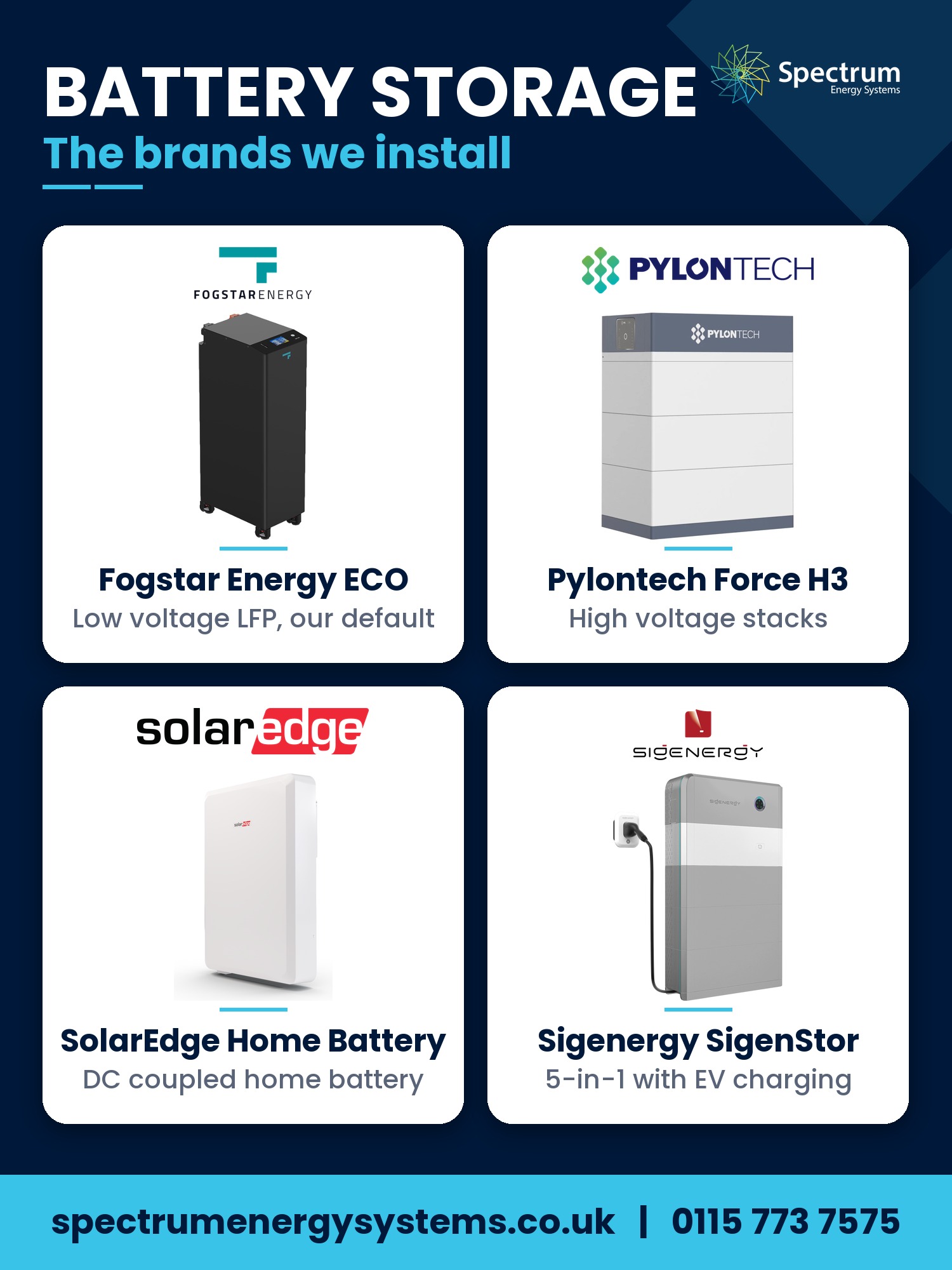
Backup is the bonus, not the whole case
A battery like the stack pictured here earns its living every single day by storing cheap or solar energy and using it at peak times. Riding through power cuts is the extra layer on top. That is why we treat backup as an add-on decision at design stage: the battery pays its way regardless, and circa £400 or circa £1,500 of switching decides how much of the house stays on when the grid goes down.
Every Spectrum installation is completed by our in-house crews under our MCS certification (NIC200223), with a 5-year workmanship guarantee backed by QANW insurance.
Frequently asked questions
Do solar panels work in a power cut?
No, not on their own. A standard grid-tied inverter must shut down when the grid fails, under ENA engineering recommendations G98 and G99, to protect engineers working on the network. To keep power during a cut you need a battery system with backup capability and a changeover switch or dedicated backup circuits.
Can solar panels power a whole house in the UK?
Yes, with a battery and an automatic changeover switch, which Spectrum fits for circa £1,500 as a typical add-on. Every circuit in the house is then backed up, within the battery’s power and capacity limits. High-draw appliances like electric showers can exceed those limits, so whole-home backup does not mean unlimited power.
Will my battery charge from solar during a power cut?
Often yes, but it depends on the system. Setups that support off-grid charging can recharge the battery from the panels while the grid is down, in daylight, which extends backup through a long outage. Not every configuration supports this, so tell your installer that outage resilience matters when the system is designed.
How long will a 16kWh battery last in a power cut?
Running essentials only, comfortably more than a day. A fridge-freezer, LED lighting, router and television average around 400 to 500 watts, so 13kWh of available charge covers over 24 hours. Heavy loads like electric cooking shorten that quickly. Figures are illustrative and depend on your appliances and the battery’s state of charge.
Is the switch to battery power instant?
No. An automatic changeover switch takes a brief moment to isolate the house and connect the battery, so there is a short interruption before power returns. It is quick, but it is not a seamless UPS, which matters if you run equipment that cannot tolerate any break at all.
Why does my inverter take a few minutes to restart after a cut?
That is normal. G98 and G99 require the inverter to watch for a stable grid voltage and frequency before reconnecting, so it waits a short observation period after power is restored. It restarts and resumes generating automatically; no manual reset is needed.
Can I add backup to an existing solar system?
Usually, yes. If you already have a hybrid inverter and battery, adding a changeover switch or essential-circuits wiring is a straightforward job. If you have panels only, you would add a battery system first. Spectrum also takes over systems fitted by other installers, so the original company disappearing is not a barrier.
Related reading
- How much solar battery storage do I need?
- The benefits of solar panel battery storage
- Hybrid vs string inverters explained
Or start with the bigger picture on our domestic battery storage page.
Keep the lights on next time the street goes dark
Spectrum Energy Systems designs battery systems with backup built in, from essential circuits at circa £400 to whole-home changeover at circa £1,500. MCS certified (NIC200223), installed by our own crews from Bulwell, Nottingham.
Book a Feasibility Assessment