

Solar Panel Direction and Angle in the UK: The Real Numbers for Your Roof
South-facing panels at 35 to 40 degrees make the most electricity over a year in the UK, and most roofs are not that. It matters less than people fear. For a Nottingham postcode the MCS table puts a south-east or south-west roof at 94 per cent of south, east or west at 80 per cent and a flat roof at 84 per cent. North is just over half. Your quote is built on your roof’s actual direction and pitch.
In This Guide
Why south wins at UK latitudes
Nottingham sits at 52.95 degrees north, and from here the sun is never overhead. At midday on the longest day it reaches about 60 degrees above the horizon, on the shortest day about 14 (timeanddate.com figures for Nottingham). It rises in the east, arcs through the southern sky and sets in the west. A south-facing panel meets that arc squarely for the longest stretch of the day, which is why south collects the most energy over a year.
The best fixed angle follows from the same geometry. Run PVGIS, the European Commission’s solar calculator, for Nottingham at its default 14 per cent system losses and it returns an optimum tilt of 41 degrees, pointing 5 degrees east of south, at 983 kWh per installed kilowatt a year. At 35 degrees the figure is 980. The top of the curve is flat, so being 10 degrees off the optimum costs almost nothing.
Every direction rated with real numbers
The MCS column is the kWh per kWp value, known as Kk, that an MCS installer uses on your performance estimate, read from the MCS Irradiance Datasets for postcode zone 11 (NG postcodes) at a 35 degree pitch. The PVGIS column is the raw European Commission model for Nottingham at the same pitch. MCS figures run lower because the standard uses an older PVGIS dataset (Climate-SAF) multiplied by a flat 0.8, which comes out more cautious than the current PVGIS model.
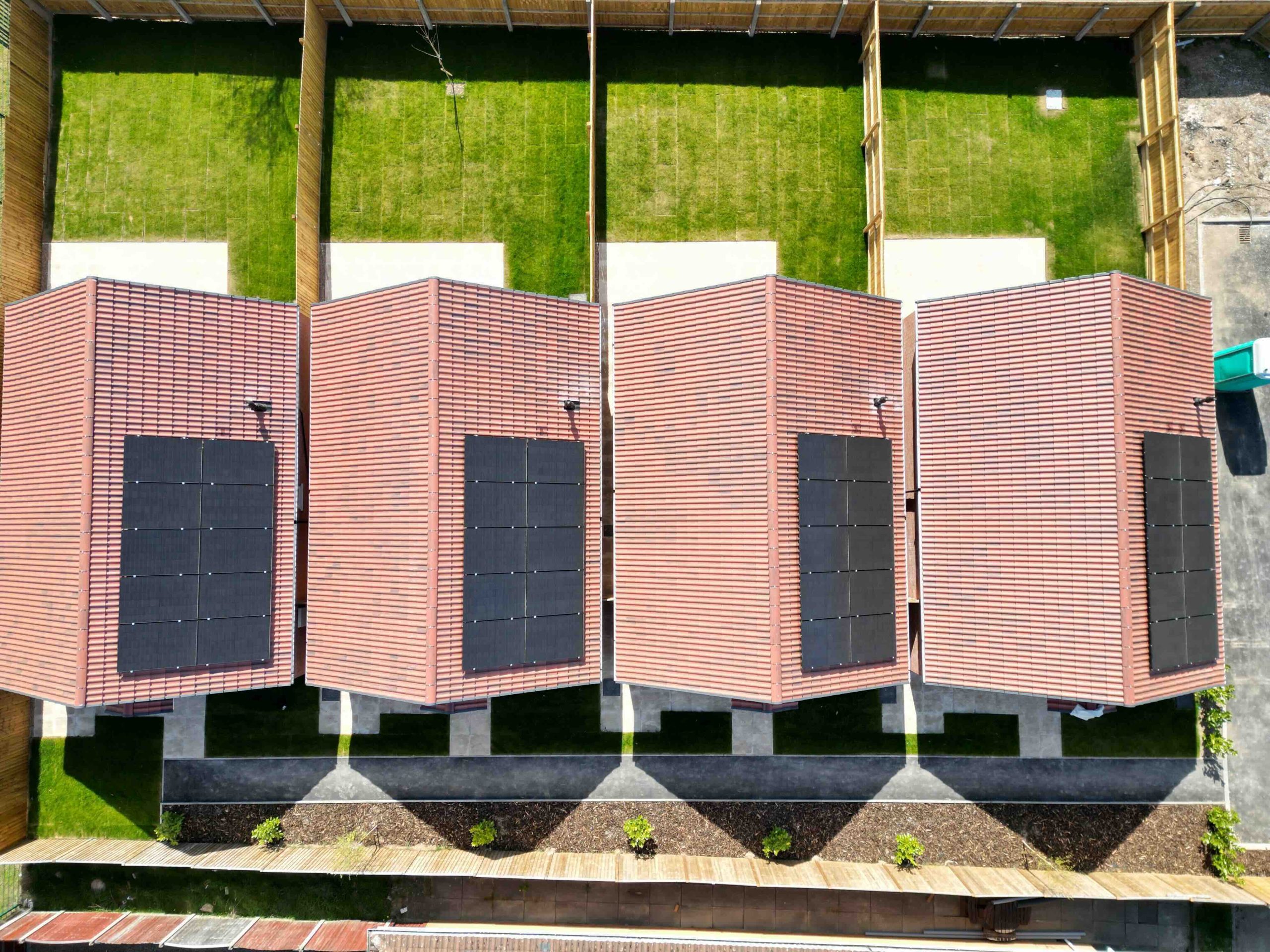
The estate pictured is typical: four new-build homes, every array on the same slope, because the design starts from where the roof points.
| Roof faces | MCS zone 11 Kk (kWh/kWp) | PVGIS Nottingham (kWh/kWp) | Against south |
|---|---|---|---|
| South | 892 | 980 | 100% |
| South-east or south-west | 840 | 913 to 928 | 93 to 95% |
| Due east or due west | 711 | 762 to 782 | 78 to 80% |
| Flat (0 degrees) | 750 | 810 | 83 to 84% |
| North | 497 | 524 | 53 to 56% |
Anything from south-east round to south-west is within a few per cent of the ideal. East and west give up a fifth, matching the Energy Saving Trust guidance that an east or west facing system gets around 15 to 20 per cent less than south. Panels laid flat on a flat roof beat east or west.
East-west splits: how we design them
A house whose ridge runs north to south has an east slope and a west slope, and we put panels on both. It is one of the most common domestic designs we install, and it works because of how a hybrid inverter is built.
The Solis hybrid inverters we fit as standard have two MPPT trackers, each with its own string input (Solis S6-EH1P-L-PLUS datasheet). The east string goes on one tracker and the west string on the other, so each face is optimised on its own and the morning-heavy east array never drags the afternoon-heavy west array down.
A south array peaks hard at midday and tails off either side. An east-west pair starts earlier, finishes later and runs flatter through the middle. Over a year the total is around 80 per cent of what the same panels would make facing south, and the share you use directly is often higher, because breakfast and evening are when most homes draw power. A Fogstar battery then carries the midday surplus into the evening.
We size a 6 kW Solis hybrid for up to 9 kWp of panels, so ten panels east and eight west on 500 W modules sit comfortably on one inverter. For the consumption side, see our guide to how many solar panels a UK home needs.
✓ What an east-west split gives you
- Generation spread from early morning to evening instead of a midday spike
- A higher share of your own power used directly in a breakfast-and-dinner household
- Each face on its own MPPT tracker, so neither slope limits the other
✗ What it costs you
- Annual total around 80 per cent of the same panels facing south
- More roof area needed for the same annual kWh
- A lower summer midday peak, so less export at the sunniest hour
Tilt: why 35 degrees is normal
Tilt sets how squarely the panel meets the sun’s average height. The PVGIS curve for a south-facing panel in Nottingham runs: flat 810 kWh/kWp (83 per cent), 10 degrees 883 (90), 20 degrees 937 (96), 30 degrees 971 (99), 35 to 45 degrees 980 (the top), 60 degrees 942 (96), vertical 722 (74). Anything from 20 to 60 degrees is within 5 per cent of the best figure.
Most British roofs already sit in that range: 30 degrees is the standard modern domestic pitch, plain clay and concrete tiles need at least 35 degrees under BS 5534, and Victorian and older houses commonly run 35 to 45. Panels go on parallel to the roof, on hooks and rails, so the angle question answers itself.
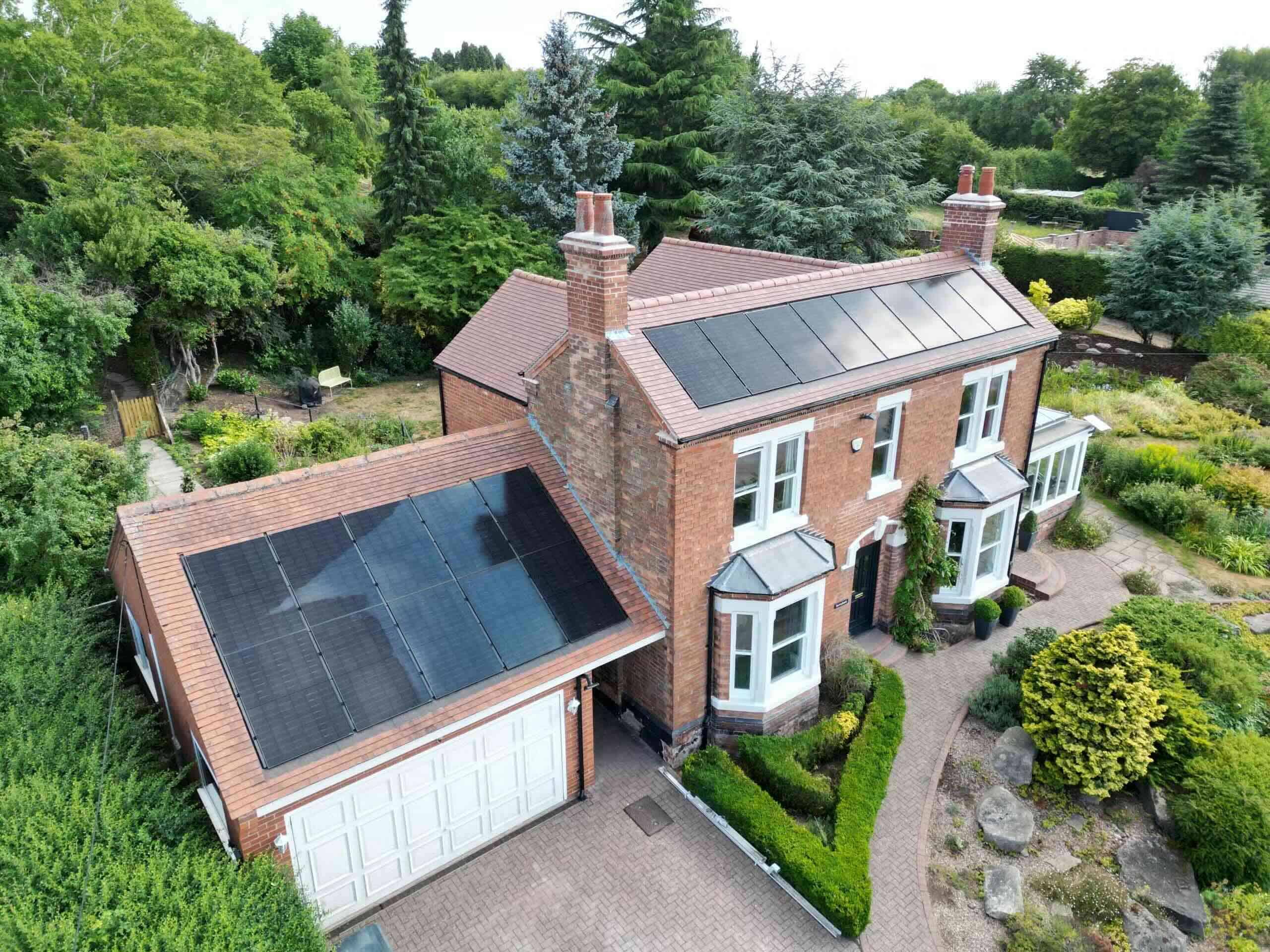
The house pictured has its main array on the main roof and a second on the shallower garage roof, and both pitches sit in the flat part of the curve. We do not fit tilt frames on pitched roofs: lifting panels off the slope to chase a few degrees adds wind load, looks poor and breaches the 200 mm projection limit that keeps a domestic install inside permitted development (Planning Portal). A steep roof is no problem either. A 50 degree pitch gives a little less in summer and a little more in winter, when the sun is low, and our guide to whether solar panels work in winter covers what the cold months produce.

Flat roofs: tilt frames or not
A flat roof is the one place tilt is a design choice. Five degrees or less is flat and gets a ballasted frame system. Anything steeper is treated as a pitched roof and clamped roof-parallel, because you cannot ballast a slope.
On a flat roof we use Esdec FlatFix frames held down with ballast blocks, no roof penetrations, with the panels at a fixed shallow tilt of about 11 to 13 degrees. That is deliberately lower than the textbook 35. A low frame needs far less ballast, which matters on a roof with a weight limit, shallow rows shade each other less so more panels fit, and the frame stays inside the 600 mm height that permitted development has allowed on flat roofs since December 2023.
The cost in yield is modest. PVGIS puts a south-facing panel at 13 degrees in Nottingham at 901 kWh/kWp, 92 per cent of the 35 degree figure. An east-west pair of frames at the same tilt comes out around 800, and on a flat roof that is often the better layout because the panels pack tighter. The 35 kW system on Johns of Nottingham’s flat roof in Mapperley was built this way.
A low-pitch metal-clad commercial roof is a different job: at around 10 degrees the panels are clamped to the roof sheet and lie at the roof’s own pitch, as on the 56 kW Jacksons Nurseries install in Bagnall. Either way the estimate uses the pitch the panels end up at.
Not sure which way your roof faces, or at what pitch?
We measure orientation and pitch at the site survey, model the shade and price one all-inclusive system. Design and quote normally within 48 hours of the survey. Call 0115 773 7575.
Book a feasibility assessmentHow the MCS estimate treats your roof
Every MCS installer must give you a performance estimate before you sign, and the method is fixed by MIS 3002, the MCS solar PV standard. Direction, angle and shade are its three site inputs. This is how the number on a Spectrum quote is built.
Step 1: Array size
Add up the rated wattage on the panel labels to get the array size in kWp.
Step 2: Postcode zone
The zones follow the SAP postcode zones. NG and LN postcodes are zone 11, the Sheffield table (S postcodes, where our Sheffield solar panel installers work, sit in zone 11 too); DE and LE are zone 6, the Birmingham table. Zone 6 gives a south roof at 35 degrees 935 kWh/kWp against 892 in zone 11, so a Derby house and a Nottingham house with identical roofs get different estimates.
Step 3: Orientation and pitch
Orientation is measured in degrees from due south, rounded to the nearest 5; pitch from horizontal, rounded to the nearest 1. Those two numbers pick the Kk value out of the zone table.
Step 4: Shade factor
A clear horizon scores 1.00. Otherwise the loss is assessed by the MCS shade method in MGD 005 and the estimate becomes kWp × Kk × shade factor.
An installer cannot flatter a north-facing roof: the table value is the table value, and it sits below the current PVGIS model for every direction. If a roof has been assessed from aerial imagery without a site visit, the standard requires the estimate to say so, because a pitch read off a photo can be a few degrees out. Our estimate uses the real pitch and azimuth from the survey, stated in the standard’s own format: orientation, inclination, zone, Kk, shade factor, annual kWh. The standard also requires a note that output cannot be predicted with certainty, which is why we never quote a saving as a guarantee.
What matters more than the compass
Shade comes first. The Energy Saving Trust puts it plainly: a south roof shaded through the day can produce less than an east or west roof in full sun. Shade is also the one input that needs a site visit.
Roof space comes second. A west roof that takes twelve panels beats a south roof that takes six, because the estimate is per kilowatt installed. Usage timing comes third, which is where a battery and the east-west split earn their keep.
A north-only roof is the one case where the compass wins, at just over half of south. There we look at the garage, an outbuilding or a ground-mounted array, which can be set to any direction and tilt.
Frequently asked questions
What is the best direction for solar panels in the UK?
South, pitched at 35 to 40 degrees, gives the highest annual output. For a Nottingham postcode the MCS table puts south-east and south-west at 94 per cent of south and due east or due west at 80 per cent. Most UK roofs are viable, and your quote’s estimate uses your roof’s actual direction and pitch.
What angle should solar panels be at in the UK?
Anything between 30 and 45 degrees is within a per cent or two of the best figure. PVGIS returns 41 degrees as the optimum for Nottingham. Most pitched roofs fall in that range, so panels are mounted parallel to the roof. Flat roofs use ballasted frames at a shallow 11 to 13 degrees for wind loading and row spacing.
Are east-west solar panels worth it?
Yes, and we install them regularly. Each face runs on its own MPPT tracker inside the Solis hybrid inverter, generation runs from early morning to evening, and the annual total is around 80 per cent of the same panels facing south. In a home that uses power at breakfast and dinner the useful share is often higher.
Do solar panels work on a west-facing roof?
Yes. A west roof in Nottingham gives about 78 to 80 per cent of a south roof over a year on both the PVGIS and MCS zone 11 figures, with the output shifted into the afternoon and evening when most households are home. A battery stores the earlier part of the day for later.
Can solar panels go on a north-facing roof?
They can, and the numbers are poor: 497 kWh/kWp at 35 degrees in MCS zone 11, which is 56 per cent of south, and steeper north roofs fall further. We normally look at another roof slope, a garage or a ground-mounted array first. Where north is the only option the estimate shows the shortfall before you commit.
Do I need planning permission for solar panels at a different angle to my roof?
Usually not, provided the install stays within permitted development: no more than 200 mm proud of a pitched roof, no higher than the ridge, and no more than 600 mm above a flat roof. Conservation areas add a rule about slopes fronting a highway, and listed buildings need consent. Anything outside those limits needs an application.
Related reading
- How to install solar panels on the ground in the UK
- Do solar panels work in winter?
- How many solar panels do I need?
- Solar panels in conservation areas
For kit, pricing and what an install involves, see our domestic solar overview.
Get the numbers for your roof
Spectrum Energy Systems is an MCS certified installer (NIC200223), NICEIC Approved Contractor (3182878) and RECC member (00080159), based at Unit 19 Pottery Court, Pottery Way, Bulwell, Nottingham, NG6 8YN, installing across the East Midlands since 2011 with over 1,000 systems fitted. Solis hybrid inverters, Fogstar batteries, Tier 1 panels and a 5-year workmanship guarantee. Call 0115 773 7575.
Request a feasibility assessment