Solar Panel Direction and Angle in UK: Complete Positioning Guide
Getting solar panel direction and angle right can mean the difference between good performance and optimal performance. Whilst south-facing at 30-40° delivers the best results, the reality is that most UK roofs—including east, west, and even some north-facing aspects—can still generate excellent energy output with proper system design.
This comprehensive guide explains exactly how orientation and tilt affect output, what you can realistically expect from your roof, and why even "non-ideal" setups often perform better than many people expect.
Quick Answer: Optimal UK Solar Panel Positioning
In This Guide
- Why Direction and Angle Matter
- The Ideal Direction: South-Facing
- East and West-Facing Panels
- North-Facing Panels: Should You Bother?
- The Optimal Angle (Tilt) for UK
- Working with Your Existing Roof Pitch
- Flat Roof Solar Panel Positioning
- Shading: The Critical Factor
- Direction and Efficiency Reference Guide
- Adjusting for Specific Goals
- Real-World Examples
- Planning Permission and Regulations
- Frequently Asked Questions
Understanding solar panel positioning is essential whether you're a homeowner exploring domestic solar installation or a business owner considering commercial solar panels. At Spectrum Energy Systems, established in 2011, we've designed and installed hundreds of systems across the East Midlands, optimising output for every roof type from perfect south-facing pitches to complex multi-aspect configurations.
The good news? Whilst optimal positioning maximises generation, even sub-optimal setups typically deliver strong performance. Understanding the science helps you make informed decisions and set realistic expectations for your specific property.
Not Sure About Your Roof's Suitability?
Our MCS-accredited engineers provide free site assessments with detailed shading analysis and output projections tailored to your property
Get Your Free Assessment Speak to Our TeamWhy Direction and Angle Matter
Understanding which way should solar panels face is fundamental to system performance. Solar panels generate electricity by capturing sunlight—and how much they capture depends largely on how directly that sunlight hits the panel surface. The angle of incidence (the angle at which sunlight strikes the panel) determines energy absorption efficiency. When sunlight hits perpendicular to the panel surface, maximum energy transfer occurs.
The UK's Position and Sun Path
The UK sits between 50°N and 60°N latitude, meaning the sun is always to our south, never directly overhead. Throughout the day, the sun traces an arc from east to west, reaching its highest point due south at solar noon. This fundamental geography explains why south-facing panels capture the most energy—they face the sun during its strongest hours. The solar panel azimuth angle (compass direction) is measured in degrees from north, with 180° representing true south.
Seasonal variation adds complexity. In summer, the sun rises northeast and sets northwest, climbing to approximately 60° above the horizon at midday. In winter, it rises southeast and sets southwest, reaching only 15-20° at its peak. Understanding how efficient solar panels are in different conditions helps set realistic expectations throughout the year.
Impact on Energy Generation
The difference between optimal and sub-optimal positioning can represent 20-40% variation in annual output. However, this doesn't mean non-ideal roofs are unsuitable—it simply means adjusting expectations and potentially system sizing. A west-facing 4kW system generating 3,200 kWh annually still delivers substantial energy production that significantly reduces grid dependence.
The Ideal Direction: South-Facing
South-facing installations represent the gold standard for UK solar, capturing direct sunlight throughout the day's peak generation hours. With the sun tracking across the southern sky, south-facing panels receive maximum irradiance from morning through afternoon.
Why South Is Best
A true south orientation (180° azimuth) maximises annual generation because panels face the sun during its highest and most intense position. This alignment captures peak irradiance during midday hours when solar intensity is greatest, providing consistent performance year-round regardless of seasonal variations.
South-facing systems typically generate 850-1,000 kWh per kWp installed annually in the East Midlands—meaning a 4kW system produces approximately 3,400-4,000 kWh per year. This baseline helps compare alternative orientations and understand expected performance. Our homeowner's guide to solar panels provides detailed information on what to expect from your installation.
True South vs Magnetic South
Important distinction: compass readings show magnetic south, which differs from true (geographic) south by approximately 1-2° in the UK (this is called magnetic declination). Whilst this small difference has minimal practical impact, professional installers account for it during system design using GPS and mapping tools rather than relying solely on compass readings.
Tolerance Range: Southeast to Southwest
The excellent news is that orientations within 45° either side of true south perform remarkably well:
- Southeast (135°): 95-98% of south-facing output—morning generation bias
- True South (180°): 100% baseline—optimal midday generation
- Southwest (225°): 95-98% of south-facing output—afternoon generation bias
These minor losses often prove insignificant when weighed against installation practicalities. If your roof faces southwest at 210°, you're looking at approximately 97% efficiency—hardly worth restructuring your roof over.
East and West-Facing Panels
East and west orientations typically generate around 80% of south-facing output—and in many scenarios, this configuration actually offers advantages. Understanding when and why east-west makes sense helps evaluate your specific situation. Choosing the right solar panel for your orientation further optimises performance.
East-Facing Performance
East-facing panels capture morning sunlight, generating peak output between sunrise and early afternoon. Annual generation typically reaches 680-850 kWh per kWp—approximately 80% of south-facing equivalent. This orientation suits households with high morning electricity usage: electric showers, breakfast cooking, home offices starting early, or EV charging overnight into morning.
West-Facing Performance
West-facing panels excel during afternoon and evening hours, generating peak output from midday through sunset. Like east-facing, expect 680-850 kWh per kWp annually. This orientation benefits households with evening-heavy usage patterns: cooking dinner, entertainment systems, EV charging after work, or heat pump operation during evening hours.
East-West Split Systems
Installing panels on both east and west-facing roof aspects creates extended generation hours—capturing sunlight from sunrise to sunset rather than concentrating output around midday. This configuration offers several advantages:
- Extended generation window: Useful output for more hours daily
- Flatter generation curve: More consistent output rather than midday peak
- Better self-consumption: Generation aligns with morning and evening usage
- Comparable total output: Combined east-west often matches south-facing totals
- Battery storage synergy: Pairs excellently with home battery storage
When East-West Makes Sense
For properties with significant morning and evening electricity demand, east-west configurations can actually deliver better results than south-facing—despite lower total generation. Higher self-consumption rates (using generated electricity directly rather than exporting) mean you benefit more from each kWh generated.
North-Facing Panels: Should You Bother?
North facing solar panels UK installations present the greatest challenge, generating approximately 50-60% of south-facing output. Whilst this represents a significant reduction, it doesn't automatically disqualify solar as an option for properties with only north-facing roof space.
North-Facing Reality
North-facing panels receive only diffuse and reflected light rather than direct sunlight, substantially reducing energy capture. Annual generation typically reaches 425-600 kWh per kWp—roughly half of optimal south-facing output. This reduced performance means careful assessment is essential before proceeding.
When North Might Work
Despite reduced output, north-facing solar can make sense in specific circumstances:
- Part of multi-aspect arrays: Combined with south, east, or west-facing panels
- Excess roof space: When other aspects are already maximised
- Commercial installations: Large-scale systems where marginal generation adds value
- Environmental priorities: Where carbon reduction is the primary goal
Better Alternatives to Consider
Before committing to north-facing installation, explore alternatives:
- Ground-mounted systems: Achieve optimal south-facing orientation regardless of roof
- Garage or outbuilding roofs: Often have different orientations than main buildings
- Flat roof sections: Can install tilted, south-facing frames
- Carport structures: Purpose-built with optimal orientation
Our expert solar fitting team can assess all options for your property, ensuring you maximise output from available space.
The Optimal Angle (Tilt) for UK Solar Panels
Determining the best tilt angle solar panels UK should be set at is crucial for maximising annual generation. Tilt angle—the angle between your panels and the horizontal—significantly affects output. Getting this right is equally important as direction.
Best Year-Round Angle by Region
The optimal tilt angle approximates your latitude, balancing summer and winter sun positions. Professional installers use solar panel angle calculator tools to determine precise angles for your location:
| UK Region | Latitude | Optimal Tilt | Typical Generation |
|---|---|---|---|
| Southern England | 50-51°N | 30-35° | 950-1,050 kWh/kWp |
| Midlands & Wales | 51-53°N | 32-38° | 900-1,000 kWh/kWp |
| Northern England | 53-55°N | 35-40° | 850-950 kWh/kWp |
| Scotland | 55-60°N | 38-42° | 800-900 kWh/kWp |
For installations across Nottinghamshire, Derbyshire, Leicestershire, and Lincolnshire, 32-38° typically delivers optimal results. Fortunately, most UK roof pitches naturally fall within 30-45°, making flush-mounted installation on existing roofs highly effective.
Efficiency by Tilt Angle
Understanding how different angles affect output helps evaluate your roof's suitability:
| Tilt Angle | Efficiency vs Optimal | Notes |
|---|---|---|
| 0° (Flat) | 80-85% | Requires tilted mounting frames |
| 10° | 85-90% | Very shallow pitch |
| 20° | 92-96% | Low pitch roof |
| 30° | 98-100% | Optimal range begins |
| 35° | 100% | Ideal for most UK locations |
| 40° | 98-100% | Optimal range continues |
| 45° | 96-98% | Steeper pitch, still excellent |
| 50° | 92-96% | Better winter performance |
| 60° | 85-90% | Very steep, reduces summer output |
Seasonal Angle Considerations
The seasonal solar panel angle requirements vary dramatically throughout the year. In summer, when the sun reaches 60° above the horizon, a lower tilt (20-25°) would be optimal. In winter, with the sun at only 15-20°, steeper angles (50-60°) capture more light. Fixed installations compromise at 30-40° to balance annual generation.
For most residential installations, adjustable mounting systems add unnecessary complexity. The modest gains don't justify additional maintenance requirements. However, some agricultural solar installations and ground-mounted commercial systems may benefit from seasonal adjustment or single-axis tracking.
Wondering What Your Roof Can Achieve?
Our free site surveys include detailed output projections based on your exact roof orientation, pitch, and shading conditions
Request Free Survey Our Installation ServicesWorking with Your Existing Roof Pitch
Understanding your solar panel roof pitch requirements is essential for installation planning. Most UK homes feature roof pitches between 30° and 45°—conveniently close to optimal for solar. Here's how your existing pitched roof solar panel orientation affects performance.
Common UK Roof Pitches
Traditional UK construction typically features:
- 30-35°: Common on modern houses—ideal for solar
- 40-45°: Victorian and Edwardian properties—excellent performance
- 20-25°: Some bungalows and extensions—90-95% efficiency
- 45-50°: Steeper traditional builds—96-98% efficiency
- Under 15°: Flat roofs and some modern designs—consider tilted frames
When to Accept Sub-Optimal Angles
Installing flush-mounted panels on existing roofs—even at non-optimal angles—often makes better sense than complex frame systems:
- Aesthetic appearance: Flush mounting looks cleaner, often preferred for planning
- Reduced wind loading: Lower risk of storm damage
- Simpler installation: No additional mounting hardware required
- Simplified maintenance: Easier access and inspection
- Minimal efficiency loss: 20-50° range achieves 92%+ of optimal
Unless your roof pitch falls below 15° or above 55°, flush mounting typically represents the best approach. The efficiency losses rarely justify additional complexity of angled frames. Learn more about the solar panel installation process to understand what's involved.
Flat Roof Solar Panel Positioning
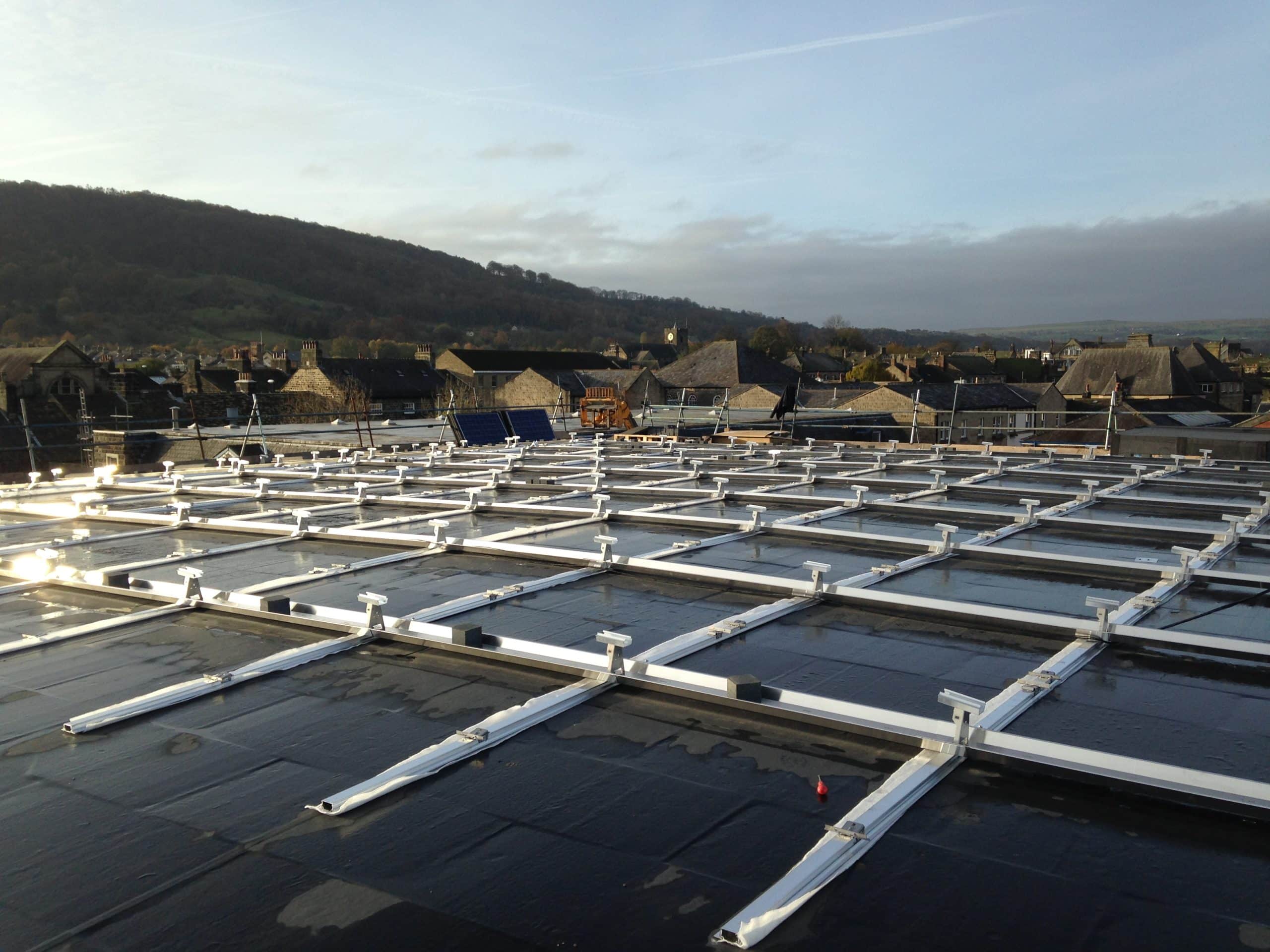
Choosing the right flat roof solar panel angle is crucial for maximising generation. Flat roofs (typically 0-10° pitch) present unique opportunities and challenges. Without natural tilt, flat-mounted panels achieve approximately 80-85% of optimal efficiency due to poor angle of incidence and self-cleaning issues. However, flat roofs also offer flexibility—you can orient panels optimally regardless of building orientation.
Tilted Mounting Systems
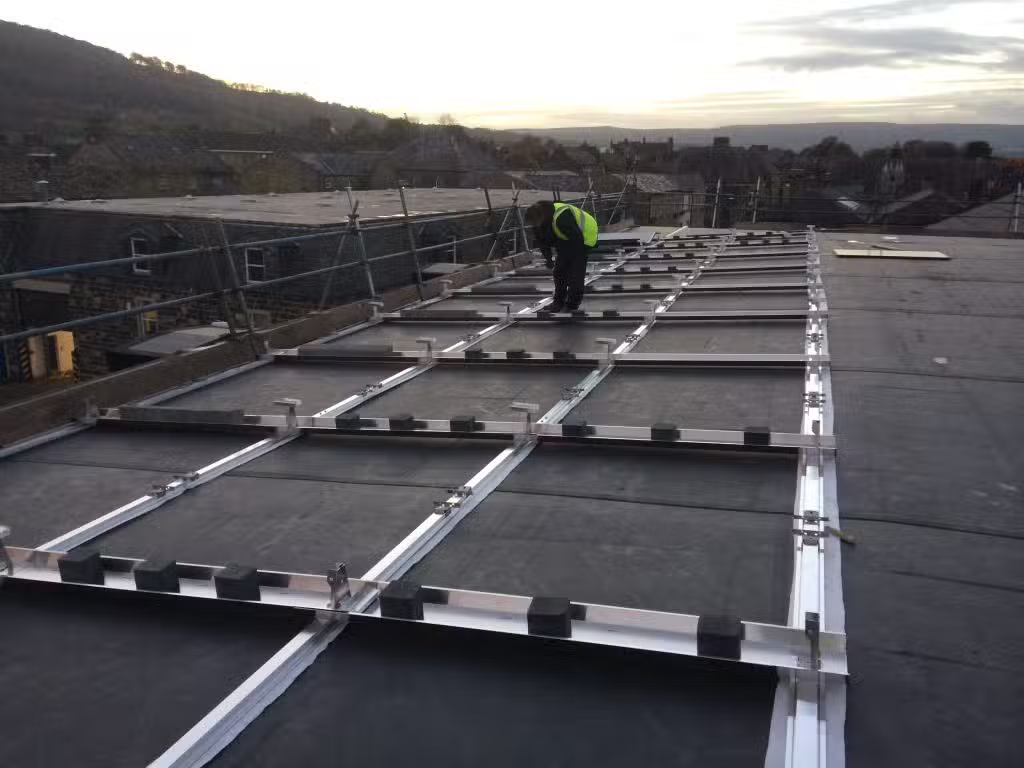
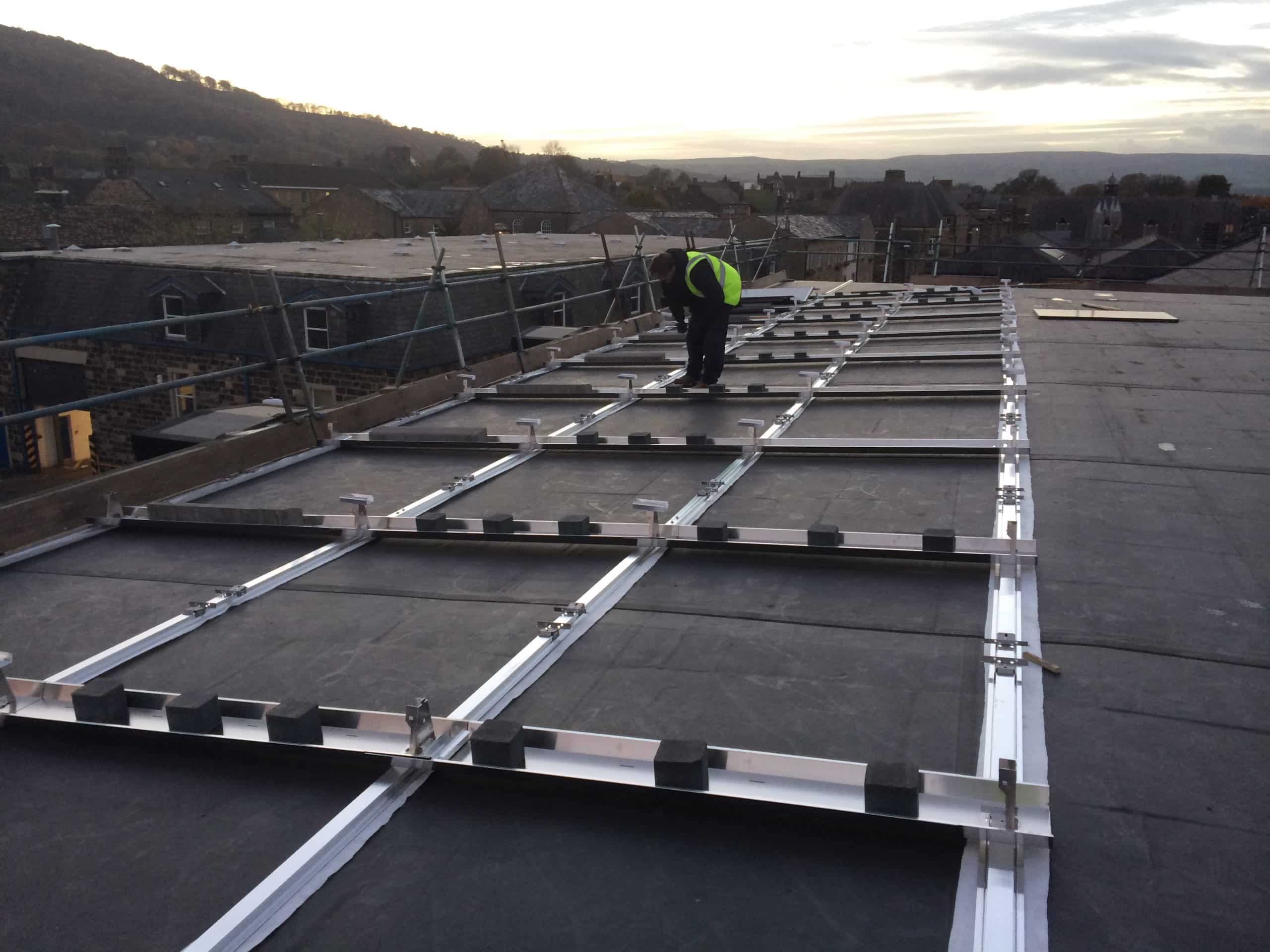
For flat roof installations, tilted mounting frames transform performance:
- Ballasted systems: Heavy frames held in place by weight—no roof penetration required
- Fixed angle frames: Typically 10-30° tilt, bolted to roof structure
- Adjustable mounts: Allow seasonal angle changes (rare for residential)
Tilted frames on flat roofs can achieve south-facing orientation regardless of building direction—a significant advantage for properties where the main pitched roof faces unfavourably.
Space and Shading Trade-offs
Higher tilt angles require greater row spacing to prevent panels shading each other. This creates trade-offs between angle optimisation and total installed capacity:
- 10° tilt: Minimal spacing needed—maximum panels fit
- 20° tilt: Moderate spacing—good efficiency compromise
- 30° tilt: Optimal efficiency but reduced panel count
For commercial flat roofs, professional design software calculates optimal configurations balancing tilt angle, row spacing, and total system capacity. Our commercial building solar solutions include detailed flat roof system design.
Shading: The Critical Factor
Shading affects solar output more dramatically than any orientation compromise. Even partial shading on a few panels can significantly reduce entire system performance, particularly with traditional string inverter configurations.
Impact of Shading
With string inverters, panels wired in series operate at the output of the weakest panel. A single shaded panel can reduce entire string output by 30-50%. Morning or afternoon shade, seasonal tree shadows, and chimney shadows all create cumulative losses that compound over time.
Common Shading Sources
- Trees and vegetation: Consider growth over 25+ year system life
- Neighbouring buildings: Especially relevant in urban areas
- Chimneys and roof features: Create predictable shadow patterns
- Satellite dishes and aerials: Often overlooked but impactful
- Future developments: Planning applications nearby
Mitigation Solutions
Modern technology addresses shading challenges effectively:
- Micro-inverters: Each panel operates independently—shading affects only shaded panels
- Power optimisers: DC-DC converters allowing independent panel operation
- Strategic panel placement: Avoiding shaded areas entirely
- Tree management: Trimming or removing problem vegetation
Professional shading analysis using specialised software models shadow patterns throughout the year, informing system design decisions. Understanding common solar panel problems helps avoid issues before installation.
Important: Shading Assessment Essential
Never install solar panels without proper shading analysis. A seemingly minor obstruction can cause disproportionate output losses. Our MCS-accredited engineers conduct thorough assessments using industry-standard tools, ensuring accurate performance predictions before you commit to installation.
Direction and Efficiency Reference Guide
Understanding solar panel efficiency by direction UK helps assess expected output. This comprehensive reference table shows how orientation affects generation:
| Azimuth | Direction | Efficiency vs South | Annual kWh/kWp (typical) |
|---|---|---|---|
| 0° / 360° | North | 50-60% | 425-600 |
| 45° | Northeast | 65-75% | 550-750 |
| 90° | East | ~80% | 680-850 |
| 135° | Southeast | 95-98% | 810-980 |
| 180° | South | 100% | 850-1,000 |
| 225° | Southwest | 95-98% | 810-980 |
| 270° | West | ~80% | 680-850 |
| 315° | Northwest | 65-75% | 550-750 |
Note: Figures represent typical East Midlands performance. Actual results vary based on specific location, shading, and system quality.
Adjusting for Specific Goals
Your optimal configuration depends on what you're trying to achieve. Different goals suggest different positioning strategies.
Maximising Self-Consumption
If using generated electricity directly (rather than exporting) is priority, consider east-west configurations that spread generation across more hours. Pairing with battery storage further increases self-consumption rates by storing midday surplus for evening use.
Maximising Total Generation
For maximum kWh output, prioritise south-facing at 30-40° tilt. This configuration captures peak irradiance during the sun's strongest hours, generating maximum total energy over the system's lifetime.
Winter Performance Priority
If winter generation matters most (perhaps for heat pump integration), steeper angles (45-50°) capture low winter sun more effectively. This trades some summer output for improved December-February performance.
Real-World Examples
These scenarios illustrate typical installations across the East Midlands:
Example 1: Perfect South-Facing at 35°
A 4kW system in Nottinghamshire on a 35° south-facing roof generates approximately 3,700-3,900 kWh annually. This represents baseline optimal performance for the region.
Example 2: East-West Split Configuration
A Leicestershire property with 2.5kW east-facing and 2.5kW west-facing (5kW total) generates approximately 3,400-4,000 kWh annually. Whilst approximately 15-20% less than equivalent south-facing, extended generation hours improve self-consumption from 35% to 55%, meaning more of the energy produced is used directly in the home.
Example 3: Southwest at 30°
A 4kW system on a 30° southwest-facing roof in Derbyshire generates approximately 3,550-3,750 kWh annually—roughly 96% of optimal south-facing output. The afternoon generation bias suits households with evening-heavy usage patterns.
Example 4: Flat Roof with 15° Tilt Frame
A 6kW commercial installation in Lincolnshire using ballasted frames at 15° tilt, oriented south, generates approximately 4,800-5,400 kWh annually. The moderate tilt balances efficiency with maximum panel density on available roof space.
The Bottom Line
Most UK properties can achieve effective solar performance regardless of orientation. Even "sub-optimal" configurations typically generate substantial energy over decades of operation. The key is realistic expectations based on accurate site assessment—not dismissing solar because your roof isn't perfectly positioned.
Planning Permission and Regulations
Most domestic solar installations fall under permitted development, requiring no planning permission. However, certain factors trigger planning requirements:
- Conservation areas: Restrictions on visible installations
- Listed buildings: Special consent typically required
- Raised/tilted frames: Protrusion limits apply (200mm above roof plane)
- Ground-mounted systems: Size and location restrictions
- Flat roof installations: Height above highest point limitations
Building regulations apply to all installations, covering structural loading, electrical safety, and fire considerations. MCS-accredited installers ensure compliance with all requirements, providing necessary documentation and certification. Our ultimate guide to installing solar PV covers regulatory requirements in detail.
Frequently Asked Questions
Conclusion: Finding Your Optimal Setup
Solar panel direction and angle significantly impact system performance, but perfect positioning isn't essential for effective results. Optimal solar panel placement involves south-facing at 30-40°, but east-west, southeast, southwest, and even moderately pitched roofs all deliver strong performance and environmental benefits.
Key takeaways for your installation:
- South-facing at 30-40° is optimal but not essential
- East and west orientations achieve around 80% efficiency—often with better self-consumption
- Most UK roof pitches (30-45°) naturally suit solar installation
- Shading assessment matters more than minor orientation differences
- Flat roofs benefit from tilted mounting frames
- Professional site surveys provide accurate output predictions
At Spectrum Energy Systems, established in 2011, we've optimised solar installations across every roof type and orientation throughout Nottinghamshire, Derbyshire, Leicestershire, and Lincolnshire. Our MCS-accredited engineers conduct thorough site assessments, using professional shading analysis tools and detailed modelling to provide accurate performance projections for your specific property.
Don't let uncertainty about your roof's suitability delay your solar journey. Even "imperfect" installations typically deliver excellent performance over their 25+ year lifespan. Understanding how long solar panels last and the benefits they deliver helps build confidence in your decision.
Ready to Discover Your Solar Potential?
Get a free, no-obligation site assessment with detailed output projections tailored to your property's specific orientation and conditions
Get Your Free Quote Contact Our TeamAbout Spectrum Energy Systems: Established in 2011, we're MCS-accredited solar installers serving Nottinghamshire, Derbyshire, Leicestershire, Lincolnshire, and the wider East Midlands. Our experienced engineers design and install tailored solar solutions for homes and businesses, ensuring maximum performance regardless of roof orientation. Learn more about our expertise or explore our case studies to see real installations across the region.