
Where Can a Home Battery Be Installed? The PAS 63100 Rules
PAS 63100:2024 is the British Standards Institution's fire-safety guidance for home battery storage, and its core message is simple: batteries belong in garages, utility spaces, outbuildings or on suitable outside walls, and they do not belong in bedrooms, on escape routes, or in lofts. It is formally guidance rather than law, but it is the benchmark competent installers design to, and where your battery goes should be a survey decision made against it, not an afterthought.
In This Guide
What PAS 63100 is, and is not
Published by the BSI in March 2024, PAS 63100 is a Publicly Available Specification covering protection against fire for battery energy storage in dwellings. Two honest framings matter. First, it is guidance, not statute: no law forces an installer to follow it. Second, that distinction matters less than it sounds, because it is the recognised good-practice benchmark the industry works to, it informs how insurers and standards bodies view installations, and an installer who shrugs at it is telling you something about their attitude to the rest of the job. We design to it as standard.
The thinking behind it is straightforward. Lithium battery fires in homes are rare, and modern LiFePO4 chemistry, the type in the Fogstar units we fit, is the calm end of the lithium family, as our fire safety article covers. But rare is not never, and if a fault ever did occur, where the battery sits decides whether it is a contained incident or a blocked escape route. PAS 63100 is simply that logic written down.

The locations it rules out
The specification's no-go list, in plain English:
- Rooms where people sleepNo bedrooms, and no cupboards or enclosures opening into them.
- Escape routesNo landings, staircases, corridors or lobbies you would flee through in a fire.
- Lofts, roof spaces and voidsRuled out entirely, more below.
- Cellars and basements without outside accessNowhere a fire could not be reached or escaped.
- Near flammablesNot within 2 metres of stored fuel, gas cylinders or flammable materials.
- Outdoors near openingsExternal installs stay at least 1 metre from doors, windows, escape routes and ventilation intakes.
The loft question
The loft deserves its own section because it was once a popular spot, out of sight, near the inverter, unused space, and PAS 63100 rules it out for new installations. The reasoning stacks up: lofts are hard to reach with an extinguisher, hot in summer (heat is the enemy of battery longevity as well as safety), floored for storage rather than heavy point loads, and directly under the roof timbers. If you have an older system with a loft battery, the guidance does not force retrospective removal, but it is worth discussing relocation when the system is next worked on. And if an installer proposes a loft battery today, that is a red flag worth adding to the list in our installer-vetting guide.
Where batteries should go
The specification's preference runs from outside inwards:
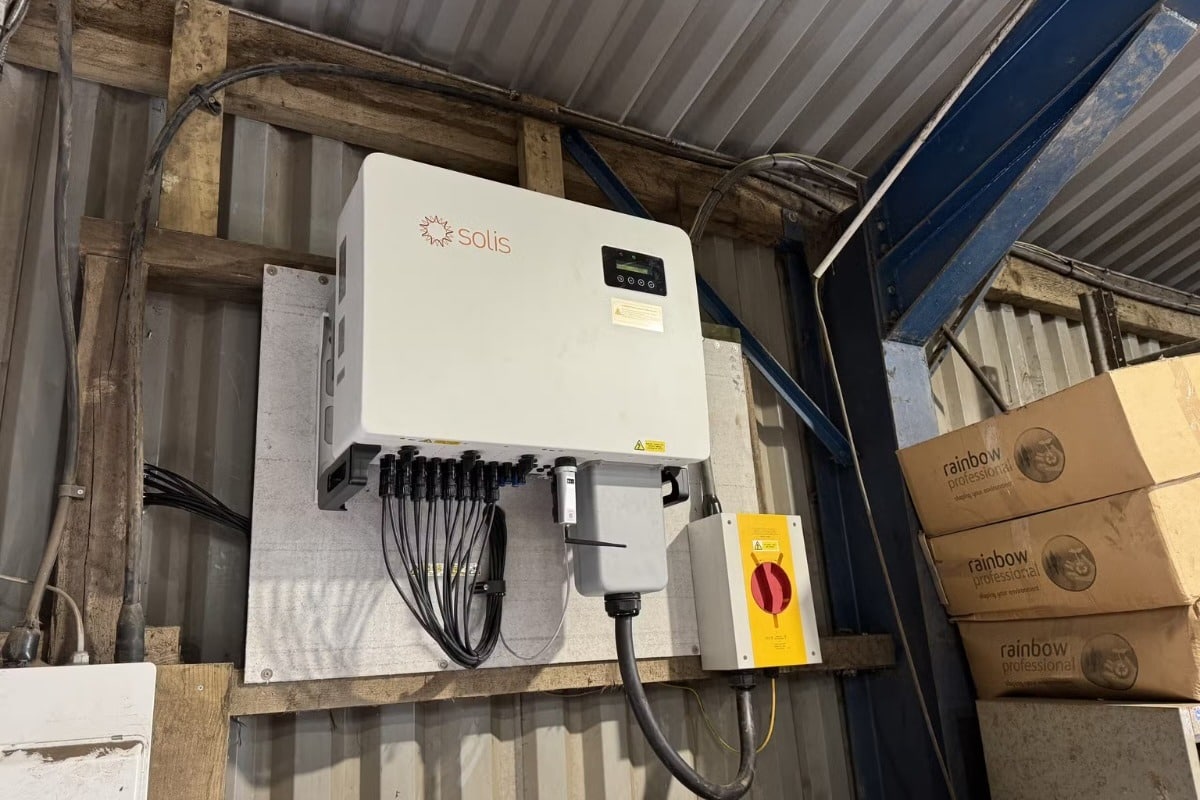
- Outbuildings and garagesThe gold standard: separated from living space, cool, accessible, with wall space for tidy mounting like the install pictured.
- Utility rooms and plant spacesInside the house but outside the sleeping-and-escape map, close to the consumer unit.
- Suitable external wallsWeather-rated enclosures, respecting the 1-metre rule around openings.
Most homes have at least one compliant option, and the survey's job is to find the one that also keeps cable runs short and the kit serviceable. In the minority of homes where compliant space is genuinely tight, that conversation happens before you sign, not on install day.
What to ask your installer
- "Where will the battery go, and why there?"The answer should reference the survey and the location rules unprompted.
- "Is the location PAS 63100 compliant?"A competent installer answers immediately; hesitation is information.
- "What chemistry are the cells?"LiFePO4 is the domestic standard for good reason.
- "Will it be registered with the network operator?"Batteries notify under the same G98/G99 framework as solar, per our grid guide, and your home insurer should be told about the installation too.
Battery siting done properly
Survey: we find the compliant location that suits your home, sized from your actual usage, one all-in price. Design normally within 2 to 4 days depending on workload. Call 0115 773 7575, 8am to 8pm, Monday to Friday.
Book a feasibility assessmentFrequently asked questions
What is PAS 63100?
A Publicly Available Specification from the British Standards Institution, published in 2024, giving fire-safety guidance for battery energy storage in homes. Its heart is a set of location rules: no bedrooms, no escape routes, no lofts, with garages, utility spaces and outbuildings preferred.
Is PAS 63100 a legal requirement?
No, it is formal guidance rather than law. In practice it is the good-practice benchmark competent installers design to and the reference point insurers and standards bodies increasingly use, so treat compliance as the norm and deviation as something needing a very good explanation.
Can a solar battery be installed in a loft?
Not under PAS 63100, which rules out lofts, roof spaces and voids for new installations: they are hard to access in an emergency, hot in summer, and sit under the roof structure. Existing loft batteries are not forced out retrospectively, but relocation is worth discussing at the next service.
Can a battery go in a bedroom or hallway?
No. Rooms where people sleep, and cupboards opening into them, are ruled out, as are landings, staircases and corridors that form escape routes. The principle: a battery must never sit between you and the way out.
Where is the best place to put a home battery?
A garage, outbuilding or utility space: separated or separable from living areas, cool, accessible for servicing, and usually near the electrical kit anyway. Outside walls work too with weather-rated enclosures kept a metre from doors, windows and vents. The survey picks the best compliant option for your layout.
Related reading
- Can solar panels catch fire? The honest answer
- How long do solar batteries last?
- Adding a battery to existing solar
- Solar panels and home insurance
- Solar battery prices UK
Installed to the standard, every time
We are Spectrum Energy Systems, MCS certified (NIC200223), siting and installing battery storage to PAS 63100 guidance across the East Midlands. Over 1,000 installs since 2011. Call 0115 773 7575, 8am to 8pm, Monday to Friday.
Get in touch