Electricity Prices per kWh in Every Region
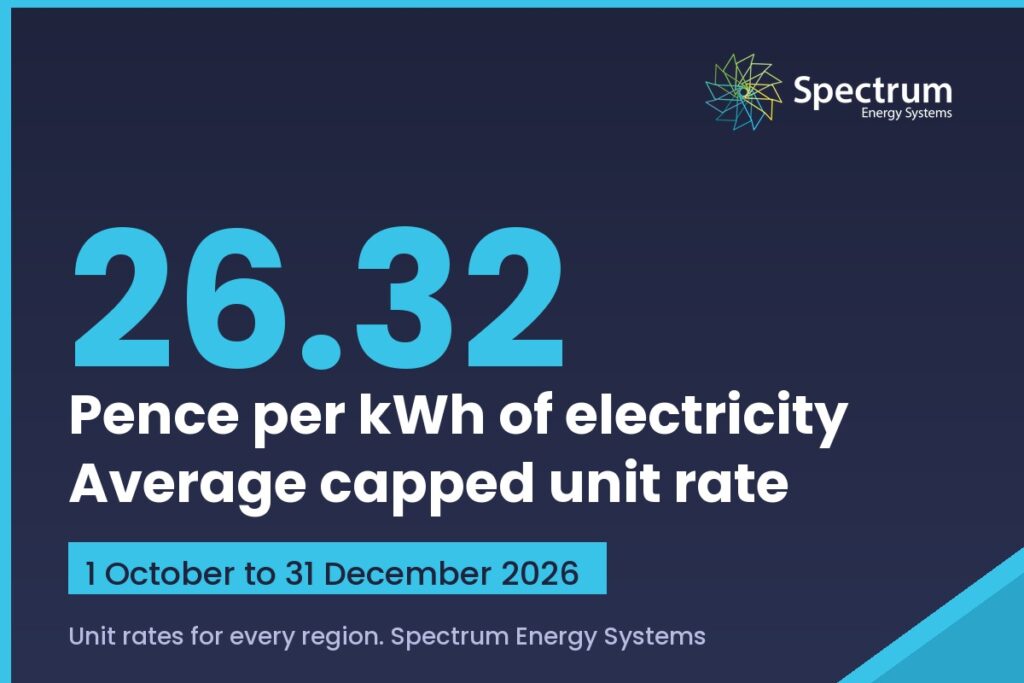
Electricity costs 26.32p per kWh on average for homes in Great Britain on a standard variable tariff paid by Direct Debit. That is Ofgem's price cap rate for 1 October to 31 December 2026. By region it runs from 25.36p in the East Midlands to 27.86p in Merseyside and North Wales, with a daily standing charge on top that averages 54.83p. For January to March 2027 the energy research firm Cornwall Insight forecasts 32.54p per kWh.
In this guide
What a kWh is and what it costs
A kilowatt hour (kWh) is the unit electricity is sold in, and it is what your bill calls a unit. It is one kilowatt of power used for one hour, so a 2 kW heater running for an hour uses 2 kWh. At 26.32p a unit, that hour costs 52.64p.
Ofgem's price cap limits the unit rate and the daily standing charge on standard variable tariffs. Ofgem's figures cover England, Scotland and Wales, and it sets a new cap every three months.
Electricity unit rates by region
Ofgem sets a separate cap for each of 14 regions. These are the single-rate electricity figures for 1 October to 31 December 2026 for homes paying by Direct Debit, lowest unit rate first.
| Region | Unit rate per kWh | Daily standing charge |
|---|---|---|
| East Midlands | 25.36p | 51.45p |
| North East England | 25.46p | 61.58p |
| West Midlands | 25.60p | 57.23p |
| Yorkshire | 25.60p | 61.67p |
| Southern Scotland | 26.11p | 61.41p |
| Northern Scotland | 26.35p | 55.14p |
| Southern England | 26.47p | 47.81p |
| North West England | 26.49p | 45.68p |
| South Wales | 26.55p | 55.41p |
| South West England | 26.58p | 55.58p |
| London | 26.60p | 42.92p |
| East of England | 26.61p | 51.84p |
| South East England | 26.88p | 52.32p |
| Merseyside and North Wales | 27.86p | 67.66p |
| Great Britain average | 26.32p | 54.83p |
Source: Ofgem, energy price cap unit rates and standing charges, read 19 November 2026. There is no VAT on household electricity at present. Ofgem's postcode lookup uses longer names for some regions, such as Eastern England and Southern Wales.
The East Midlands, where we are based, has the lowest capped unit rate in Great Britain this quarter at 25.36p. Merseyside and North Wales has the highest unit rate and the highest standing charge, and London has the lowest standing charge at 42.92p a day. Ofgem says standing charges differ by region because of four things: the number of people living there, the region's average energy use, how much energy suppliers have to buy for it and what the network there costs to build and upgrade. The daily charge for every region is in our guide to the electricity standing charge.
How you pay changes the rate
The cap is set separately for each payment method. These are the Great Britain averages for single-rate electricity.
| How you pay | Unit rate per kWh | Daily standing charge |
|---|---|---|
| Direct Debit | 26.32p | 54.83p |
| Standard credit (paying when the bill arrives) | 27.80p | 63.49p |
| Prepayment meter | 25.52p | 54.83p |
Multi-rate tariffs such as Economy 7 have a day rate and a cheaper night rate. Ofgem's capped average for multi-rate electricity is 24.90p a unit by Direct Debit, and each supplier sets its own split between day and night. In the East Midlands, British Gas charges 30.940p by day and 14.538p at night, and EDF charges 31.106p and 14.308p.
British Gas, EDF and Octopus per kWh
On a standard variable tariff the three suppliers we checked charge the same for a unit. We compared British Gas's and EDF's published rate sheets and Octopus's published rates with the cap for all 14 regions. British Gas and EDF match the cap on both the unit rate and the standing charge everywhere. Flexible Octopus matches the unit rate and has a slightly lower standing charge.
So where you live and how you pay decide your price per kWh on these tariffs. Fixed and time-of-use tariffs are priced separately.
| East Midlands, Direct Debit, single rate | Unit rate per kWh | Daily standing charge |
|---|---|---|
| Ofgem price cap | 25.36p | 51.45p |
| British Gas Standard Variable | 25.355p | 51.452p |
| EDF Standard (Variable) | 25.355p | 51.452p |
| Flexible Octopus | 25.355p | 50.204p |
Rates from 1 October 2026, read on 19 November 2026 from each supplier's own published rates. Full regional tables: British Gas prices per kWh and EDF price per kWh.
How the price has moved
| Price cap period | Average unit rate, Direct Debit | Average standing charge |
|---|---|---|
| 1 July to 30 September 2026 | 26.11p | 57.19p |
| 1 October to 31 December 2026 | 26.32p | 54.83p |
| 1 January to 31 March 2027 (forecast) | 32.54p | 56p |
July to September included 5% VAT and the later periods do not, so Ofgem says the figures cannot be compared directly. The January figures are the final forecast from Cornwall Insight, an energy research firm, published on 18 November 2026.
Ofgem is due to announce the real January rates by 25 November 2026. Looking further back, the House of Commons Library put electricity unit prices around 40% above their mid-2021 level in its September 2026 briefing. Our article on the energy price increase forecast for January goes through what is changing and why.
What a kWh from your own roof is worth
Every unit of your own solar that you use at home replaces one you would have bought, so it is worth your unit rate: 25.36p in the East Midlands today, 26.32p on the Great Britain average. Units you do not use are exported and paid at your export tariff. We assume 12p a unit for export in our proposals, and the rates on offer are in our export tariff comparison.
What a unit costs you to generate depends on the system. On one design we quoted in September 2026, for a home using about 4,850 kWh a year, with 13 panels (6.37 kWp) and a 16 kWh battery, the simulation expects 5,969 kWh in the first year. Carry that forward 20 years, allowing for the panels' warranted loss of output, divide the quoted price by it, and each unit the system makes comes to about 10p, whether it is used in the house or exported. That leaves out any replacement parts in that time. The panels in that design carry a 30-year performance warranty. It is our own arithmetic on one roof, so treat it as an illustration.
A battery raises the share of your own units you use, because it keeps daytime solar for the evening. There is more on that in home battery storage.
See what your own units would be worth
Tell us your address, your unit rate and your yearly electricity use. We design the system on your roof remotely and send one all-in price, subject to site survey, with the figures behind it. Design and quote takes 1 to 3 days.
Get Estimate
Finding your own unit rate
Your unit rate is on your bill or in your supplier's app, next to the standing charge and the name of your tariff. If you are on a fixed tariff it will not be the capped rate in the table above.
On more than 50 home quotes we produced between September and mid-November where the customer gave us a single unit rate, it ran from about 18p to 33p, with about 25p in the middle. That spread is why we ask for your own rate and yearly usage before we design anything.
FAQs
How much is 1 kWh of electricity in the UK?
On average 26.32p under Ofgem's price cap for 1 October to 31 December 2026, for a home on a standard variable tariff paying by Direct Debit. That is the average across England, Scotland and Wales. The capped rate runs from 25.36p in the East Midlands to 27.86p in Merseyside and North Wales. A daily standing charge averaging 54.83p is charged on top.
What is the average electricity price per kWh?
The Great Britain average under the price cap is 26.32p per kWh by Direct Debit, 27.80p by standard credit and 25.52p on a prepayment meter, for 1 October to 31 December 2026. Those are single-rate figures with no VAT, because VAT on household electricity has been 0% since 1 October 2026 and the Budget said it will stay at 0% until 30 June 2027.
Is the price per kWh the same with every supplier?
For the three we checked, yes on standard variable tariffs. From 1 October 2026 British Gas and EDF both charge the capped unit rate and standing charge in all 14 regions, and Flexible Octopus charges the capped unit rate with a slightly lower standing charge. Fixed and time-of-use tariffs are priced separately.
Will electricity prices per kWh go up in January 2027?
Cornwall Insight's final forecast, published on 18 November 2026, is an average capped unit rate of 32.54p per kWh from 1 January 2027, up from 26.32p. It stays a forecast until Ofgem announces the cap, which is due by 25 November 2026. The cap is then reset every three months.
Why does electricity cost more in some regions?
Ofgem sets a separate cap for each of 14 regions. For standing charges it says the differences come from four things: the number of people in a region, its average energy use, how much energy suppliers have to buy for it and what the network there costs to build and upgrade. This quarter the capped unit rate is lowest in the East Midlands and highest in Merseyside and North Wales.
How do I work out what an appliance costs to run?
Multiply the appliance's power in kilowatts by the hours it runs, then by your unit rate. A 2 kW heater running for one hour uses 2 kWh, which is 52.64p at the average capped rate of 26.32p. A 100 watt device uses 1 kWh in ten hours, which is 26.32p.
What is a kWh of solar power worth?
A unit of your own solar used at home is worth the unit rate you would have paid, 26.32p on the Great Britain average today. A unit you export is paid at your export tariff instead. We assume 12p a unit for export in our proposals, so using your own power at home is worth about twice as much.
Sources
Every external figure on this page comes from one of these, all read on 19 November 2026.
- Ofgem: Energy price cap unit rates and standing charges
- Ofgem: Changes to energy price cap between 1 October and 31 December 2026 (26 August 2026)
- British Gas: Standard Variable tariff rates effective from 1 October 2026
- EDF: Standard (Variable), Deemed and Welcome prices effective from 1 October 2026
- Octopus Energy: published rates for Flexible Octopus
- Cornwall Insight: Energy Bills Set for Steep Rise in January (18 November 2026)
- House of Commons Library: Domestic energy prices, in short (21 September 2026)
- HMRC: Budget 2026, Overview of tax legislation and rates, section 2.20
The cost per unit of solar and the range of unit rates come from our own quotes and simulations between September and November 2026.
Related reading
- Electricity standing charge
- How solar panels lower your electricity bills
- Battery time-shifting
- Smart Export Guarantee rates by supplier
For the systems themselves, see home solar panel installation.
Spectrum Energy Systems has been fitting solar since 2011 from our base in Bulwell, Nottingham, with our own installation crew. We work across Nottinghamshire, Derbyshire, Leicestershire and Lincolnshire, and further afield.
Get the numbers for your own home
Send us your address and yearly usage and we will design a system on your roof and send one all-in price, subject to site survey, in 1 to 3 days. NICEIC Reg. 3182878 · MCS #NIC200223.
Get Estimate