
Storm, Hail and Wind: Can UK Weather Damage Solar Panels?
Solar panels are engineered for weather considerably worse than Britain usually delivers: certified to international standards that include hail impact testing at motorway-speed strikes, and mounted to withstand the wind loads UK roofs are designed around. Weather damage does happen, but it is rare, and when it does the culprit is usually flying debris or poor original mounting rather than the weather beating the panel itself. After a serious storm, a ground-level look and a glance at your generation figures tells you nearly everything; the rest is what insurance and workmanship guarantees exist for.
In This Guide
What panels are built to survive
Every certified panel on a UK roof has passed the international IEC test regime, which is more brutal than people imagine: repeated impact testing that fires hailstones of around 25mm at motorway speeds at the glass, mechanical load tests pressing simulated snow and wind loads far beyond British norms onto the panel face, and thermal cycling that freezes and bakes the panel through thousands of simulated seasons. The front face is toughened glass engineered specifically for impact, sitting in an aluminium frame designed to spread loads into the mounting rails. This is why the same panel technology survives on roofs in the Alps and Alberta; a Nottinghamshire winter is not the hard case.
Threat by threat, honestly
| Weather | Real risk to panels |
|---|---|
| Rain | None. Panels are sealed units; rain is the free cleaning service |
| UK hail | Very low. British hail rarely approaches the size the impact tests cover |
| Wind | Low for the panels; the mounting is what matters, more below |
| Snow | Very low. Load tests exceed UK snowfall; panels shed it as they warm |
| Lightning | Direct strikes are extremely rare and no likelier because panels are fitted; installation practice accounts for surge protection where appropriate |
| Flying debris | The genuine one: a neighbour's tile or branch strikes with force no standard anticipates |
What actually fails in storms
Across the storm callouts we attend, servicing systems from any installer, the pattern is consistent, and it is rarely the panel:
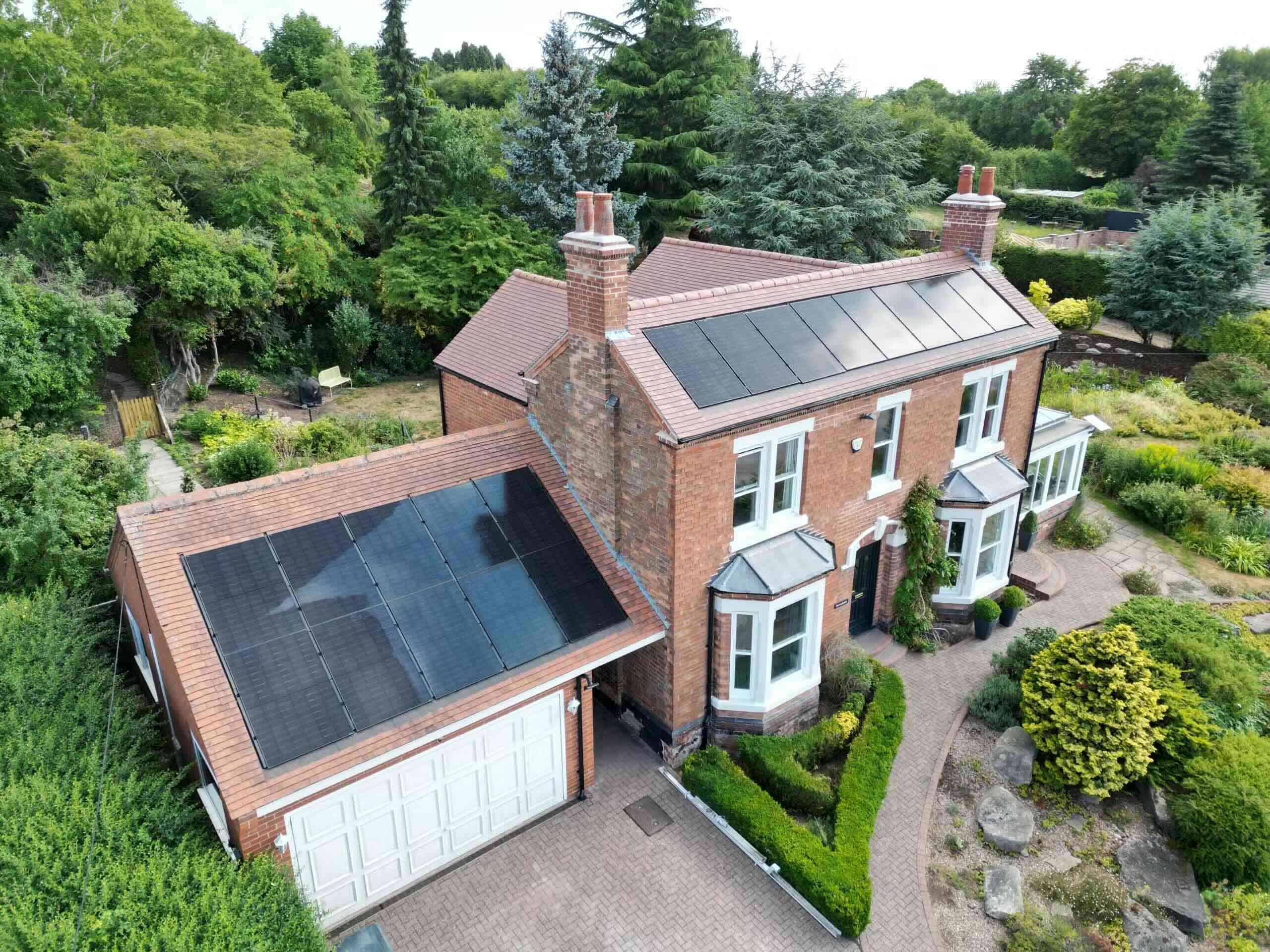
- Poor original mountingToo few fixings, clamps torqued wrong, rails cantilevered past their spec. Wind finds every shortcut, which is why mounting is engineered to the roof's wind zone on a proper install like the one pictured below, and why cheap installs surface in the first serious gale.
- Debris strikesRidge tiles, branches and trampolines airborne in a named storm can crack any glass. Rare, dramatic, and squarely an insurance matter.
- Micro-cracks after impactThe sneaky one: glass looks fine, output quietly drops. This is why the post-storm generation check below matters more than binoculars.
- Flashing and weatherproofingOccasionally storm-driven rain finds a lazy roof penetration. Workmanship, not weather, and covered by a proper installer's guarantee.
After a rough night: the checks
- Look from the groundPanels sitting flat and aligned, no visible cracks, nothing lodged on the array. Binoculars help; ladders are for professionals.
- Check the generationCompare output with similar recent days. Normal numbers after a storm are strong evidence everything survived; a sudden drop on a bright day is the flag worth acting on.
- Glance at the inverterA clean display, no fault codes, means the electrical side rode it out; our fault codes guide decodes anything else.
- Do not climbStorm-loosened anything is exactly what professional access equipment exists for. A suspected problem is a phone call, not a ladder.
Who pays if something breaks
Three layers, matched to three failure types. Genuine storm damage, the debris strike, the freak hailstone, is a home insurance matter: panels professionally fitted to your roof are normally covered as part of the building, and our insurance guide covers telling your insurer and claiming. Failures of the installation itself, mounting or weatherproofing that let go in conditions they should have shrugged off, belong to the installer's workmanship guarantee, which is why ours runs 5 years backed by QANW. And manufacturing defects that storms merely expose sit with the panel warranty. A competent installer helps you route a problem to the right one rather than leaving you to argue with all three.
Storm worry, odd output, or just want it checked?
We inspect and repair systems from any installer across the East Midlands, with proper access equipment and honest diagnosis. Call 0115 773 7575, 8am to 8pm, Monday to Friday.
Maintenance and supportFrequently asked questions
Can hail damage solar panels in the UK?
It is very unlikely. Certified panels pass impact testing that fires hailstones of around 25mm at motorway speeds at the glass, and British hail rarely approaches that scale. The freak exception would be an insurance matter, like any other storm damage to your roof.
Can strong wind blow solar panels off a roof?
Not from a properly engineered installation: mounting is designed against the wind loads for your area with margins on top, and the panels sit within the roof's own wind envelope. Where wind does cause failures, the cause is almost always undersized or badly fitted mounting, a workmanship issue rather than a weather one.
What should I check after a storm?
Three things from safety: a ground-level visual for cracks, misalignment or debris; your generation figures against similar recent days; and the inverter display for fault codes. Normal output and a clean display after a storm is strong evidence all is well. Anything suspicious is a call to an installer, not a ladder.
Does home insurance cover storm damage to solar panels?
Normally yes: professionally installed panels are typically treated as part of the building, so genuine storm damage claims like any roof damage. Tell your insurer the panels exist when they are fitted, and keep your installation certificates, both of which smooth any future claim.
Do solar panels attract lightning?
No. Panels do not make your roof meaningfully more likely to be struck, direct domestic strikes are extremely rare in the UK, and installation practice accounts for surge protection where the system design calls for it. Lightning risk is not a reason to hesitate over solar.
Related reading
- Solar panels and home insurance
- Solar panel warranties explained
- Will solar panels damage my roof?
- Inverter fault codes explained
- Do solar panels work on cloudy days?
Built for British weather, guaranteed against everything else
We are Spectrum Energy Systems, MCS certified (NIC200223), installing solar engineered to its wind zone across the East Midlands since 2011, with a 5-year QANW-backed workmanship guarantee. Call 0115 773 7575, 8am to 8pm, Monday to Friday.
Get in touch