Why Your DNO Refused Your Solar Application (And What to Do)
DNO refusals on solar PV applications usually fall into three categories: insufficient local network capacity (most common), engineering non-compliance in the application, or phase imbalance concerns. None is the end of the road. Common fixes include reducing export capacity, fitting an export-limiting inverter, paying for network reinforcement, or upgrading from single-phase to three-phase supply. For commercial prospects, Spectrum’s £500 refundable standalone DNO application service identifies capacity issues before you commit to a full install.
A DNO refusal sounds like a hard stop. In practice it’s usually a negotiation. The DNO is saying ‘we can’t accept this exact specification on this exact site’ - not ‘you can’t have solar’. The job is to find a modification that satisfies both the customer’s generation goal and the DNO’s network constraints.
The three common reasons for refusal
1. Insufficient local network capacity. Your local cables and transformer can’t accept the proposed export volume on top of existing connections. Most common reason. Particularly common in rural areas with older infrastructure or urban areas with lots of recent solar uptake.
2. Engineering non-compliance. The proposed inverter isn’t on the certified G99 list, the single-line diagram has errors, protection settings are wrong, or earthing arrangement isn’t compliant. Usually a paperwork fix; the install itself can still proceed.
3. Phase imbalance / network stability concerns. Single-phase install proposed in an area where local network already has heavy single-phase load. Resolution typically involves three-phase upgrade or reduced single-phase export.
Fix 1: Reduce export capacity
The simplest fix is to cap inverter export. If the DNO will accept 5kW export but not 11kW, fit an inverter that’s limited to 5kW - even if the panel array generates more, the inverter doesn’t allow more than 5kW to flow to the grid. The surplus is absorbed by the battery (if fitted) or curtailed (if not).
This is genuinely lossless on most installs because your battery is absorbing midday surplus anyway. The grid only sees the export-limited figure. Common solution on rural sites with weak local cables.
Fix 2: Fit smart export limiting
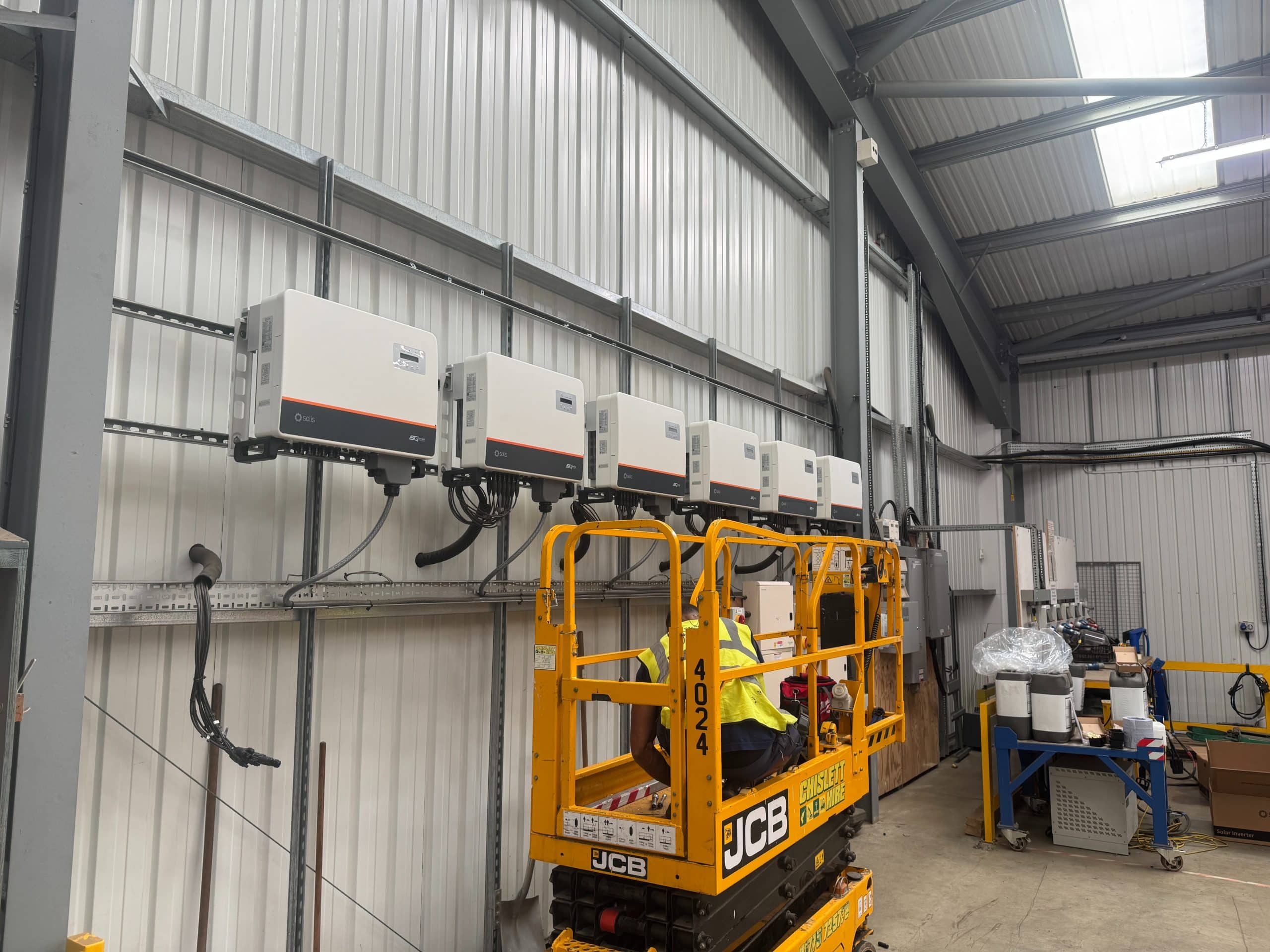
A step beyond fixed export caps is dynamic export limiting that monitors local voltage and frequency and tapers export only when the network is approaching its limit. The DNO sometimes accepts higher headline capacity if smart limiting is fitted, because the system actively respects local network state. Spectrum fits Solis hybrids with dynamic export limiting where it’s the right answer.
Fix 3: Pay for network reinforcement
For larger commercial installs where reduction isn’t acceptable, the DNO will cost network reinforcement - upgrade of cables, transformer change, sometimes a new connection. The customer pays. Costs range from £5,000 for minor upgrades to £100,000+ for major reinforcement.
Worth the cost when:
- The system is large enough that reinforcement cost amortises across the install’s revenue
- The customer has a long-term operational interest in the site (industrial, agricultural)
- The reinforcement also benefits other electrical needs (EV fleet charging, heat-pump heating)
Not worth the cost when:
- The reinforcement exceeds 10-15% of the install’s capex
- The customer’s payback maths can’t absorb the addition
- A smaller export-limited install does most of what was wanted at a fraction of the cost
Fix 4: Upgrade to three-phase
If you’re currently on single-phase and the DNO can’t accept the export volume on that phase, upgrading to three-phase typically unlocks 3× the capacity on the same supply. Three-phase upgrade costs £2,000 - £5,000 for typical domestic; commercial sites are often already three-phase.
Worth doing if you also want EV charging, heat pumps, or higher kW solar in the future.
Fix 5: Resubmit with engineering corrections
If the refusal is engineering-paperwork rather than capacity, just fix the documentation. Common engineering corrections:
- Swap to a certified G99 inverter
- Correct single-line diagram - show isolators and meter correctly
- Update protection settings to match current engineering recommendations
- Confirm earthing arrangement
Resubmission timeline is fast - DNOs typically re-review within 5-10 working days of resubmission.
DNO refused your solar?
We’ve seen most refusal patterns and know what the DNO is looking for. Spectrum can resubmit on your behalf or run a fresh design that hits an acceptable spec.
Speak to Our TeamHow to avoid refusals in the first place
- Use an MCS-certified installer with G99 experience. Engineering errors that trigger refusal are usually avoidable. Spectrum’s applications are pre-checked against the DNO’s acceptance criteria.
- Run a pre-application enquiry for large installs. The DNO can do a non-binding capacity check before the formal G99 application. Useful on commercial sites where you want to know likely capacity before designing.
- Specify export-limited from the start. Lower headline export = lower refusal risk. Designs that already match the network typically sail through.
- Use a Solis hybrid that’s on the certified G99 list. Most Spectrum specifications use Solis precisely because the certified-list compliance is sorted.
Commercial prospects: the £500 refundable DNO check
For commercial customers, the unknown grid capacity is often the biggest single uncertainty. Spectrum’s £500 refundable DNO application service runs a G99 application before you commit to the full install, so you know exactly what export capacity the DNO will approve before deciding on the build size.
The £500 is credited against the install if you proceed with Spectrum. Without this service, most commercial customers face the choice of (a) designing on assumption then potentially redesigning if DNO refuses, or (b) running the DNO application themselves, which is an engineering documentation exercise most non-installers find impractical.
Local network capacity in the East Midlands
National Grid Electricity Distribution publishes generation capacity heatmaps for its network. Rural Lincolnshire, parts of north Nottinghamshire and the Peak District fringes have constrained capacity in places, something our solar installers in Lincoln run into on farm and village jobs. Urban Nottingham, Derby and Leicester have variable capacity by local substation, so our Derby solar panel installers and solar installers in Leicester never promise an export limit before the DNO has answered. The map isn’t a guarantee - specific feeders and transformers vary - but it’s a useful pre-application sanity check.
FAQs
Can a DNO refuse a domestic solar install?
Yes - if local network capacity is insufficient. The most common solution is export-limiting the inverter to a level the DNO can accommodate. For typical 4kWp domestic solar this is rarely a binding constraint; for larger 10kW+ residential systems it sometimes is.
How long does it take to fix a DNO refusal?
Engineering-paperwork fixes are typically resubmitted within 5-10 working days and reviewed by the DNO in another 5-15 working days. Capacity-driven refusals can take longer if redesign is needed. Reinforcement-route resolutions can take months - the DNO has to schedule the physical work.
Do I have to pay if the DNO refuses my application?
A G99 application may carry a DNO network fee, typically around £153+VAT, whatever the outcome. Network studies or reinforcement quotes may attract fees on larger systems. If you used Spectrum’s £500 refundable DNO service and the DNO refuses, we’d work with you on resubmission at no extra cost - the £500 still applies as install credit if you go ahead.
Can I appeal a DNO refusal?
Formally, you can challenge a DNO decision through Ofgem’s standard complaint procedure. In practice, refusals are usually engineering decisions backed by network data and successful formal appeals are rare. Modifying the design to meet network constraints is the more practical route.
Does export-limiting reduce my solar income?
It caps your peak export, not your total generation. If you have battery storage, the limited surplus charges the battery instead of exporting - net effect on lifetime kWh is small. Without battery, you lose some peak-midday generation, typically 5-15% on a sunny day. Most domestic installs absorb the limit comfortably.
Can I get my DNO to upgrade the local network for free?
Generally no - reinforcement costs follow the customer. The DNO is regulated to charge cost-reflective fees for new connections and reinforcement. Where local network upgrades are planned anyway (DNO’s own infrastructure investment), timing can sometimes help - ask the DNO if any planned upgrades cover your area.
Should I use the standalone DNO check before quoting?
For commercial sites with material capex commitment, yes - it’s the cheapest way to remove the grid-capacity unknown from the install decision. Spectrum’s £500 refundable DNO service does exactly that. For domestic installs under 6kWp, the refusal risk is low enough that the standalone service usually isn’t needed.
Related reading
- G99 application solar: how DNO approval works
- Solar grid connection: G98 vs G99 explained
- Solar panel installation cost UK 2026
- Solar PV capital allowances
For the full Spectrum service overview see contact our team.
Speak to Spectrum Energy Systems
MCS NIC200223. G99 application support across National Grid Electricity Distribution and Northern Powergrid. £500 refundable standalone DNO service for commercial customers.
Speak to Our Team