LFP vs NMC Solar Batteries: What’s the Difference?
LFP (lithium iron phosphate) is the safer, longer-lasting chemistry that has become the default for residential solar batteries in 2026. NMC (nickel manganese cobalt) is more energy-dense and lighter, but carries a higher thermal runaway risk and shorter cycle life. Every battery Spectrum fits on solar PV installs - Fogstar and Pylontech - uses LFP. Where you’ll still see NMC is in EVs and laptops, not stationary home storage.
Most homeowners shopping for a solar battery in 2026 don’t need to memorise the chemistry - the credible products are almost all LFP. But it’s worth understanding why, because there’s still NMC kit floating around the second-hand market and in older installs, and the safety conversation matters.
What LFP and NMC actually are
Both LFP and NMC are lithium-ion chemistries. The difference is the cathode material - the positive electrode that determines voltage, energy density and safety profile.
- LFP - lithium iron phosphate (LiFePO₄). Iron-and-phosphate cathode. Lower energy density per kg, but very stable thermally. The chemistry won’t enter thermal runaway except under extreme abuse (puncture, fire, sustained overcharge).
- NMC - nickel manganese cobalt. Cobalt-rich cathode. Higher energy density per kg, which is why it dominates the EV market where weight matters. Thermal runaway is a real risk under abuse conditions, which is why EV thermal management systems are sophisticated.
The head-to-head table
| Property | LFP | NMC |
|---|---|---|
| Energy density (Wh/kg) | ~120-160 | ~180-230 |
| Cycle life to 80% capacity | ~6,000-8,000 | ~2,000-3,000 |
| Thermal runaway temperature | ~270°C | ~210°C |
| Cobalt content | None | 5-30% (ethical sourcing concerns) |
| Cost per kWh (2026, cell level) | Lower | Higher |
| Dominant residential market share (UK) | ~95%+ | Niche / legacy |
| Used in EVs? | Increasingly (Tesla LFP, BYD) | Still dominant in long-range EVs |
Why LFP won the home storage market
Three reasons, in order of how much they mattered to the industry:
1. Safety. Stationary home batteries sit indoors, often in garages or utility rooms attached to the house. A thermal runaway event in NMC chemistry can vent hot gas and ignite. LFP under the same abuse conditions vents far less aggressively and is much harder to set on fire. After several high-profile NMC home-battery fires (mostly in Korea and Australia) in 2018-2022, the residential market shifted decisively to LFP.
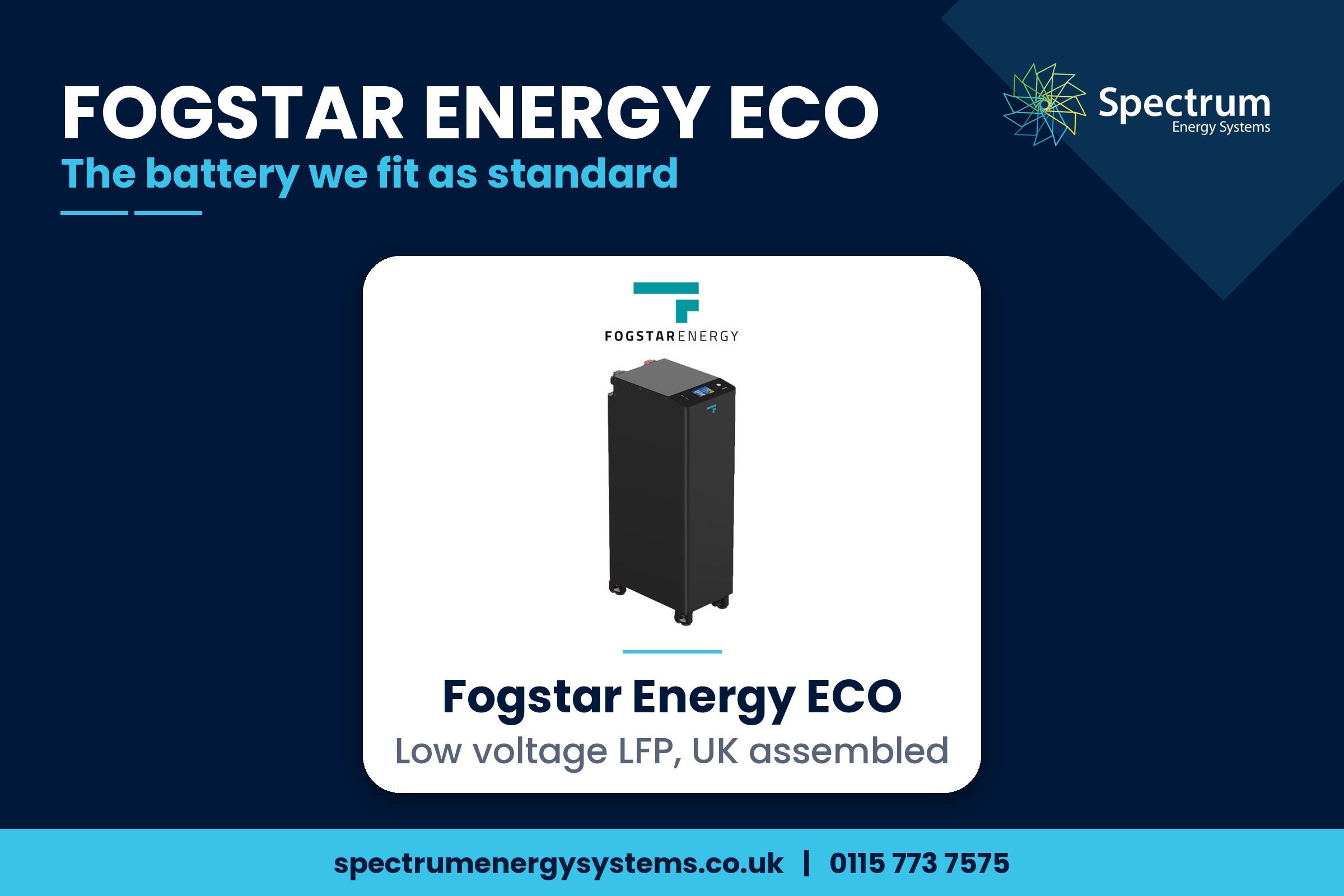
2. Cycle life. A home battery cycles roughly once a day. NMC’s 2,000-3,000 cycle warranty means warranty expiry at year 6-8. LFP’s 6,000-8,000 cycle warranty (the Fogstar Energy 16.1kWh is rated 8,000) stretches that past year 16. For an asset class meant to last 10+ years, LFP is the natural fit.
3. Cost. LFP cell prices have fallen faster than NMC since 2020, largely because LFP doesn’t need cobalt, and cobalt has gone through several supply-chain shocks. LFP cells are now cheaper than NMC cells of equivalent capacity, despite being less energy-dense.
Where NMC still makes sense
NMC isn’t obsolete - it’s just been displaced from home storage. NMC still wins on:
- EVs needing long range. Energy density per kg matters when the battery has to be carried around. Most premium EVs (Tesla Model S, BMW iX) still use NMC for the long-range variants.
- Portable applications. Power tools, e-bikes, laptops. Weight matters; cycle life matters less.
- Aerospace and aviation. Same logic - energy per kg is king.
None of these use cases apply to your house. Your house doesn’t move. Your house doesn’t need a 600-mile range. LFP’s lower energy density translates to a slightly larger box on the wall, which is a price you almost certainly happily pay for the safety and cycle-life upgrade.
Want to know what’s actually in your quote?
If an installer hasn’t told you the chemistry of the battery they’re proposing, that’s worth asking. We’ll quote LFP every time, with the part number on the page.
 Request a Quote
What about ‘next-gen’ chemistries?
Sodium-ion (Na-ion) and solid-state lithium are both progressing but neither is mainstream for UK home storage in 2026. CATL has shipped commercial sodium-ion cells; BYD has hinted at home-storage variants. Sodium-ion promises lower cost and even safer thermal profile than LFP, at the price of lower energy density still. If it lands at commercial scale, it’ll likely displace some LFP at the budget end. We’ll watch it. For now, LFP is the answer.
Solid-state lithium remains 3-5 years away from commercial-scale home storage by any honest assessment.
What this means for your battery shopping
Three short rules:
- If the spec sheet doesn’t say LFP or LiFePO₄, ask. Don’t buy NMC for home storage in 2026 unless you understand exactly why.
- Brand names like Fogstar (Spectrum’s default), Pylontech, Powerwall 3, Sungrow, BYD home - all LFP.
- Some older second-hand or end-of-life-stock NMC home batteries (LG Chem RESU 10H, some older Sonnen units) are still in market. Treat with care - the safety story is real.
The Spectrum default specification
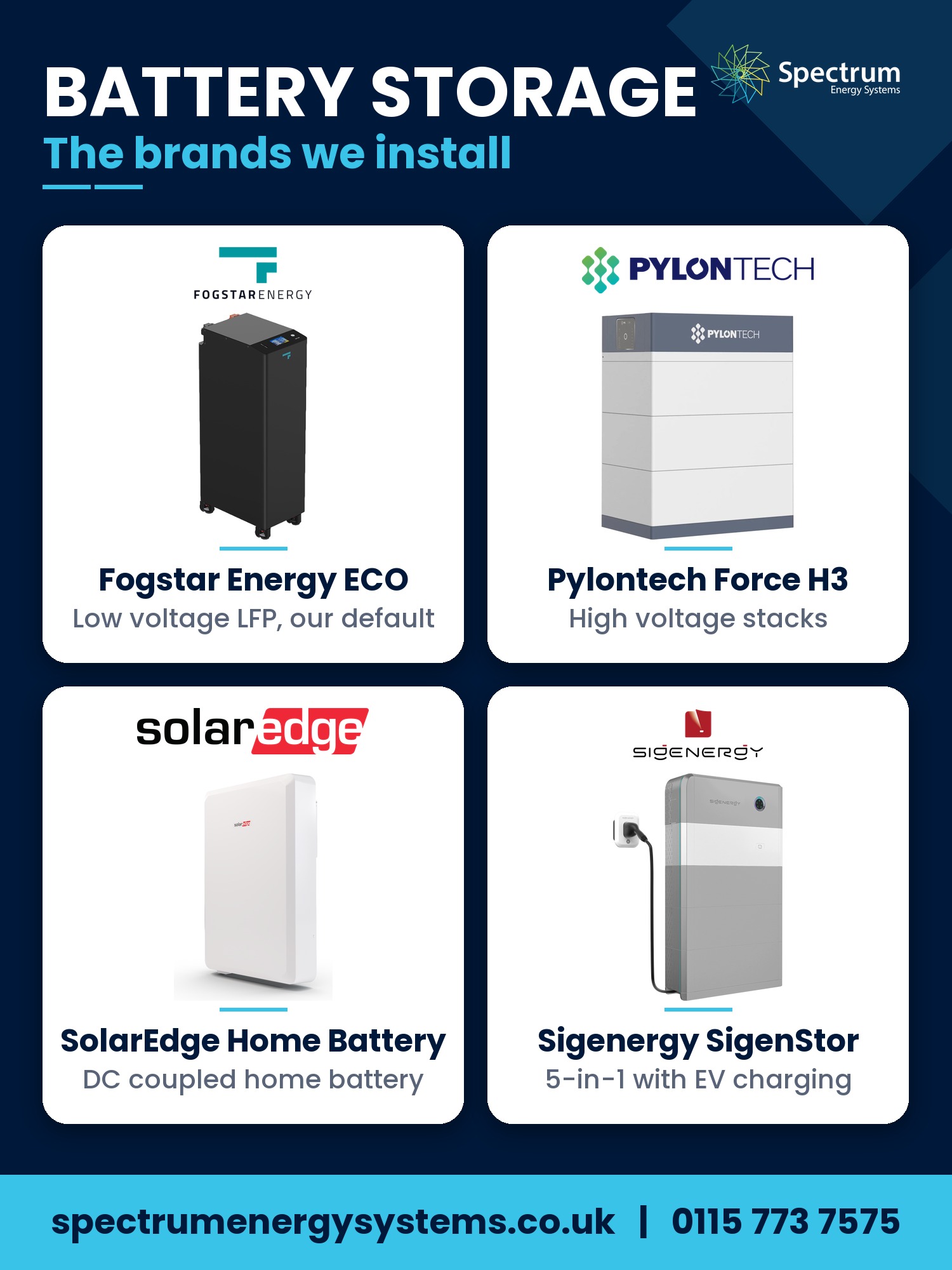
Spectrum fits LFP on every install. Fogstar 16.1kWh on LV Solis hybrid systems. Pylontech Force H3 on HV Solis hybrid systems. We don’t fit Tesla Powerwall - see our Tesla Powerwall vs Fogstar comparison. We’ve never specified NMC for a residential install and don’t plan to. For a worked LFP-vs-LFP comparison see our Fogstar vs Pylontech article.
FAQs
Is LFP safer than NMC for home solar batteries?
Yes. LFP has a higher thermal runaway threshold (~270°C vs ~210°C for NMC), vents less aggressively under abuse, and is harder to ignite. After several NMC home-battery fires in Korea and Australia, the UK residential market has standardised on LFP. Every battery Spectrum fits is LFP.
Do LFP batteries last longer than NMC?
Yes - significantly. LFP warrants ~6,000-8,000 charge cycles to 80% capacity (the Fogstar Energy 16.1kWh is rated 8,000). NMC warrants ~2,000-3,000. For a battery cycling once a day, that’s the difference between 16-22 years of warrantied use and 6-8. LFP is the chemistry built to live on a wall for a decade-plus.
Are Tesla Powerwalls LFP or NMC?
Powerwall 3 is LFP, in line with the rest of the residential market. Older Powerwall 2 units use NMC chemistry - some are still in the field, but Tesla has shifted to LFP for new production. If you’re specifying a Powerwall in 2026, you’re specifying LFP.
Why does NMC still get used in EVs if LFP is safer?
Because energy density per kg matters in vehicles in a way it doesn’t in stationary home storage. An EV with NMC can carry the same range in a lighter battery pack. Tesla, BYD and others are increasingly shifting to LFP even in EVs - especially shorter-range and rear-wheel-drive variants - but NMC still dominates long-range premium EVs.
Is a Fogstar battery LFP?
Yes. Fogstar uses prismatic LiFePO₄ cells in all current solar battery models - 10kWh, 16.1kWh, 32kWh outdoor and 48.3kWh stack. The chemistry is LFP. Cell origin is named in the spec sheet, and the BMS is tuned to LFP’s charge/discharge characteristics.
Will sodium-ion replace LFP?
Possibly at the budget end of stationary storage by the late 2020s. CATL is shipping commercial sodium-ion cells and BYD is exploring home-storage variants. Sodium-ion promises lower cost and safer thermal profile than LFP, at the price of lower energy density. For now, LFP remains the default. Watch this space.
Are LFP batteries cheaper than NMC?
At cell level, yes in 2026. LFP cell prices fell faster than NMC over 2020-2025, partly because LFP doesn’t require cobalt - a metal with periodic supply-chain shocks. Pack-level cost depends on the manufacturer, but the underlying cell economics favour LFP.
Related reading
- Fogstar vs Pylontech: which solar battery is right for you?
- How much solar battery storage do I need?
- Solar panel warranty guide UK
For the full Spectrum service overview see domestic battery storage.
Specifying the right chemistry - and the right kit
Spectrum fits LFP solar batteries (Fogstar - default, Pylontech - commercial) across Nottinghamshire, Derbyshire, Leicestershire and Lincolnshire. MCS NIC200223. QANW Insurance-Backed Guarantee on every install.
Request a Quote