
How Much Solar Battery Storage Do I Need? UK Sizing Guide
Most UK homes need between 10kWh and 16kWh of usable battery storage. The right size depends on three things: your evening (4-10pm) consumption, your tariff (flat-rate vs Agile/Flux), and whether you run an EV or heat pump. A 4-bed Nottinghamshire home with no EV typically lands at 10-13kWh. Add an EV and you’re looking at 16kWh. Add a heat pump on top and the answer is 16-32kWh.
Battery sizing is the single most common question we get asked on residential site surveys. It’s also the question installers get most wrong - either pitching a tiny battery to hit a marketing price point, or over-spec’ing to inflate the quote. The right answer comes from your actual electricity consumption, not from a brochure.
The 30-second sizing rule
Battery capacity (kWh) ≈ your average evening + overnight consumption between 4pm and 8am the next morning. That’s the window solar can’t cover, and that’s where the battery earns its money.
Take your last 12 months of electricity usage in kWh. Divide by 365. Take 55-65% of that figure - that’s roughly your evening/overnight share. Round up to the nearest stocked battery size.
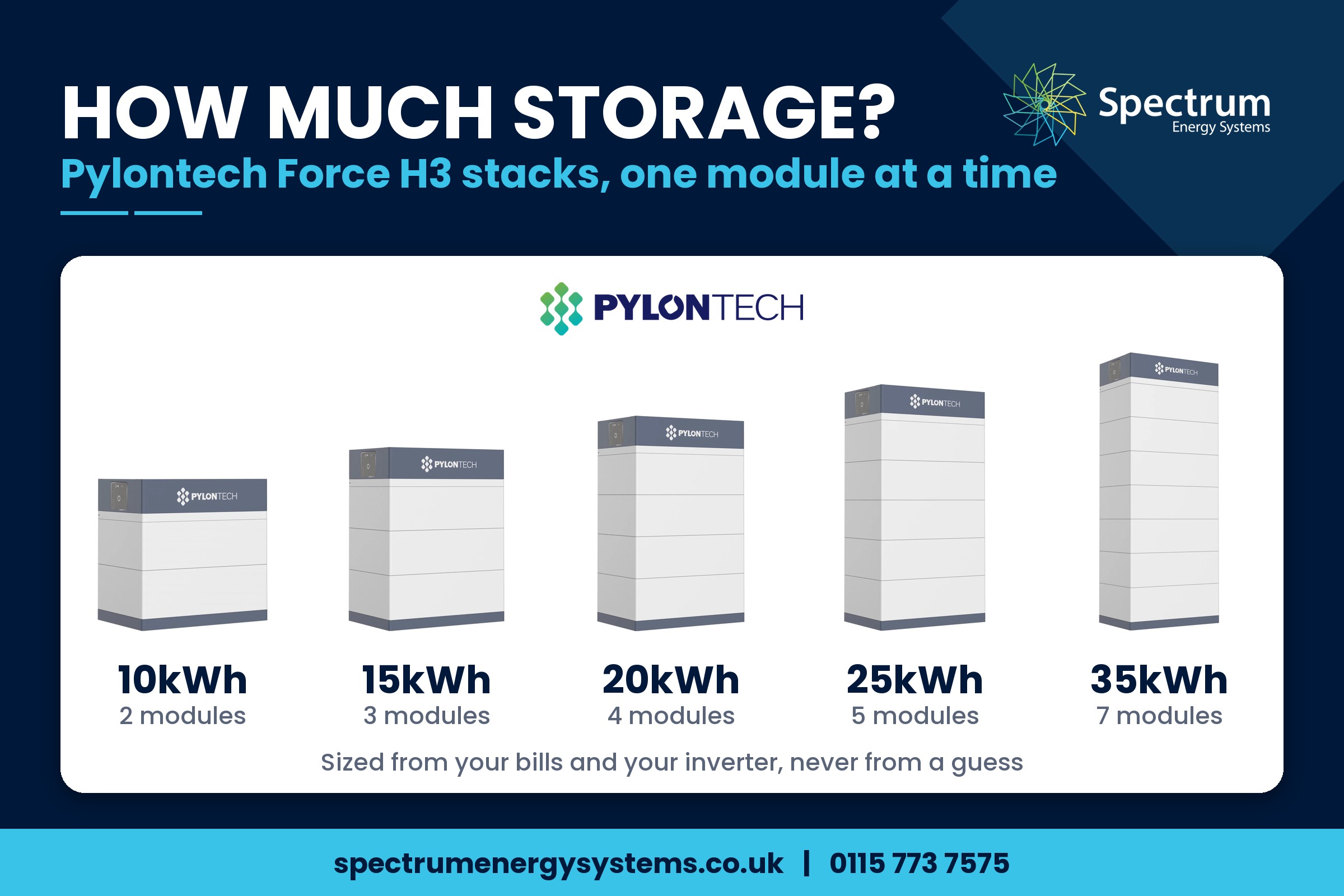
Worked example: a 4-bed home using 4,400 kWh/year averages 12kWh/day. 60% of 12 is 7.2kWh evening/overnight. A 10kWh battery covers it with comfortable headroom for a cloudy day. A 16.1kWh covers a week of UK winter weather without grid pulls.
Size by household type
| Household | Annual kWh | Recommended battery | Notes |
|---|---|---|---|
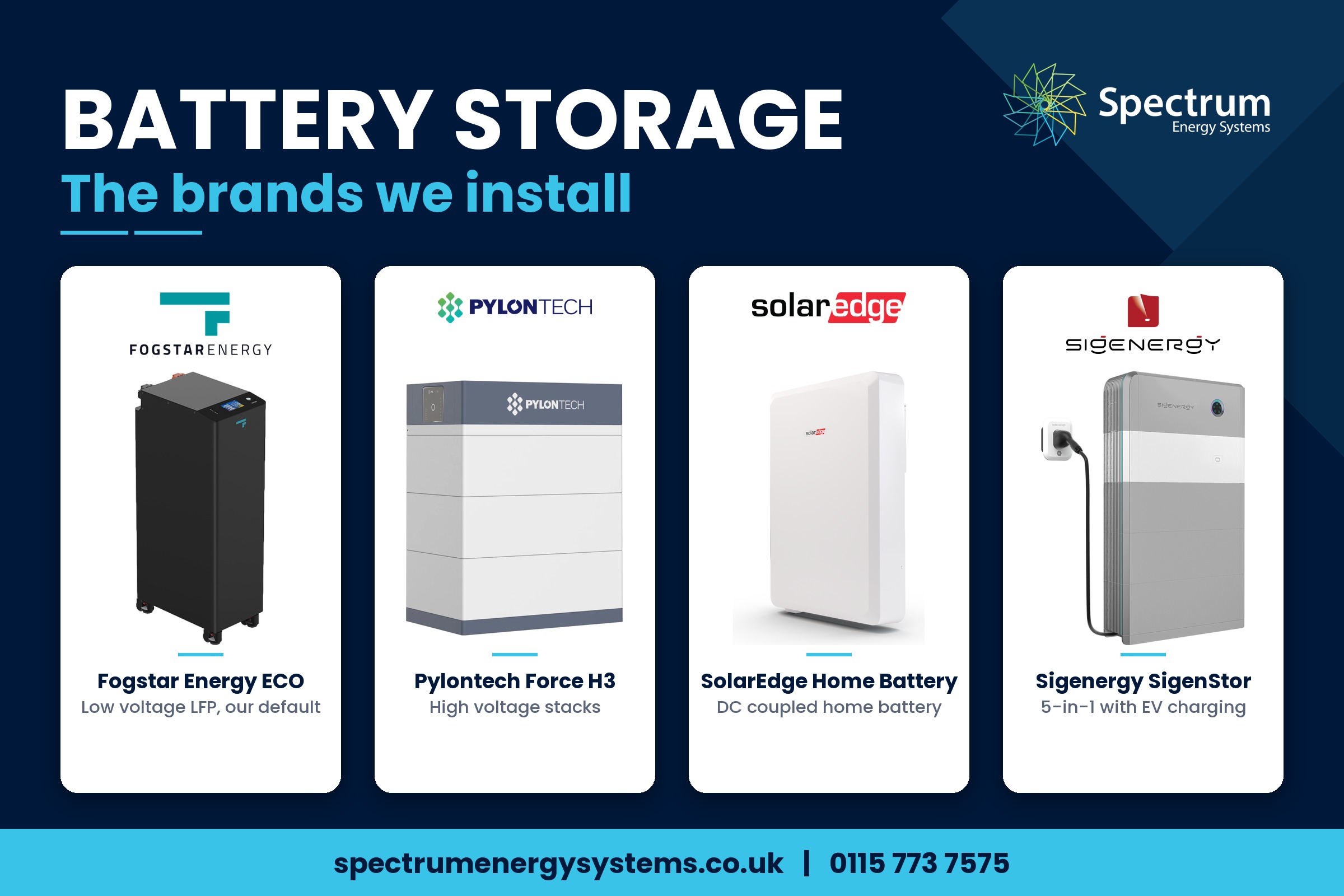
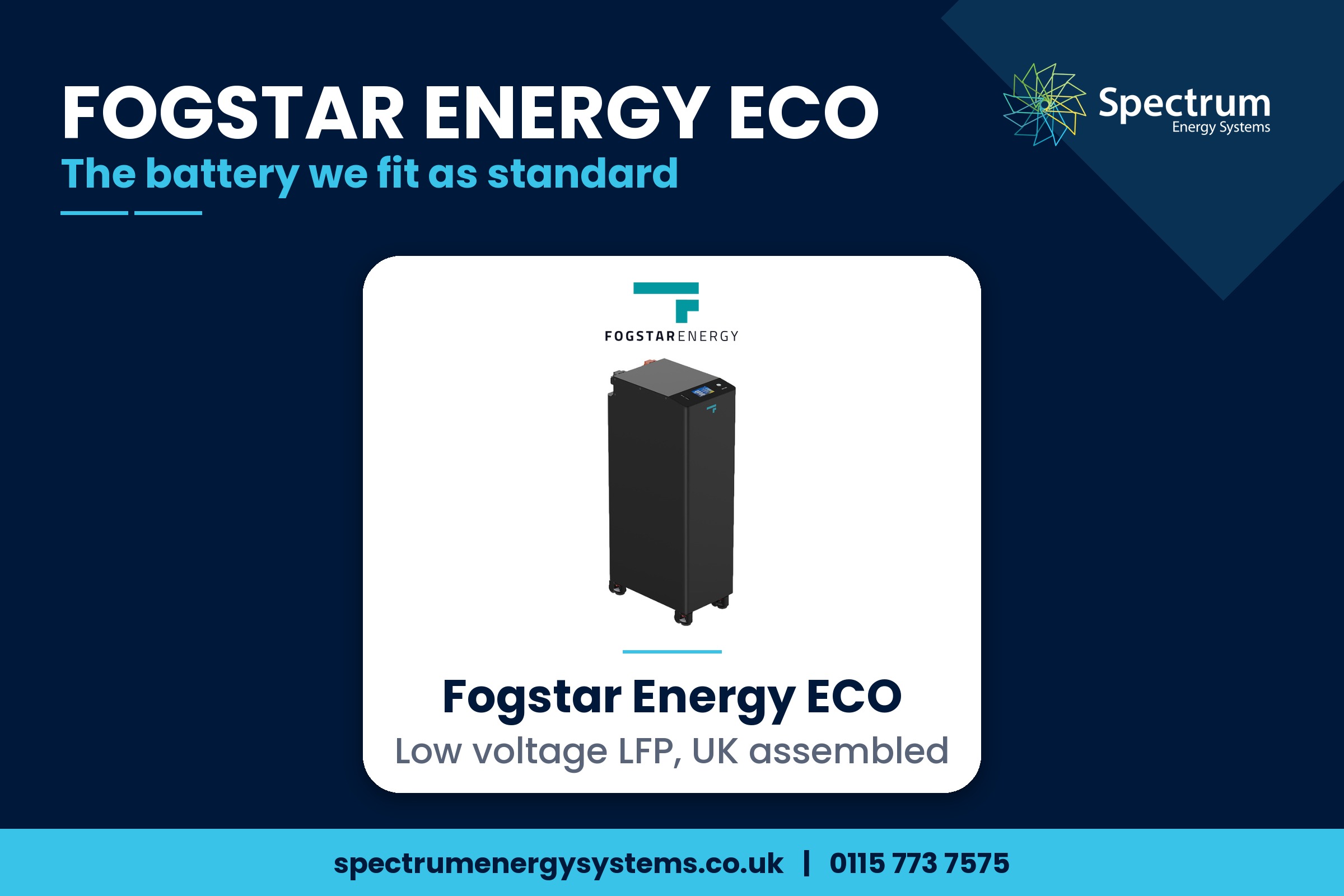
| 2-bed flat or small terrace, no EV | ~2,400 | 5-10kWh | Smaller Fogstar or starter Pylontech stack |
| 3-bed semi, no EV | ~3,200 | 10-13kWh | Fogstar 10kWh or 16.1kWh, comfort headroom |
| 4-bed detached, no EV | ~4,400 | 13-16kWh | Fogstar 16.1kWh is the most common spec |
| 4-bed + 1 EV (10,000mi/yr) | ~6,500 | 16kWh+ | Fogstar 16.1kWh or add a second module |
| 5-bed + EV + heat pump | ~9,500 | 20-32kWh | Fogstar 32kWh outdoor or 48.3kWh stack |
| Light commercial (workshop, small farm) | ~15,000+ | 32kWh+ HV | Pylontech Force H3 with HV Solis inverter |
Why ‘just buy the biggest battery you can afford’ is wrong
A battery only earns money when it cycles - charges and discharges. Money-per-kWh on Agile is real but capped by your actual consumption. A 32kWh battery in a 3,000 kWh/year household might only cycle through 60% of its capacity each day. The unused capacity is dead capital.
The general rule: buy a battery you’ll cycle 80-100% of, most days. Anything bigger turns over more slowly and lengthens your payback. Anything smaller leaves cheap-window arbitrage on the table.
How to read your half-hourly data (if you have it)
If you have a SMETS2 smart meter, you can request 12 months of half-hourly readings from your supplier. Drop them into the Spectrum sizing model on site survey and we’ll show you exactly what battery capacity covers your real evening peak across 365 days - not just the average. We sometimes see customers whose July evenings draw 11kWh while February evenings draw 6kWh. Sizing for the peak month gives you all-year coverage.
EV charging - the biggest sizing variable
One EV doing 10,000 miles a year typically pulls 2,500-3,000 kWh extra through the home meter. Whether that load lands on the battery or bypasses it depends on charging strategy:
- Charging overnight on Octopus Go (7p/kWh). Battery doesn’t need to cover the EV - cheap-rate grid handles it. Battery is sized for non-EV evening load only.
- Charging from solar on cloudy days. Battery needs headroom to prioritise the house first, then push surplus to the car. Add 20-30% capacity to baseline.
- Charging from Agile cheap windows alongside the house. Battery competes with EV for cheap-window capacity. Add a Fogstar module to handle both.
Want a sizing answer based on your actual bills?
Send us a year of your kWh data and we’ll model two or three battery sizes against your real consumption shape - no charge, no commitment.
 Use the Savings Calculator
Heat pumps change the maths
A typical UK heat pump pulls 2,500-4,000 kWh/year on top of household baseload. Worst case is a cold January evening with the heat pump cycling hard at 4pm-8pm. That window is the same window the battery is trying to cover. We size for both simultaneously - usually 20-32kWh of battery on heat-pump homes, with the battery preferentially feeding the heat pump in peak windows. For full system design see our domestic solar page.
The commercial sizing rule
Commercial battery sizing flips the logic. The battery isn’t covering an evening peak - it’s smoothing daytime self-consumption and (on a Shape Shifters or equivalent commercial tariff) arbitraging cheap-window pricing. We size commercial batteries to 4-6 hours of midday solar surplus, typically 25-100kWh on systems between 50kW and 250kW. The 35kW Johns of Nottingham install is at the lower end of that band.
Common sizing mistakes
- Sizing on solar kWp. ‘You’ve got 5kWp of panels, so you need 5kWh of battery’ - this rule of thumb is wrong. Battery size tracks consumption, not generation.
- Assuming summer pattern is the year. Most homes pull 50-80% more in winter evenings. Sizing for July leaves you exposed in January.
- Ignoring the tariff. A flat-tariff household needs less battery than an Agile household, because the only role of the battery on flat tariff is to shift solar self-consumption.
- Buying for backup, not arbitrage. If whole-home backup is the goal, size for your ‘essential loads’ running 24h, not for your normal usage pattern.
FAQs
Is a 5kWh solar battery enough for a UK home?
5kWh is enough for a 1-2 bedroom flat or a small terraced house with low evening consumption. For a typical 3-bed semi (~3,200 kWh/year) it’s undersized - you’ll drain mid-evening and pull from the grid at peak rates. 10kWh is the smallest practical capacity for a typical UK family home.
Can I add more battery capacity later?
Yes - Fogstar and Pylontech are both modular. You can add a second 16.1kWh Fogstar module to your existing one, or extend a Pylontech stack with additional modules. The inverter has to be sized for the larger battery at the design stage, so flagging future expansion on the first install saves you re-quoting the inverter later.
How much battery do I need for whole-home backup?
For 24 hours of essential-load backup (fridge, lighting, internet, boiler, no electric heating or hot water), plan for 10-14kWh. For 24 hours of full-load backup including kitchen and electric showers, plan for 20-32kWh. Whole-home backup also needs an automatic changeover switch - Spectrum fits this on request.
Does a bigger battery always pay back better?
No. Battery payback comes from cycles. A 32kWh battery in a 3,000 kWh/year household cycles only ~60% per day, while a 16kWh battery cycles ~95%. The smaller battery turns over faster, generating more arbitrage per kWh of installed capacity. There’s a sizing sweet spot, and bigger isn’t always better.
What size battery for an EV plus solar?
For an EV doing 10,000 miles/year and a typical home, 16kWh of battery covers evenings while overnight cheap-rate charging handles the car. For higher annual mileage or a household where the EV charges during the day from solar surplus, step up to 24-32kWh so the battery can buffer between house and car loads.
What if my consumption changes after installation?
Adding an EV or heat pump after install is common - either retrofit a second Fogstar module (the inverter must support it) or upgrade to a larger battery. Removing load (kids leaving home, switching to gas heating) just means the existing battery cycles slightly less. Either direction, an MCS installer can rebalance the system.
Is there a maximum battery size for a UK home?
Practically, the limit is the inverter and the DNO connection. A single-phase Solis 5kW hybrid handles up to ~30kWh of usable battery comfortably. Beyond that you’d move to a Solis HV hybrid (15kW+) and DNO approval becomes more involved. Spectrum handles the G99 application as part of the install.
We size every battery at the survey, with battery storage installs across Leicester and the wider East Midlands.
Related reading
- Fogstar vs Pylontech: which solar battery is right for you?
- Solar battery storage payback time UK 2026
- Best solar battery for Octopus Agile in 2026
- LFP vs NMC solar batteries: what’s the difference?
- off-grid vs on-grid solar systems
For the full Spectrum service overview see domestic battery storage.
Get a battery sized to your actual consumption
We’ll model two or three options against your real kWh data and quote both the kit and the install - one all-in price, no breakdown gymnastics.
Request a Quote