DPW Solar vs Nuance Energy Mounted Solar Options: Which Ground Mount System Is Right for Your Project
Quick Navigation
- Overview of Ground Mount Solar Mounting Systems
- Overview of DPW Solar Mounting Systems
- Overview of Nuance Energy Mounting Systems
- Key Differences: Comparison Table
- Installation Speed Comparison
- Structural Integrity and Engineering Performance
- Site Compatibility: Which System Works on Your Terrain
- Scalability and Project Expansion
- Project Evaluation Considerations
- Which System Is Best for Your Project
- Real-World Use Case Scenarios
- Frequently Asked Questions
Selecting the right ground mount solar racking system is one of the most consequential decisions in any commercial or utility-scale solar project. The mounting structure directly affects installation speed, structural reliability, terrain adaptability, and long-term project performance across the system's 25–30+ year lifespan.
This independent comparison examines two established ground mount manufacturers — DPW Solar and Nuance Energy — to help solar EPC contractors, commercial developers, procurement managers, and engineering consultants evaluate which system best fits their project requirements. For a broader look at commercial solar project planning, see our complete business solar guide.
Need Independent Ground Mount Advice?
Our MCS-accredited engineers provide manufacturer-independent guidance on mounting system selection, structural design, and system specification tailored to your site conditions.
Get Your Free Assessment Contact Our TeamOverview of Ground Mount Solar Mounting Systems
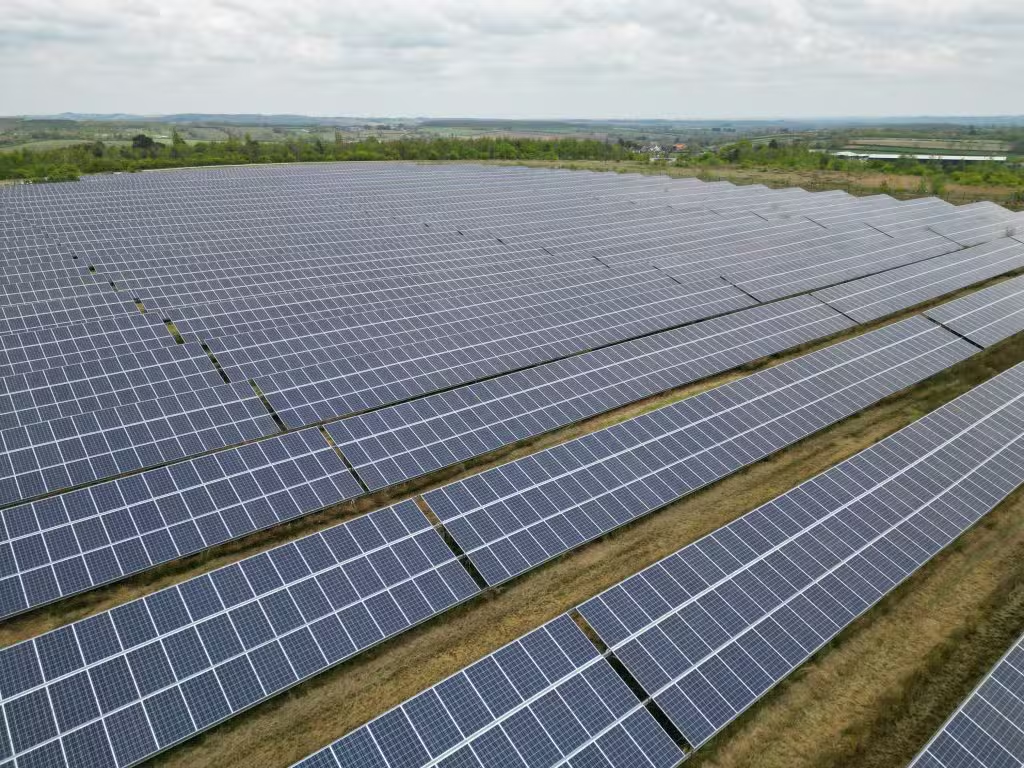
Ground mount solar racking systems provide the structural foundation for solar panels installed at ground level rather than on rooftops. These systems secure panels at optimal tilt angles, withstand environmental loads (wind, snow, seismic), and maintain structural integrity across decades of operation. For projects where roof space is limited or unsuitable, ground mount systems offer greater flexibility in array sizing, orientation, and future expansion. Our guide to solar panel installation for UK businesses covers the full range of mounting options available.
The choice of mounting system directly influences four critical project outcomes:
- Deployment speed and labour efficiency: Labour requirements, equipment needs, and foundation complexity all vary significantly between system types
- Structural reliability: Load capacity, material quality, and engineering design determine how well the system performs under extreme weather conditions
- Terrain compatibility: Some systems adapt readily to challenging ground conditions, whilst others are optimised for standardised, flat sites
- Long-term performance: Maintenance requirements, system lifespan, and operational durability affect the overall value delivered by the mounting system
Understanding these factors is essential for solar EPC contractors and project developers evaluating ground mount options. Both DPW Solar and Nuance Energy approach these challenges from different engineering philosophies — one prioritising custom structural engineering, the other prioritising modular rapid deployment. Explore our commercial solar planning guide for broader project considerations.
Overview of DPW Solar Mounting Systems

DPW Solar, owned and operated by Preformed Line Products (PLP), has manufactured solar mounting and racking systems since 1993. The company produces its POWER-FAB range of pole mounts, multi-pole mounts, ground mounts, and roof mounts at PLP's facility in Albemarle, North Carolina, using 6061-T6 structural aluminium extrusions and MIG-welded steel components.
DPW Solar's approach centres on custom-engineered, made-to-order systems designed to match specific module dimensions and site conditions. Each mounting structure is fabricated to fit the installer's chosen solar panels, reducing on-site adaptation and ensuring precise component fit. This bespoke methodology suits projects where structural performance and site-specific engineering take priority over deployment speed.
Custom Engineering and Structural Strength
DPW Solar systems are built around heavy-duty construction with high load capacity. Key structural features include:
- 6061-T6 structural aluminium extrusions: Mill-finish or powder-coated rails providing corrosion resistance and long-term durability
- MIG-welded steel components: Pipe caps, rail brackets, and structural connections using industrial welding for maximum joint strength
- Wind ratings up to 130 mph: Standard multi-pole mounts withstand Class C wind zones, with high-wind versions available for exposed sites
- Stainless steel hardware: Module mounting hardware resists corrosion in aggressive environments
- Adjustable tilt: Multiple positive-locking tilt angle settings allow seasonal adjustment for maximum energy harvest
The POWER-FAB range is designed to comply with applicable structural codes, including ASCE 7 and the International Building Code (IBC), with PE-stamped engineering available for permitting requirements. For complex structural projects, DPW Solar provides professional engineering review and custom structural analysis. Learn more about how expert solar fitting ensures proper structural performance.
Best Use Cases for DPW Solar Systems
- Uneven or complex terrain: Custom engineering accommodates challenging topography and non-standard foundation requirements
- High-wind environments: 130 mph wind ratings suit exposed coastal, elevated, or open-field locations
- Large utility-scale projects: Structural robustness supports large array configurations with high load requirements
- Sites requiring seasonal tilt adjustment: Multiple angle settings maximise annual energy yield
- Projects requiring PE-stamped structural documentation: Full engineering packages support complex permitting processes
Overview of Nuance Energy Mounting Systems

Nuance Energy manufactures the Osprey PowerRACK and Osprey PowerPlatform — modular, pre-engineered ground mount racking systems designed for rapid deployment with minimal equipment and labour. The company's approach eliminates conventional foundation methods (pile-driven posts, helical screws, concrete piers) in favour of patented earth anchor technology.
Nuance Energy's systems are UL 2703 compliant (bonding and grounding for PV mounting systems) and the Osprey PowerPlatform was recognised by Solar Power World as a Top Product in 2017. The Osprey PowerRACK has been deployed across commercial, agricultural, utility, and disaster-recovery applications. For context on how different next-generation solar technologies complement modern mounting systems, see our dedicated page.
Modular Design and Rapid Deployment
The Osprey PowerRACK differentiates itself through its "kitted" modular components and earth anchor foundations. Key features include:
- Rapid assembly: A 3–4 person crew can typically assemble a 10kW table in approximately one hour using standard handheld tools
- No heavy machinery required: Eliminates the need for excavators, pile drivers, concrete trucks, or on-site welding — only standard handheld tools are needed
- Patented earth anchor foundations: Multi-patented anchoring technology secures the system without concrete, geotechnical reports, or conventional post foundations
- Real-time load testing: Patented soil condition anchor testing during installation verifies foundation integrity without separate geotechnical surveys
- Wind loads up to 140 mph, snow loads up to 60 psf: Engineered for demanding environmental conditions, with custom load configurations available
- Fixed tilt range of 10°–35°: Standard configurations, with custom tilts available up to 45°
- Adjustable front legs (24"–51"): Pre-assembled, independently adjustable legs accommodate site-level variations
The modular approach means that higher-wage specialist labour (welders, heavy equipment operators) is replaced by general installation crews with minimal training — typically 30 minutes of instruction. This significantly reduces the labour complexity and streamlines deployment across commercial building solar installations and agricultural solar projects.
Best Use Cases for Nuance Energy Systems
- Flat or moderately sloped terrain: Handles slopes up to 10° N/S and 8° E/W without additional engineering
- Fast-deployment commercial projects: Significantly compressed installation timelines compared to conventional ground mount methods
- Labour-efficient projects: Reduced crew size and skill requirements lower the labour demands substantially
- Brownfield and contaminated land: Earth anchor technology preserves soil stability on sensitive sites — no ground disturbance from concrete foundations
- Temporary or relocatable installations: Modular, transportable design allows Lift & Shift™ redeployment for mining, military, or disaster-recovery applications
- Agricultural dual-use sites: Minimal ground disturbance supports continued land use around and beneath arrays
Key Differences Between DPW Solar and Nuance Energy
The following table summarises the core differences between DPW Solar's custom-engineered approach and Nuance Energy's modular rapid-deployment methodology. Both systems are established and proven, but serve different project priorities. Understanding your project's specific requirements — terrain, timeline, structural demands, and labour availability — determines which system delivers the best outcome. For broader guidance on commercial solar installation planning, visit our main hub page.
| Comparison Factor | DPW Solar | Nuance Energy |
|---|---|---|
| Engineering Approach | Custom-engineered, made-to-order | Pre-engineered, modular kitted components |
| Installation Speed | Longer — conventional foundations and custom fabrication | Faster — ~10kW per hour with 3–4 person crew |
| Labour Requirements | Skilled trades (welders, heavy equipment operators) | General labour with ~30 min training |
| Foundation Method | Installer-supplied steel pipe/posts with conventional foundations (concrete, driven posts, helical screws) | Patented earth anchor technology — no concrete |
| Wind Load Rating | Up to 130 mph (standard) | Up to 140 mph (standard, custom available) |
| Snow Load Rating | Custom-engineered per site | Up to 60 psf (standard, custom available) |
| Terrain Compatibility | Excellent — custom solutions for complex terrain | Good — slopes up to 10° N/S, 8° E/W |
| Tilt Adjustability | Seasonally adjustable with multiple locking positions | Fixed tilt 10°–35° (custom up to 45°) |
| Heavy Machinery Required | Yes — typically for foundations | No — handheld tools only |
| Geotechnical Report | Typically required | Often eliminated via real-time anchor load testing |
| Relocatability | Permanent installation | Transportable — Lift & Shift™ capable |
| Scalability | Custom expansion planning required | Modular — add capacity with identical components |
| Certifications | ASCE 7 and IBC compliant (per PLP) | UL 2703 compliant, Solar Power World Top Product (2017) |
| Manufacturing Heritage | Since 1993 (Preformed Line Products) | Patented earth anchor technology, US-based |
← Swipe to view full table →
Installation Speed Comparison
Installation timeline is frequently the deciding factor for time-sensitive commercial solar projects. Delays in mounting system deployment cascade through the entire project schedule — affecting panel installation, electrical connection, commissioning, and energy generation start dates.
| Metric | DPW Solar | Nuance Energy |
|---|---|---|
| Typical project installation (estimated) | 3–5 weeks (varies significantly by project scale and site complexity) | 1–3 weeks (varies significantly by project scale and site complexity) |
| 10kW table assembly | Varies — dependent on foundation type and terrain | ~1 hour (racking, foundation, panels, load testing) |
| Daily crew output (experienced) | Varies — dependent on foundation type and terrain | Up to 50–70 kW per 8-hour shift |
| Crew size | Larger — specialist trades required | 3–4 person general crew |
| Pre-installation site preparation | Foundation excavation, concrete curing, post driving | Minimal — earth anchors installed during assembly |
← Swipe to view full table →
Nuance Energy's modular design compresses installation timelines significantly. The elimination of concrete curing periods alone can save days or weeks depending on project scale and weather conditions. However, DPW Solar's longer installation process delivers greater structural customisation — a worthwhile trade-off for sites with complex engineering requirements.
Project Planning Note: Installation timelines depend on multiple variables beyond the mounting system itself — including site access, weather conditions, electrical infrastructure, grid connection timescales, and DNO approval processes. Always factor these into project scheduling alongside racking deployment estimates.
Structural Integrity and Engineering Performance
Ground mount systems must maintain structural integrity across decades of exposure to wind, snow, temperature cycling, and ground movement. Both DPW Solar and Nuance Energy engineer their systems for long-term performance, but through fundamentally different approaches.
DPW Solar: Custom Structural Engineering
DPW Solar's strength lies in bespoke structural solutions. Each system is designed around the specific module dimensions, site wind zone, snow loads, and foundation conditions. Key structural characteristics include welded steel connections rated for heavy loads, 6061-T6 structural aluminium rails with optional anodised or powder-coated finishes, and PE-stamped engineering documentation for complex permitting. This approach excels when sites demand non-standard structural solutions — such as exposed hilltop locations, sites with variable ground bearing capacity, or installations requiring compliance with stringent structural codes.
Nuance Energy: Engineered Modular Performance
Nuance Energy's Osprey PowerRACK achieves comparable structural performance through pre-engineered modular design. The system's standard wind load rating of 140 mph and snow load rating of 60 psf meet or exceed requirements for the majority of UK and international installation sites. The patented earth anchor foundation system provides structural stability without concrete — and the real-time load testing feature verifies foundation integrity during installation rather than relying on pre-project geotechnical surveys.
Engineering Consideration
Both systems use corrosion-resistant materials suitable for long-term outdoor exposure. The choice between custom-welded steel connections (DPW) and pre-engineered modular connections (Nuance) depends on the structural demands of the specific site. For most commercial installations on reasonably level ground, both approaches deliver reliable 25–30+ year performance. For an overview of how mounting system choice integrates with broader system design, see our ultimate guide to installing solar PV.
Site Compatibility: Which System Works on Your Terrain
Terrain compatibility often narrows the mounting system shortlist before other factors come into play. The following matrix shows how each system handles common UK and international ground conditions:
| Terrain Type | DPW Solar | Nuance Energy |
|---|---|---|
| Flat, level ground | ✓ Suitable — may be over-engineered for simple sites | ✓ Ideal — fastest deployment |
| Moderate slopes (up to 10°) | ✓ Fully suitable with custom design | ✓ Suitable — within standard design parameters |
| Steep or irregular terrain | ✓ Strength — custom engineering accommodates complex sites | △ Limited — may need erosion control or custom solutions |
| Rocky ground | ✓ Suitable — conventional foundations adaptable | △ Anchor performance varies with rock depth |
| Soft or sandy soil | ✓ Suitable with appropriate foundation design | ✓ Suitable — earth anchors tested in real-time during install |
| High-wind zones | ✓ Up to 130 mph standard | ✓ Up to 140 mph standard |
| Brownfield / contaminated land | △ Concrete foundations may disturb contaminated soil | ✓ Strength — earth anchors minimise ground disturbance |
| Agricultural land (dual-use) | △ Permanent foundations limit land reversion | ✓ Strength — transportable design preserves land use |
← Swipe to view full table →
For commercial growers and agricultural operations, the ability to preserve soil integrity and potentially relocate arrays is a significant advantage. For manufacturing and production facilities on complex industrial sites, custom engineering may be essential. A professional site survey and structural assessment determines which approach delivers the best long-term outcome.
Scalability and Project Expansion
Solar arrays frequently grow beyond their initial design. Businesses add capacity as energy demands increase, additional roof or ground space becomes available, or battery storage integration justifies increased generation. The mounting system's scalability directly affects how readily — and economically — future expansion can occur.
- Nuance Energy: Modular architecture scales naturally. Additional Osprey PowerRACK units use identical components, identical assembly processes, and identical foundation methods. No custom engineering is required for expansion — simply add more kitted units. This makes Nuance systems particularly attractive for phased deployment strategies
- DPW Solar: Expansion requires custom engineering for each additional array section, accounting for structural loads, foundation requirements, and module compatibility. Whilst this adds lead time, it also ensures every expansion meets the same rigorous structural standards as the original installation — important for sites with complex or variable ground conditions
Future-proofing tip: Regardless of mounting system, discuss long-term expansion plans with your installer during the initial design phase. Electrical infrastructure (cabling, inverter capacity, inverter type selection, and grid connection capacity) often constrains expansion more than the racking system itself. Our team can advise on designing for future growth — see our solar energy support options for phased deployment guidance.
Project Evaluation Considerations
Selecting a ground mount system involves weighing multiple project variables beyond the racking hardware itself. The following framework highlights the key evaluation areas where DPW Solar and Nuance Energy differ — contact our team for a personalised assessment tailored to your specific site and project requirements.
Deployment Phase
- DPW Solar: Custom design and fabrication requires additional lead time. DPW systems require installer-supplied steel pipe foundations, which typically involve conventional methods (concrete, driven posts) and specialist labour
- Nuance Energy: Reduced crew size and general (non-specialist) labour streamline deployment. Earth anchor foundations eliminate the need for concrete, geotechnical surveys, and heavy equipment. Pre-engineered kits reduce on-site decision-making and potential errors
Operational Phase
- DPW Solar: Welded steel and structural aluminium components require minimal ongoing maintenance. Custom-engineered connections are typically more robust against long-term settlement or movement on challenging sites. Seasonally adjustable tilt can increase annual yield
- Nuance Energy: Modular connections are designed for long-term integrity but may require periodic re-torquing of bolted joints. Earth anchor foundations should be inspected as part of routine solar panel maintenance. Fixed tilt (without seasonal adjustment in standard configurations) may produce marginally lower annual yield compared to adjustable systems
End-of-Life Phase
- DPW Solar: Concrete foundations remain in the ground — decommissioning may require additional demolition and site remediation
- Nuance Energy: Earth anchor foundations can be fully removed with minimal site disturbance. Modular components are transportable and potentially reusable. This is particularly advantageous for property developers or lease-based projects with end-of-term site restoration requirements
Project Assessment
Every project has unique site conditions, structural demands, and operational priorities that influence which system delivers the best outcome. Our team can provide a detailed, manufacturer-independent evaluation for your specific project. Request a personalised assessment to explore which mounting system best suits your requirements.
Which System Is Best for Your Project
Choose DPW Solar If:
- Your site has complex, uneven, or steep terrain
- You need high structural strength for exposed or high-wind locations
- You are building a large utility-scale project requiring PE-stamped engineering
- You require custom engineering to meet specific structural codes
- Seasonal tilt adjustment is important for maximising annual yield
- The installation is permanent with no future relocation requirement
Choose Nuance Energy If:
- You need fast deployment to meet project deadlines or generation targets
- Your site is flat or moderately sloped with standard ground conditions
- You want to minimise labour demands and reduce dependence on specialist trades
- The site is a brownfield, contaminated land, or agricultural dual-use area
- You may need to relocate or expand the array in future
- Eliminating geotechnical survey requirements streamlines the project timeline
Many projects benefit from professional, manufacturer-independent advice during the specification stage. Our team at Spectrum Energy Systems, established in 2011, provides objective mounting system recommendations based on site-specific structural analysis, project timeline, and commercial objectives. We design and install commercial solar systems across the East Midlands and UK-wide, with experience across multiple industry sectors.
Real-World Use Case Scenarios
To illustrate how project requirements map to system selection, consider these typical scenarios:
Commercial Solar Farm on Flat Agricultural Land
A landowner in Lincolnshire with 5 acres of flat, disused farmland wants to develop a commercial solar farm with minimal ground disturbance and the option to restore the land at lease end. Nuance Energy's Osprey PowerRACK would typically suit this project — rapid deployment, no concrete foundations, earth anchors that can be fully removed, and modular expansion as project requirements grow. Our solar solutions for growers page covers agricultural applications in detail.
Industrial Facility on Challenging Terrain
A manufacturing facility in Derbyshire with an adjacent hillside plot — uneven ground, exposed to prevailing winds, requiring a large ground mount array to offset significant electricity consumption. DPW Solar's custom-engineered approach would likely be more appropriate — bespoke structural design for the terrain, high wind load ratings, and conventional foundations engineered for the specific ground conditions.
Warehouse or Logistics Depot
A commercial building with a large, flat car park or yard area available for ground mount solar alongside EV charging infrastructure. Either system could work here, but Nuance Energy's speed advantage and reduced labour requirements may suit a straightforward, level site.
Public Sector or Education Campus
A school or college campus or public sector building with available grounds for a ground mount installation — structured procurement processes requiring project certainty, and potential phased deployment. Nuance Energy's predictable, kitted approach simplifies procurement, whilst DPW Solar's PE-stamped documentation may be required for public sector structural compliance.
Explore our case studies to see how Spectrum Energy Systems has delivered ground mount and roof mount solar projects across different sectors and site conditions.
Frequently Asked Questions
Making an Informed Decision
Choosing between DPW Solar and Nuance Energy comes down to matching the mounting system's strengths to your project's specific demands. There is no universally "better" system — only the better fit for your terrain, timeline, structural requirements, and commercial objectives.
DPW Solar delivers proven custom engineering for complex, demanding sites where structural performance cannot be compromised. Nuance Energy delivers proven modular deployment for projects where speed, labour efficiency, and site preservation drive the business case.
Both manufacturers produce quality systems with multi-decade lifespans. The critical success factor is not just the racking hardware — it is the quality of system design, installation workmanship, and ongoing maintenance that determines long-term performance and value.
Spectrum Energy Systems, established in 2011, provides manufacturer-independent advice on mounting system selection as part of our end-to-end solar design and installation service. Our MCS-accredited engineers assess each site individually, recommending the mounting solution that best serves the project's structural, commercial, and operational requirements. We serve the East Midlands — including Nottingham, Derby, Leicester, and Lincoln — and deliver UK-wide for suitable multi-site or commercial portfolios. Explore our top benefits of solar panels for home and business for broader context on solar energy advantages.
Get Expert Ground Mount Guidance
Our experienced team provides manufacturer-independent mounting system recommendations tailored to your site, project timeline, and commercial objectives. Contact us for a free consultation and site assessment.
Get Your Free Solar Quote Book a ConsultationAbout Spectrum Energy Systems: Established in 2011, we're MCS-accredited solar installers serving Nottingham, Derby, Leicester, Lincoln and the wider East Midlands. Our experienced engineers design and install tailored solar solutions for homes and businesses, ensuring maximum performance and long-term value. Learn more about our expertise or explore our business resources for comprehensive solar guidance. We also specialise in commercial building solar installations, solar systems for offices, and solar solutions for retail businesses.