
How to Choose the Right Solar Panel Battery: A 2026 UK Guide
For most UK homes in 2026 the right battery is 13-16kWh of usable LFP storage, fitted on a hybrid inverter (Solis is our default) and run by Home Assistant + Predbat against Octopus Agile. Spectrum’s default kit: Fogstar Energy ECO 16.1kWh on LV Solis (under 15kW), Pylontech Force H3 on HV Solis (above 15kW). The brand matters less than getting voltage class, chemistry, sizing and warranty right.
In This Guide
Quick overview
Choosing a battery isn’t about chasing the biggest brand. It’s about lining up six things in order: chemistry, capacity, voltage class, inverter pairing, location, and warranty. Get those right and any reputable LFP battery will deliver. Get any of them wrong - the wrong voltage class is the most common - and even the best battery on the market won’t work as it should.
Battery basics - what a solar battery actually does
A solar battery stores DC electricity (either from your panels directly via a hybrid inverter, or AC-converted from the grid) and releases it as needed to power your home. The three jobs it does:
- Solar self-consumption- soaks up daytime solar surplus that would otherwise be exported, releases it during evening peak.
- Tariff arbitrage- charges from cheap overnight Octopus Agile prices, discharges during expensive 4-7pm peak.
- Export optimisation- on Agile Outgoing the battery can hold and time-shift export to the most lucrative half-hours.
The hardware sat on your wall is now only half the story. The other half is the inverter and software controlling it - we cover both below.
Battery chemistry - LFP is the only domestic answer in 2026
LFP (Lithium Iron Phosphate)
- Stable chemistry, no thermal runaway risk in normal use
- 6,000-10,000 cycle life to 80% capacity
- Tolerates 100% depth of discharge daily
- Wider operating temperature range than NMC
- What every reputable UK installer fits in 2026
NMC (older Tesla-style chemistry)
- Slightly higher energy density (less wall space)
- Higher fire risk under fault conditions
- Shorter cycle life than LFP
- Largely replaced for new domestic installs
Every battery Spectrum fits is LFP. See our LFP vs NMC comparison for the full chemistry breakdown.
Sizing - how much capacity do you actually need?
Battery sizing depends on three things: evening consumption, daytime surplus solar to store, and whether you want to play Octopus Agile arbitrage. Real-world Spectrum guidance:
| Household | Recommended capacity | Why |
|---|---|---|
| 1-2 bed flat / small house, no EV | 10-13kWh | Lower evening demand, smaller solar array |
| 3-bed semi, no EV | 13-16kWh | The Spectrum default - covers evening peak + light Agile arbitrage |
| 4-bed detached, no EV | 16-24kWh | Higher evening load, more daytime surplus to store |
| EV household | 16-24kWh | EV typically charges off cheap Agile windows; battery covers home load |
| Heat pump household | 24-32kWh | Heat pumps run extended hours; needs more storage to time-shift |
For the full sizing methodology including how we work out usable vs nameplate capacity, see our battery sizing article.
AC vs DC coupled - which one for your install?
DC-coupled (via hybrid inverter)
DC solar passes straight to the battery without an AC conversion. Slightly higher efficiency (around 2-3% better round-trip), one box on the wall, single warranty for the whole stack. This is what Spectrum installs on every new build - Solis hybrid + Fogstar (LV) or Pylontech (HV).
AC-coupled
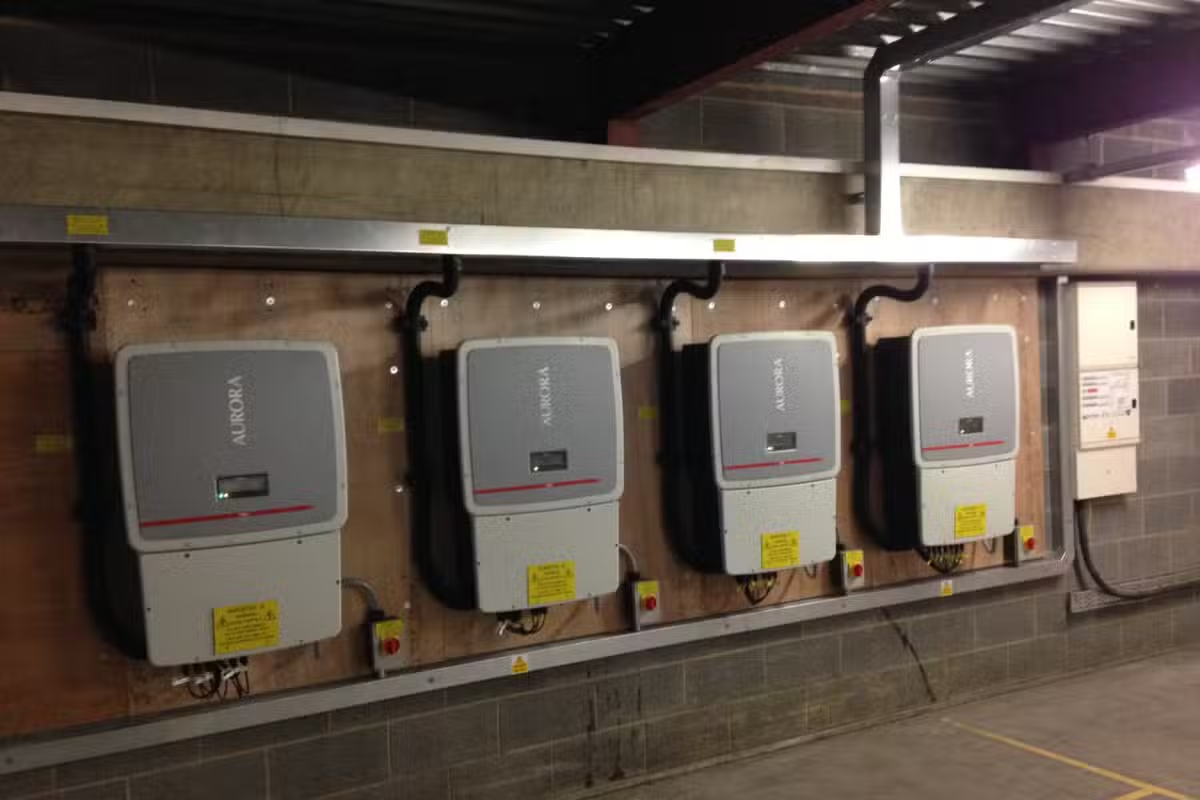
Battery has its own inverter and ties to the home’s AC circuit. Better for retrofits where there’s already a working string inverter, or where solar and battery are physically far apart. Slightly lower efficiency, two warranties, two pieces of kit. We use AC-coupled on retrofits to 2014-2020 installs where ripping out the existing inverter isn’t cost-effective.
Key specifications to compare
- Usable capacity (kWh)- not the same as nameplate. A 16.1kWh Fogstar has ~15.3kWh usable at 95% DoD. Compare usable, not nameplate.
- Continuous power output (kW)- how much the battery can deliver simultaneously. 5kW is enough for most homes; 7kW+ if you run heat pump + EV + cooker.
- Round-trip efficiency- how much energy you get back vs what you put in. LFP batteries hit 92-96% round-trip; below 90% indicates a poor design.
- Voltage class (LV vs HV)- must match your inverter. LV (~48-55V) for Solis under 15kW; HV (~150-500V) for Solis above 15kW.
- Modularity- can you add modules later? Fogstar Energy ECO and Pylontech Force H3 are both stackable.
- Communication protocol- CAN bus or RS485 to talk to the inverter; Modbus or local API for Home Assistant.
Brands worth considering in 2026
| Brand | Best for | Spectrum recommendation |
|---|---|---|
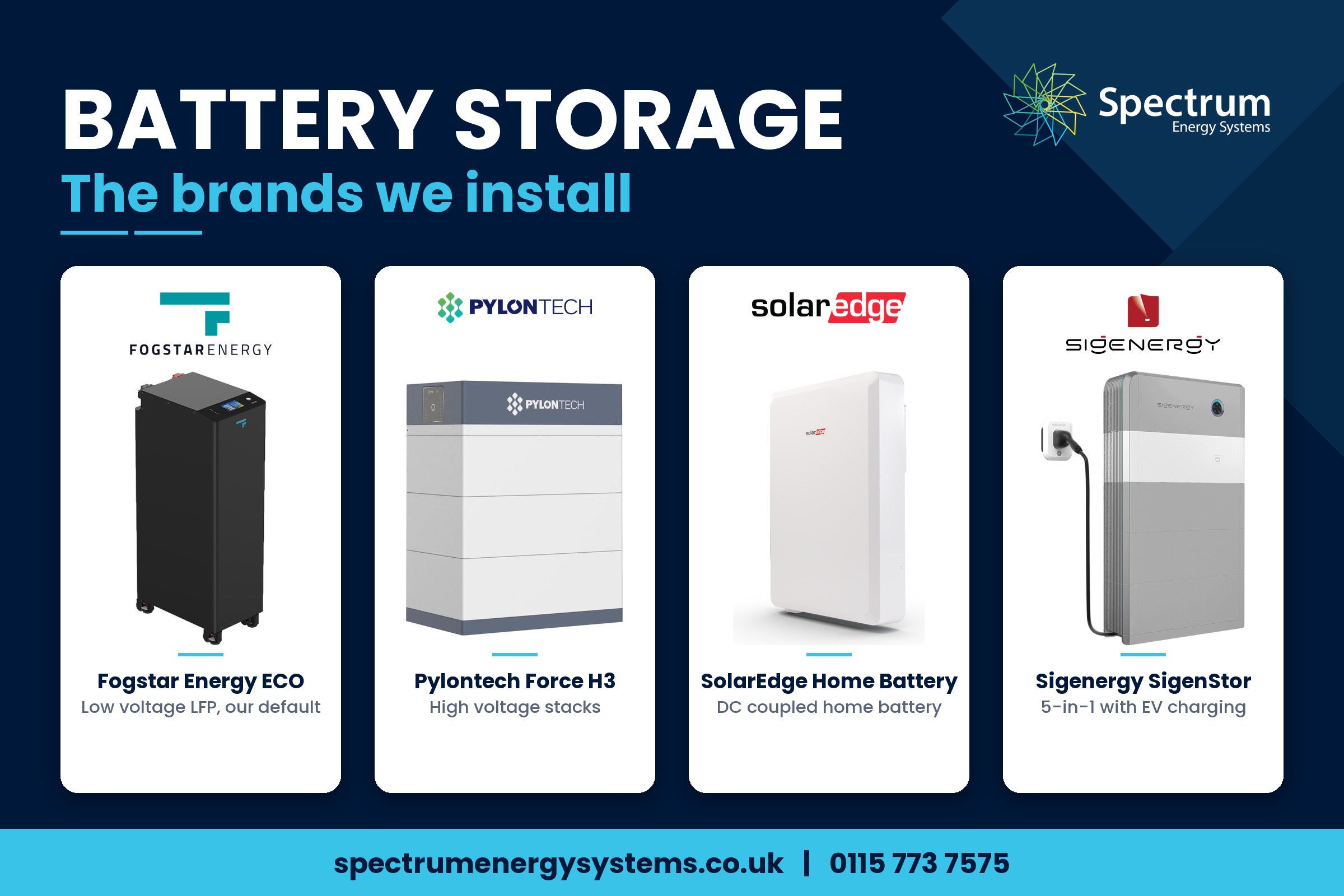
| Fogstar Energy ECO | LV Solis hybrid, typical UK home | ✓ Default LV pick. 16.1kWh module, LFP, 10-year warranty, full Modbus/Home Assistant. |
| Pylontech Force H3 | HV Solis hybrid, higher consumption | ✓ Default HV pick. Stackable in 5.32kWh modules to 25.5kWh per stack, LFP, IP55 rated. |
| Sigenergy SigenStor | Premium all-in-one with EV charger | Strong product on the higher-end - we fit it on request but Fogstar/Pylontech cover most enquiries. |
| SolarEdge Energy Bank | SolarEdge inverter installs | Locked to SolarEdge ecosystem; only relevant if SolarEdge is already specified. |
| Tesla Powerwall | Closed-ecosystem all-Tesla setups | Capable hardware but closed firmware limits Predbat integration. See our Tesla vs Fogstar comparison- we don’t default to it. |
Inverter compatibility - the make-or-break decision
Battery brand follows inverter voltage class. Get this wrong and the battery won’t talk to the inverter at all.
1 Up to 15kW inverter (most UK homes)
Use a Solis LV hybrid inverter (S6 range). Pair with Fogstar Energy ECO 16.1kWh. LV class battery, ~48V nominal. Spectrum’s default stack.
2 Above 15kW inverter (large homes, EV+heat pump combos)
Use a Solis HV hybrid (S6-EH3P-K-H range). Pair with Pylontech Force H3 (HV class, ~150-500V). Stack to 25.5kWh per tower.
3 Three-phase commercial
Solis-50K or larger three-phase hybrids in parallel, with Pylontech Force H3 stacks or Fogstar outdoor cabinets. Commercial DNO approval (G99 Type B) required.
Where to install the battery
- Garage- the typical UK installation location. Temperature-stable, near the consumer unit, accessible for maintenance.
- Utility room or hallway- fine if the wall is suitable and the temperature range is right.
- Plant room- common on heat-pump-equipped homes; ventilation must allow heat dissipation.
- External / outdoor cabinet- on commercial sites or where indoor space is unavailable. Use Pylontech Force H3 (IP55) or Fogstar outdoor cabinet variants. Cold-weather de-rating applies below 0°C.
What to avoid: lofts (temperature swings + ladder access), unheated outhouses (winter cold cuts capacity), or anywhere within 600mm of a habitable room boundary that hasn’t been signed off for battery-class fire separation. We confirm location at site survey.
Smart features that actually matter
Forget the marketing. The smart features that change real-world performance are:
- Modbus or local API access- lets Home Assistant talk to the battery directly.
- Time-of-use scheduling- via inverter or external software (Predbat).
- Per-cell BMS monitoring- alerts on cell-level imbalance before they become a problem.
- Firmware updates- over-the-air or installer-pushed.
What doesn’t matter: glossy companion apps with mood lighting. The decisions Predbat makes are 100x more important than the dashboard appearance.
Want help sizing and specifying?
Spectrum’s MCS engineers will design the system, size the battery properly, and configure Home Assistant + Predbat as part of the install - subject to a no-obligation site survey.
Request a feasibility assessmentWarranty & lifespan
The two warranties to look at:
- Cycle warranty- e.g. “8,000 cycles to 80% capacity.” This is the operative number for daily-cycled domestic use.
- Time warranty- e.g. “10 years.” Hits whichever comes first.
Fogstar Energy 16.1kWh: 10 years / 8,000 cycles. Pylontech Force H3: 10 years / 6,000 cycles. Both are realistic for normal cycling patterns - you’ll hit the 10-year mark before the cycle limit on most homes.
Backup / off-grid capability
Most UK homes don’t need true backup - mains is reliable and faults are typically resolved within a few hours. Where backup makes sense:
- Medical equipment dependency
- Rural / overhead supply with regular outages
- Home office with no commute fallback
For backup we fit either Solis EPS (emergency power supply, single-circuit) or a more comprehensive backup gateway. It adds 5-10% to the install cost and a longer commissioning day.
Future-proofing
Five things to think about before signing the order:
- Modular expansion- can you add capacity later? Fogstar and Pylontech both stack.
- EV charger compatibility- will the inverter cooperate with a smart EV charger? Solis works with most OCPP-compatible chargers.
- Heat pump compatibility- if you might add a heat pump, size the battery for that scenario.
- Tariff flexibility- insist on an open inverter/battery that can switch between Octopus tariffs as the market evolves.
- Software automation- Modbus access future-proofs against new tariffs that haven’t been invented yet.
Safety
UK battery installs follow IET Code of Practice for Electrical Energy Storage Systems plus BS 7671. Headline requirements:
- 30-minute fire separation between battery and habitable rooms (typically met by garage installation)
- Smoke detection in the battery’s location
- Operating temperature range respected (typically 0 to 50°C for LFP, with reduced performance below 5°C)
- Manufacturer-specified clearance to combustibles (usually 100-300mm)
- DC isolator and AC isolator on either side of the inverter
Every Spectrum install goes through MCS-compliant commissioning and is signed off by a qualified electrician.
Common mistakes to avoid
- Wrong voltage class. Fitting an HV battery to an LV inverter (or vice versa). They won’t talk. Always specify the battery against the inverter.
- Under-sizing for Agile. Buying 5kWh because “that’s enough for evening peak” misses 60% of Agile’s arbitrage opportunity.
- Closed-ecosystem batteries. Locks out Predbat. Costs money in the long run.
- Skipping Modbus access. Inverters without open Modbus can’t be properly automated.
- Buying brand-only. The headline brand matters less than chemistry, voltage class and warranty terms.
Example Spectrum specifications
| Household | Inverter | Battery | Indicative all-in |
|---|---|---|---|
| 3-bed semi, no EV | Solis S6-EH1P5K-L-PRO (5kW LV hybrid) | Fogstar Energy ECO 16.1kWh | £11,500 - £12,500 |
| 4-bed detached, EV | Solis S6-EH1P6K-L-PRO (6kW LV hybrid) | Fogstar Energy ECO 16.1kWh | £12,500 - £13,500 |
| Large 5-bed + heat pump | Solis S6-EH3P15K-H (15kW HV hybrid) | Pylontech Force H3 25.5kWh | £16,500 - £19,000 |
| Commercial unit, daytime use | Solis-50K three-phase hybrid | Pylontech Force H3 51kWh stack | From £28,000 +VAT |
Prices indicative, no-obligation site survey required. Domestic installs are 0% VAT under the current treasury regime - see our 0% VAT article.
FAQs
What size solar battery do I need for a UK home?
For most UK households the right answer in 2026 is 13-16kWh of usable capacity. A 3-bed semi without EV or heat pump runs comfortably on a 16kWh Fogstar; a 4-bed detached typically wants 16-24kWh; an EV household 16-24kWh; a heat pump household 24-32kWh. Spectrum’s default Solis LV + Fogstar 16.1kWh covers most domestic enquiries.
Which battery brand does Spectrum fit by default?
Fogstar Energy ECO 16.1kWh on any Solis LV hybrid inverter (up to 15kW). Pylontech Force H3 stacks on Solis HV inverters (above 15kW). Both are LFP, fully Home Assistant and Predbat compatible, and supplied as matched stacks so warranty and commissioning are one job.
AC-coupled or DC-coupled - which is better?
DC-coupled (through a hybrid inverter) is more efficient on new builds because solar passes through fewer conversions to reach the battery. AC-coupled makes sense for retrofits where an existing string inverter is already installed. Spectrum’s default is DC-coupled via a Solis hybrid; we use AC-coupled on retrofits to legacy 2014-2020 systems.
How long should a solar battery last?
Modern LFP batteries are rated for 6,000-10,000 cycles to 80% end-of-warranty capacity, which works out to 15-20 years of normal daily cycling. Fogstar 16.1kWh and Pylontech Force H3 both ship with 10-year warranties. Real-world degradation we’ve monitored from 2018 onward is tracking closer to 0.5% per year than the warranted 2%.
Does my battery need backup capability?
Most UK homes don’t truly need EPS or off-grid backup. Mains reliability is high, faults are typically resolved within a few hours, and adding backup adds cost and complexity. We fit backup where a customer specifically wants it (medical equipment, rural location, home office) but don’t push it as standard.
Conclusion
The right solar battery in 2026 isn’t a brand decision - it’s a configuration decision. Match the chemistry to safety (LFP), the capacity to your household (13-32kWh on a sliding scale), the voltage class to the inverter (LV under 15kW, HV above), and the software stack to your tariff (Home Assistant + Predbat against Octopus Agile). Spectrum’s defaults - Solis hybrid + Fogstar (LV) or Pylontech Force H3 (HV) - cover 95% of the UK domestic market because they line all of that up out of the box.
Related reading
- How much solar battery storage do I need?
- Fogstar vs Pylontech: UK comparison
- LFP vs NMC solar batteries
- Best solar battery for Octopus Agile
- Tesla Powerwall vs Fogstar
Speak to Spectrum Energy Systems
MCS NIC200223. We design, install and configure batteries across the East Midlands - Solis hybrid, Fogstar or Pylontech, Home Assistant and Predbat against Octopus Agile. One quote, one warranty.
Request a feasibility assessment