Solar Panels for Business Premises: The Owner's Guide
Most UK business premises suit rooftop solar. What matters is your roof type, your three-phase supply, and how much electricity you use during the day. Expect roughly £850 to £1,100 per kWp installed (ex-VAT), G99 grid approval before connection, and almost no disruption to trading while the work happens on the roof.
In This Guide
Is Your Roof Suitable? It Depends on the Building Type
The first question we answer on any feasibility assessment is what the roof is made of and how it is pitched. Different commercial buildings take panels in different ways, and the mounting method changes with them.
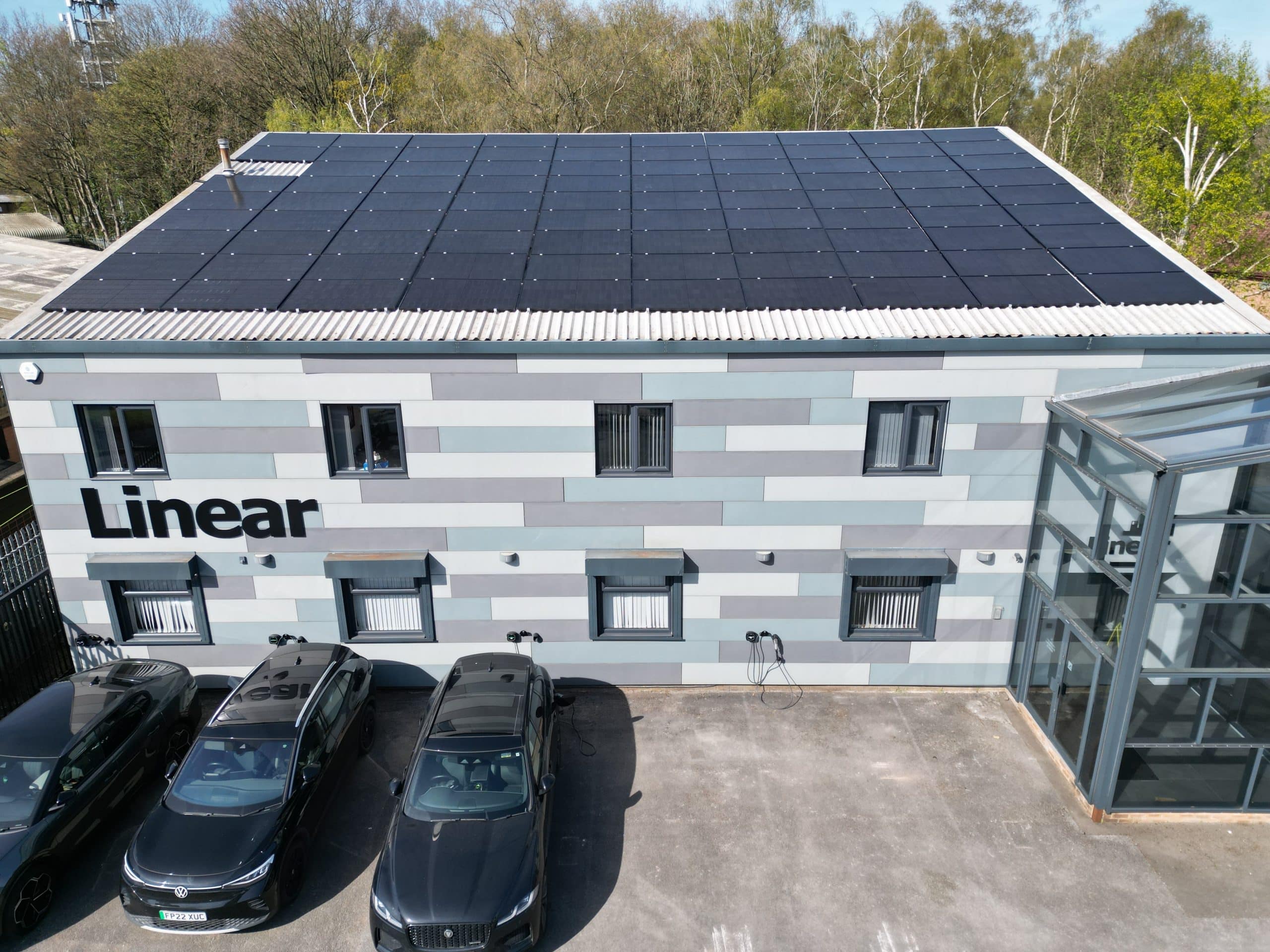
Steel portal frame with a metal roof. The classic warehouse or industrial unit, and the easiest building type to fit. Panels clamp directly to the trapezoidal or corrugated sheet using roof-specific fixings, with no penetrations through the weatherproof layer on most profiles. The Linear Insulation building pictured here took a 66.85kW JA Solar array on exactly this construction. The one thing we always check is the age and condition of the sheet: if a re-clad is due within five years, do it before the panels go on, not after.
Flat roofs. Panels sit on a ballasted mounting system, angled frames weighed down with blocks rather than bolted through the membrane. The structural engineer's question is whether the deck can carry the extra load, which a survey answers. Flat roofs also allow an east-west panel layout, which spreads generation across more of the working day. Our 35kW installation for Johns of Nottingham used exactly this arrangement on a three-storey flat roof.
Pitched tile or slate roofs. Common on offices, shops and converted premises. These are fitted the same way as domestic systems, with hooks fixed to the rafters beneath the tiles. Perfectly workable, just slower per panel than a metal shed roof.
Asbestos cement roofs are the main hard stop. We do not fix to them, so the realistic options are replacing the roof first or looking at a different roof face or a ground mount.
Single-Phase or Three-Phase? Check Before You Plan Anything
Your electricity supply sets the ceiling on system size. Most business premises have a three-phase supply, which comfortably supports commercial-scale arrays. A minority of smaller premises, converted houses, small shops and rural units, are on single-phase, which in practice limits the inverter and therefore the system size unless the supply is upgraded.
You can check without an electrician: look at your main incoming fuse. One fuse and one meter tail usually means single-phase; three fuses means three-phase. We confirm it properly at the survey, but knowing early saves everyone time, because it shapes the whole design.
Your Consumption Profile Drives the Sizing, Not the Roof
A common mistake is sizing the system to fill the roof. The better approach is sizing it to your consumption, because electricity you use on site is worth several times more than electricity you export. Businesses that run through the day are the best fit for solar for exactly this reason.
Manufacturing units, food producers, growers with refrigeration, offices full of IT, and retail with chillers all consume heavily during daylight hours, so most of what the roof generates gets used on site. A venue that trades mainly in the evening will use less of its own generation directly, which is where battery storage starts to make sense, holding the daytime surplus for use after dark. Half-hourly meter data, which most commercial suppliers can provide, lets us model this precisely rather than guessing.
G99 Grid Approval: Sorted Before Installation, Not After
Any commercial-scale system needs permission from the Distribution Network Operator (DNO) before it connects to the grid. For systems above 3.68kW per phase, that means a G99 application, submitted and approved before the installation goes ahead. Across most of the East Midlands the DNO is National Grid Electricity Distribution.
The application includes a single line diagram of the proposed system and details of the inverters. Approval timescales vary with the DNO's workload and how busy your local substation is. Occasionally the DNO caps the export allowance, in which case the system is fitted with an export limitation device and the design leans harder on self-consumption.
We also offer a standalone grid application service at £500 for businesses that want to know what the network will allow before committing to anything. If the DNO refuses an extension, the £500 goes towards reconfiguring the system you already have, and if you proceed with an installation, it is credited against the job.
Planning Permission: Usually Not Needed
Rooftop solar on commercial buildings is normally permitted development in England, provided the panels sit within the limits set out in the government's planning guidance for renewable energy. The main exceptions are listed buildings, premises in conservation areas, and installations that would protrude significantly above the roofline. Flat-roof systems on taller buildings occasionally need a check on height limits. We flag any planning question at the survey stage, before you have spent anything.
VAT and Capital Allowances
Commercial solar is priced plus VAT. If your business is VAT registered, you reclaim it in the normal way, so the working number for your appraisal is the ex-VAT price. The zero rate that applies to domestic installations does not extend to business premises.
Solar equipment also qualifies for capital allowances, which reduce the corporation tax bill in the years after installation. The rules, rates and worked examples are covered in our separate guide to capital allowances on solar PV. Speak to your accountant about which route fits your circumstances; we are installers, not tax advisers.
What It Costs and What Drives the Payback
Commercial installations we quoted in 2026 have generally landed between £850 and £1,100 per kWp installed, ex-VAT, with the lower rates on larger, simpler roofs. Four things drive how quickly the system pays for itself:
- Self-consumption percentage The more of your generation you use on site, the faster the return. This is the biggest lever by far.
- Your unit rate Businesses paying more per kWh save more per kWh displaced. Anyone who renewed a supply contract recently knows which direction those rates went.
- System size Bigger systems cost less per kWp, so well-matched larger arrays tend to return faster.
- Roof complexity A clean metal roof installs quickly; scaffolding-heavy or ballasted jobs carry more labour.
As a real reference point: a 49.68kWp system we quoted at £37,000 plus VAT, for a business consuming around 40,000kWh a year, worked out at a payback of circa 4 years on current electricity prices. That figure is illustrative and specific to that site's consumption; your own number comes out of the feasibility assessment.
Find Out What Your Roof Could Do
Send us a recent electricity bill and your address, and we will tell you honestly whether solar stacks up for your premises. It starts with a free remote roof and energy assessment, so we can see what fits and give you an idea of costs. Prefer us to visit first? We can do that too. Design and quote normally within 2 to 4 days.
Book a Feasibility AssessmentWhat Happens During Installation (and What It Disrupts)
The question every owner asks: do we have to stop trading? Almost always, no. The work happens on the roof and in the plant room, away from your operation. Here is the typical sequence for a commercial job:
Step 1: Survey and design
We survey the roof, the supply and the switchgear, then design the system from the survey and quote from the design, normally within 2 to 4 days.
Step 2: G99 approval
The grid application goes in and the DNO's approval comes back before any kit is ordered. Nothing is installed at risk.
Step 3: Access and mounting
Scaffolding or edge protection goes up, then the mounting system: clamps on metal roofs, ballast trays on flat roofs, rafter hooks on tiles. All roof-level work.
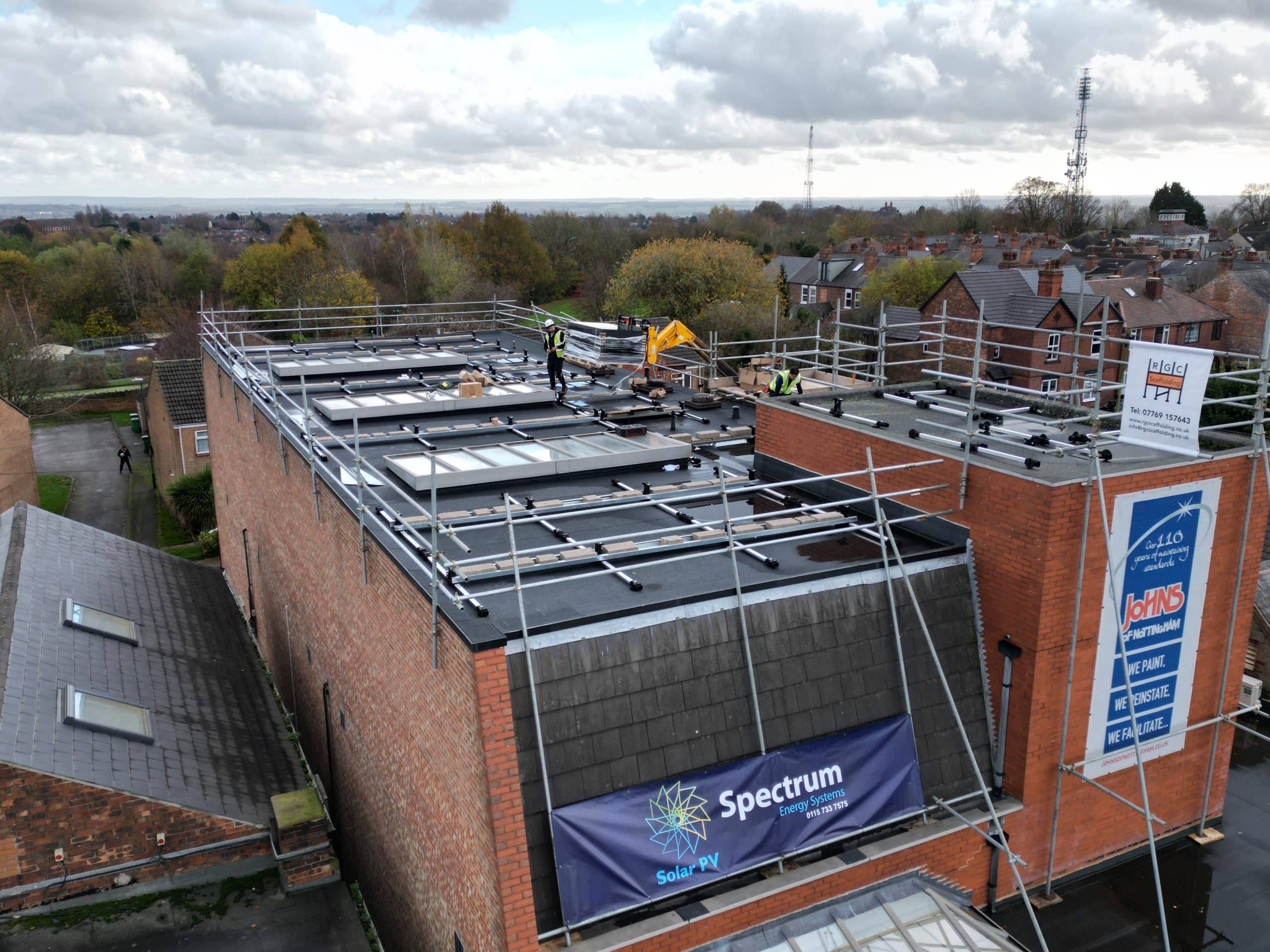
Real job: Johns of Nottingham, 35kW flat roof. This is the ballast mounting stage on their three-storey city-centre premises, rails and weighted trays laid around the rooflights without a single bolt through the membrane. The finished system used JA Solar all-black panels in an east-west layout to spread generation across the working day. The business traded normally throughout the installation. We have installed on working sites from this city rooftop to the 177kWp Elsoms Seeds warehouse in Spalding and Jacksons Nurseries' 56kW growing operation in Bagnall.
Step 4: Panels and electrical
Panels are lifted and fixed, then cabled to inverters in the plant room. Deliveries are timed around your yard's quiet periods where it matters.
Step 5: Connection and commissioning
The one brief interruption: connecting the system into your distribution board needs a short, planned power shutdown, agreed with you in advance and typically scheduled for the quietest window. Then the system is tested, commissioned and switched on.
After commissioning you receive the handover pack with certificates, warranties and monitoring access, and the DNO is notified that the system is connected. Every Spectrum installation is carried out by our own in-house crews under our MCS certification (NIC200223), with a 5-year workmanship guarantee backed by QANW insurance.
Frequently Asked Questions
Do solar panels work on an old factory roof?
Usually, yes, if the roof sheet itself is sound. Metal roofs from the 1980s onwards generally take panels well. The exceptions are asbestos cement sheets, which we will not fix to, and roofs due a re-clad, which should be replaced before panels go on.
Will installation stop my business trading?
No. The work happens on the roof and in the plant room, so your operation continues as normal. The only interruption is a short, planned power shutdown when the system is connected to your distribution board, scheduled in advance for your quietest window.
How much do solar panels for business premises cost?
Commercial installations Spectrum quoted in 2026 generally landed between £850 and £1,100 per kWp installed, ex-VAT. A 50kW system therefore sits broadly in the £42,500 to £55,000 range depending on the roof. VAT-registered businesses reclaim the VAT.
Do I need planning permission for solar on a commercial building?
Usually not. Rooftop solar on commercial premises is normally permitted development in England. The main exceptions are listed buildings, conservation areas and systems protruding well above the roofline. We check the planning position as part of the survey before you commit to anything.
What is a G99 application and who handles it?
G99 is the grid connection application your Distribution Network Operator requires before a commercial-scale solar system connects to the network. Spectrum prepares and submits it, including the single line diagram, and we wait for approval before installing. We also offer a standalone £500 grid application service.
Does my business need a battery as well as panels?
Not always. A daytime-heavy business may use most of its generation directly, so panels alone stack up. Batteries earn their place where usage runs into the evening, where the DNO limits export, or where cheap overnight tariff rates can be stored and used through the day.
Does the site survey cost anything?
No, the site survey is free. We assess the roof, the electrical supply and your consumption pattern, then design the system from the survey and provide the quote from the design, normally within 2 to 4 days. There is no obligation attached to the assessment.
Our solar panel installers in Leicester fit systems for business premises across Leicestershire.
Related reading
- energy saving tips for UK businesses
- Are commercial solar panels worth it? The investment case in detail, with real figures.
- Capital allowances on solar PV How the tax relief works for UK businesses.
- Solar for commercial buildings Our service page for offices, units and mixed-use premises.
- Solar for agriculture For farms, growers and rural businesses.
For the full picture of what we install and how, start with our commercial solar overview.
Speak to Spectrum Energy Systems
In-house crews, MCS certification NIC200223, and over 10 MW connected across the East Midlands since 2011. Tell us about your premises and we will tell you what the roof can do.
Speak to Our Team