
How Solar Panels Can Lower Your Electricity Bills: UK Savings Guide 2026
With UK electricity prices remaining significantly higher than pre-2022 levels, more homeowners than ever are asking how solar panels can lower electricity bills. The answer is straightforward: a well-designed solar system can reduce your annual electricity costs by 50-70%, with savings depending on your usage patterns and system configuration.
This comprehensive guide explains exactly how solar panels cut your energy costs, what savings you can realistically expect, and how to maximise your return on investment in the East Midlands and across the UK.
What's In This Guide
- Do Solar Panels Really Lower Your Bills?
- How Solar Panels Reduce Your Bill
- How Much Can You Save?
- Solar Panel Payback Period
- Savings Over 25 Years
- Additional Ways Solar Saves Money
- Solar vs Traditional Electricity
- Can Solar Eliminate Your Bill?
- Maximising Your Savings
- Common Misconceptions
- Calculate Your Savings
- Is Solar Worth It?
- Start Saving Today
- Frequently Asked Questions
At Spectrum Energy Systems, established in 2011, we've helped hundreds of East Midlands homeowners slash their electricity bills through professionally designed solar installations. With over 10MW of connected solar capacity across Nottinghamshire, Derbyshire, Leicestershire, and Lincolnshire, we understand precisely what it takes to maximise savings in UK conditions.
Whether you're exploring domestic solar solutions for the first time or seeking to understand the solar energy financial benefits before committing, this guide provides the honest, fact-based insights you need to make an informed decision.
Do Solar Panels Really Lower Your Electricity Bills?
Yes—and the evidence is clear. Solar panels reduce electricity bills by generating free electricity from sunlight, directly offsetting the power you would otherwise purchase from your energy supplier. Every kilowatt-hour (kWh) your panels produce is a kilowatt-hour you don't buy at current grid rates.
At today's electricity prices, the savings accumulate rapidly. A standard 4kW domestic solar system generates approximately 3,400-4,000 kWh annually in the UK—a significant portion of an average home's electricity needs. Your actual savings depend on how much you use directly versus export to the grid.
Real Savings From UK Solar Installations
Understanding realistic savings expectations helps set appropriate goals for your solar investment. Based on our installations across the East Midlands, here's what typical households experience:
| Home Type | Typical System Size | Annual Generation | Bill Reduction |
|---|---|---|---|
| Small terrace/flat | 2-3kW | 1,800-2,700 kWh | 40-55% |
| Average semi-detached | 3.5-4.5kW | 3,200-4,100 kWh | 50-65% |
| Large detached home | 5-8kW | 4,500-7,200 kWh | 55-75% |
| High consumption home | 6-10kW + battery | 5,400-9,000 kWh | 65-85% |
These figures assume typical self-consumption rates (using 30-50% of generated electricity directly) combined with Smart Export Guarantee payments for surplus electricity. Actual savings vary based on your usage patterns, tariff structure, and system configuration.
Calculate Your Potential Savings
Get a personalised assessment of how much solar panels could save on your electricity bills
Get Your Free Quote Speak to Our TeamHow Solar Panels Reduce Your Electricity Bill
Solar panels lower electricity costs through several interconnected mechanisms. Understanding each helps you maximise savings and make informed decisions about system sizing and usage patterns.
Offsetting Grid Electricity Consumption
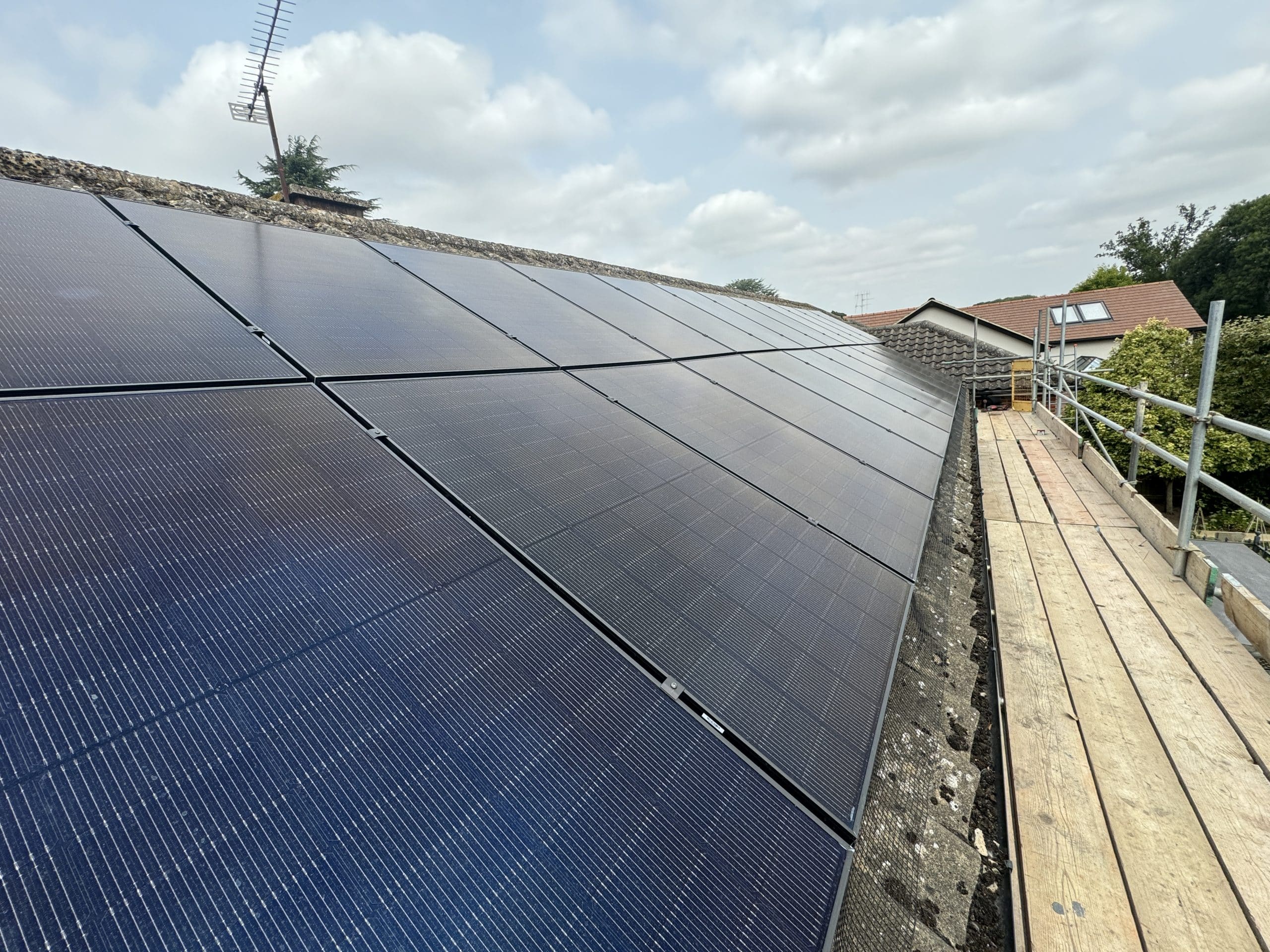
The primary way solar panels save money is simple: they generate electricity you would otherwise buy. During daylight hours, your panels produce power that flows directly into your home, supplying appliances, lighting, and systems without drawing from the grid.
This "self-consumption" delivers the highest savings because you avoid the full retail electricity price. Every unit you generate and use directly saves you the cost of buying from the grid—significantly more valuable than exporting surplus at lower SEG rates.
Key self-consumption strategies include:
- Running high-consumption appliances during peak solar hours: dishwashers, washing machines, and tumble dryers during midday
- Programming heating and hot water systems: to maximise daytime usage when solar generation peaks
- Charging electric vehicles during daylight: using smart EV charging systems that prioritise solar power
- Using smart home controls: to shift consumption automatically based on generation
Smart Export Guarantee Payments
When your panels generate more electricity than you're using, the surplus flows to the national grid. Under the Smart Export Guarantee (SEG), energy suppliers must offer payment for this exported electricity. The SEG replaced the older Feed-in Tariff scheme (similar to net metering savings programmes in other countries), providing ongoing income for your surplus generation.
SEG rates vary significantly between suppliers. Some suppliers offer premium rates for flexible export arrangements (such as time-of-use export tariffs). Whilst export payments are lower than retail savings, they still contribute meaningfully to your overall financial return.
For a typical 4kW system, annual SEG income supplements your direct savings and improves overall returns. Contact energy suppliers directly to compare current SEG rates.
Protection Against Peak Rate Charges
Many electricity tariffs now feature time-of-use pricing, charging higher rates during peak demand periods (typically 4pm-7pm). Solar panels generate most electricity during midday hours, helping you reduce grid consumption before peak pricing kicks in.
When combined with battery storage, you can store solar-generated electricity during the day and use it during expensive peak hours—avoiding the highest tariff rates entirely. This strategy can provide additional annual savings for households on time-of-use tariffs.
Maximising Your Solar Savings
The key to maximising electricity bill reductions lies in using as much of your solar generation directly as possible. Shifting consumption to daylight hours, adding battery storage, and choosing smart home systems can boost self-consumption from a typical 30% to 60-80%—potentially doubling your effective savings.
How Much Can You Save With Solar Panels?
Savings from solar panels vary based on several factors. Understanding how solar reduces utility costs and what determines your average solar panel savings helps set realistic expectations. Let's examine the key variables affecting your potential savings.
Your Current Electricity Costs
The higher your current electricity bills, the more you stand to save with solar. Households with higher electricity consumption typically achieve the fastest payback periods and highest lifetime savings. If your bills are lower, solar still makes financial sense—the payback period simply extends slightly.
Solar System Size
System size directly influences savings potential. A larger system generates more electricity, but only delivers proportional savings if you can use or export that generation. Choosing the right solar panel configuration involves balancing system size against your consumption patterns and available roof space.
Our MCS-accredited engineers analyse your electricity usage to recommend optimal system sizing—ensuring you maximise savings without overspending on excess capacity.
Location and Roof Orientation
The East Midlands receives approximately 900-1,050 kWh of solar radiation per square metre annually—comparable to much of central Europe and sufficient for excellent solar performance. Within this region, local variations exist:
| Roof Orientation | Performance vs South-Facing | Impact on Savings |
|---|---|---|
| South-facing (optimal) | 100% | Maximum savings potential |
| South-east or south-west | 95-97% | Negligible reduction |
| East or west facing | 80-85% | 10-15% lower savings |
| East-west split installation | 85-90% | Better morning/evening generation |
Roof pitch also affects performance—30-40 degrees is optimal for UK latitudes. However, modern panel efficiency means even non-ideal orientations deliver strong returns. Learn more about solar panel efficiency and what affects performance.
Solar Panel Payback Period: When Do You Break Even?
The solar panel payback period—how long until your savings equal your initial investment—is a crucial metric for evaluating your solar panel return on investment. For most UK homeowners, payback occurs within 6-10 years, with many systems now achieving payback in 6-8 years thanks to elevated electricity prices.
Calculating Your Payback Period
Payback calculation involves dividing your net system cost (after any grants or incentives) by your annual savings. For example:
Understanding Payback
Payback calculation involves dividing your net system cost (after any grants or incentives) by your annual savings. The typical payback period for UK solar systems is 6-10 years.
After payback, you enjoy essentially free electricity for the remaining 15-20+ years of the system's lifespan—delivering significant lifetime value. Contact us for a personalised payback calculation based on your specific circumstances.
Factors That Accelerate Payback
Several factors can shorten your payback period:
- Higher electricity consumption: More usage means more savings from self-consumption
- Daytime occupancy: Working from home or shift patterns increase self-consumption rates
- Electric vehicle ownership: EV charging during solar hours maximises direct usage
- Adding battery storage: Though it increases upfront cost, battery storage benefits can significantly boost self-consumption
- Rising electricity prices: Future rate increases accelerate savings accumulation
- Available grants: Schemes like the Nottingham City Council decarbonisation grants reduce upfront costs
Solar Savings Over 25 Years: The Long-Term Picture
Solar panels typically operate effectively for 25-30 years, with most manufacturers guaranteeing at least 80% output after 25 years. This extended lifespan transforms solar from an expense into a long-term investment generating returns for decades. Understanding how long solar panels last in the UK helps contextualise lifetime value.
Cumulative Savings Projection
Solar panels deliver compounding value over their lifespan:
- Years 1-8: Building toward payback as savings accumulate
- Years 8-10: Typical payback achieved—your initial investment recovered
- Years 10-25: Pure profit phase—essentially free electricity generation
- Year 25+: Many systems continue operating effectively beyond warranty period
As electricity prices rise over time (the long-term trend), your savings increase proportionally. This compounding effect means solar becomes more valuable the longer you own your system.
Protection Against Rising Energy Costs
One of solar's most valuable but often overlooked benefits is protection against electricity price volatility. Once installed, your solar generation cost is essentially fixed—you've already paid for the equipment. If grid electricity prices rise (as they have dramatically since 2021), your solar savings increase proportionally.
This "hedge against inflation" effect means solar panels become more valuable precisely when they're needed most—during periods of high energy costs. It's a form of energy security that paying monthly electricity bills can never provide.
Additional Ways Solar Panels Save You Money
Beyond direct electricity bill reductions, solar panels deliver several additional financial benefits that improve your overall solar power bill savings and monthly savings from solar panels.
VAT Savings on Installation
Residential solar panel installations currently qualify for 0% VAT (reduced from 5% in April 2022). This incentive significantly reduces upfront costs and accelerates payback. Note: This 0% VAT rate is scheduled to continue until at least March 2027, when it may revert to 5%.
Increased Property Value
Research consistently shows solar panels increase property values. Studies indicate homes with solar installations typically sell for 6-14% more than comparable properties without—with a 2024 Swansea University study finding an average 6-7% premium, whilst earlier DECC research suggested increases up to 14% for energy-efficient homes.
Buyers increasingly prioritise energy efficiency, with solar panels signalling lower running costs and environmental responsibility. Properties with solar often sell faster too, reducing time on market.
Reduced Maintenance Costs
Solar panels require minimal ongoing maintenance—typically just annual cleaning and periodic inspection. Unlike boilers or other home systems requiring regular servicing and eventual replacement, solar panels deliver decades of service with minimal upkeep costs. Regular solar panel maintenance ensures optimal performance throughout the system's lifespan.
Solar Panels vs Traditional Electricity: Cost Comparison
Visualising the difference between solar and grid electricity costs helps illustrate long-term value:
Without Solar
You pay full grid rates for all electricity
of electricity purchased from grid
(Subject to future price rises)
With Solar
Generate your own free electricity
of electricity purchased from grid
(Protected from price volatility)
Over the system's lifetime, solar significantly reduces your dependence on grid electricity whilst providing ongoing protection against future price rises.
Do Solar Panels Eliminate Your Electricity Bill Completely?
Solar panels significantly reduce but rarely eliminate electricity bills entirely. Understanding why helps set realistic expectations:
- Evening and night-time usage: Panels only generate during daylight, so you'll typically import some grid electricity during dark hours
- Winter generation reduction: UK winters mean shorter days and lower sun angles, reducing generation when heating demand peaks
- Standing charges: Remaining grid-connected incurs standing charges regardless of consumption
- High-demand periods: Occasional high consumption may exceed solar generation, requiring grid top-up
However, adding battery storage substantially increases self-sufficiency. Battery systems store daytime generation for evening use, potentially reducing grid dependence to 20-30% of total consumption. Combined with smart home energy solutions, some households achieve 80%+ self-sufficiency.
Maximising Self-Sufficiency
For households seeking maximum independence from the grid, we recommend solar panels paired with appropriately sized battery storage. This combination typically achieves 70-85% self-consumption, dramatically reducing bills whilst maintaining grid connection for backup reliability. Explore our guide to grid-tied vs off-grid systems for detailed comparisons.
Maximising Your Solar Savings
Extracting maximum value from your solar investment requires thoughtful system design and smart usage habits.
Optimal System Sizing
A properly sized system balances generation against consumption. Oversized systems generate more than you can use, leading to lower-value exports. Undersized systems leave potential savings unrealised. Our MCS-accredited engineers analyse your consumption patterns to recommend the ideal configuration. Read our ultimate guide to installing solar PV for comprehensive sizing guidance.
Energy Efficiency Improvements
Reducing overall energy consumption before installing solar amplifies your investment's impact. Simple efficiency measures—LED lighting, improved insulation, efficient appliances—reduce the system size needed to cover your consumption, lowering upfront costs whilst maximising bill reductions.
Smart Energy Management
Smart controls and home automation systems can automatically shift consumption to high-generation periods. Features include:
- Automated appliance scheduling based on solar output
- Smart EV charging that prioritises solar power
- Intelligent immersion heater controllers for hot water
- Whole-home energy management systems
Battery Storage Benefits
Adding battery storage increases self-consumption from typical 30-40% to 60-80%, substantially boosting effective savings. Whilst batteries add upfront cost, they're increasingly cost-effective as prices fall and electricity rates rise. Learn more about battery storage benefits and whether they suit your circumstances.
Regular Maintenance
Clean, well-maintained panels operate at peak efficiency. Annual cleaning removes dust, bird droppings, and debris that can reduce output by 5-15%. Our solar system health check services ensure your system continues delivering maximum savings throughout its lifespan. Proper solar panel cleaning is essential for optimal performance.
Common Misconceptions About Solar Savings
Several myths persist about solar panel savings. Let's address the most common:
Misconception: "Solar panels are too expensive to be worthwhile"
Reality: Solar panel costs have fallen over 80% in the past decade. Systems typically recover their cost within 6-10 years whilst generating free electricity for 15+ additional years. Contact us for a personalised quote based on your property.
Misconception: "UK weather is too cloudy for solar"
Reality: Solar panels work with daylight, not direct sunshine. The UK receives sufficient solar radiation for effective generation—Germany, with similar conditions, has far more installed solar capacity. Modern panels perform well in diffuse light conditions typical of British weather. Learn more about solar panel efficiency in UK conditions.
Misconception: "Payback takes too long to be worthwhile"
Reality: With 6-10 year typical payback and 25+ year lifespans, solar panels deliver 15-20 years of essentially free electricity after breaking even. Few home improvements offer comparable long-term returns. With electricity prices remaining elevated, payback periods are shorter than ever.
Misconception: "Savings aren't significant enough to matter"
Reality: With 50-70% bill reductions typical, savings are meaningful for most households. These savings compound over the 25+ year system lifespan, and as electricity prices rise, your savings increase proportionally.
How to Calculate Your Potential Solar Savings
Estimating your solar panel savings on electric bill requires a few key pieces of information. Whilst online home solar savings calculator tools provide rough estimates, professional assessment delivers accurate projections tailored to your specific situation:
Information You'll Need
- Annual electricity consumption: Check your bills or smart meter data (kWh per year)
- Current electricity rate: Your tariff details from your energy supplier
- Roof details: Approximate size, orientation, pitch, and any shading
- Daily occupancy pattern: When you're typically home using electricity
Simple Savings Estimate
For a rough calculation:
- Determine appropriate system size (typically 3-5kW for average homes)
- Estimate annual generation (multiply kW by 850-1,000 for UK)
- Assume 35-50% self-consumption depending on occupancy
- Calculate direct savings (self-consumed kWh × your electricity rate)
- Add export value (exported kWh × your SEG rate)
Understanding the Calculation
Your savings calculation depends on:
- System generation: A 4kW system typically generates 3,400-4,000 kWh annually in the UK
- Self-consumption rate: The percentage you use directly (typically 30-50% without battery)
- Grid offset value: Electricity you generate and use avoids grid purchase costs
- Export income: Surplus energy exported earns SEG payments
Contact us for a personalised savings calculation based on your electricity usage and property details.
For accurate, personalised projections, professional assessment is essential. Our expert solar installation services include detailed savings analysis based on your specific circumstances.
Is Solar Worth It for Lowering Your Bills?
Are solar panels worth it for savings? For most UK homeowners, the answer is yes—solar panels represent an excellent investment for reducing electricity bills. The financial case is strongest when:
- You have moderate to high electricity consumption
- You have suitable roof space (south-ish facing, minimal shading)
- You're planning to stay in your home for 5+ years
- You can shift some electricity usage to daylight hours
- You're concerned about future energy price increases
Even if not all conditions apply, solar often still makes financial sense. The combination of bill savings, SEG payments, property value increases, and protection against rising costs creates compelling returns for most situations.
The Bottom Line
Solar panels cut energy costs like few other home improvements can—paying for themselves typically within 6-10 years whilst continuing to generate returns for decades afterward. With electricity prices remaining elevated, solar represents both a practical bill-reduction strategy and a sound long-term investment.
Start Saving on Your Electricity Bills
Understanding how solar panels lower electricity bills is the first step toward taking control of your energy costs. With typical bill reductions of 50-70%, payback periods of 6-10 years, and decades of ongoing savings, solar represents a proven path to meaningful bill reductions.
At Spectrum Energy Systems, established in 2011, we've helped hundreds of East Midlands households slash their electricity bills through expertly designed solar installations. Our MCS-accredited engineers create tailored solutions that maximise savings for your specific property and usage patterns.
Whether you're exploring solar options as a first-time buyer or seeking to optimise an existing system, our team provides honest guidance focused on delivering genuine value. We serve homeowners across Lincoln, Nottingham, Derby, Leicester, and throughout Nottinghamshire, Derbyshire, Leicestershire, and Lincolnshire.
Ready to Lower Your Electricity Bills?
Get a free, no-obligation assessment of your solar savings potential from our expert team
Get Your Free Quote Contact Our TeamFrequently Asked Questions
About Spectrum Energy Systems: Established in 2011, we're MCS-accredited solar installers serving Nottingham, Derby, Leicester, Lincoln and the wider East Midlands. Our experienced engineers design and install tailored solar solutions for homes and businesses, ensuring maximum savings and return on investment. Learn more about our expertise or explore our solar installation case studies to see real-world results.
Savings and performance figures referenced in this article are typical estimates and may vary. Actual savings depend on individual circumstances including usage patterns, tariff selection, and system performance. Contact us for a personalised assessment.