Solar Inverter Fault Codes Explained: What They Mean and What to Do
A solar inverter fault code tells you which protection tripped. Grid codes such as OV-G-V or NO-Grid usually mean a supply problem that clears itself. Isolation and leakage codes such as ISO-PRO or ILeak-PRO need an engineer. Note the code, restart once at most, and call for help if it comes back.
In This Guide
Where to find the fault code
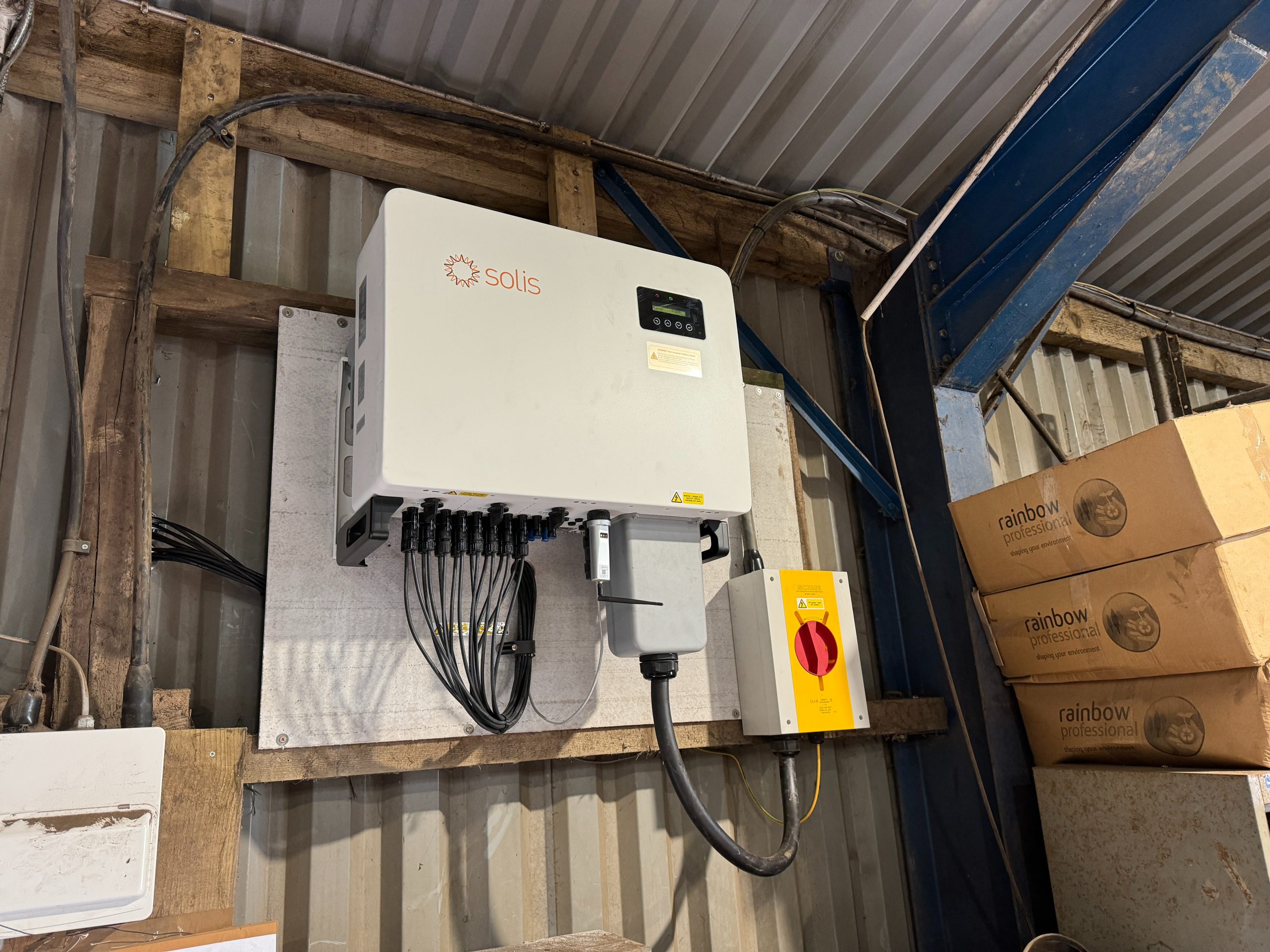
Most inverters show the current fault in two places: the small display or status LEDs on the unit itself, and the monitoring app. On a Solis inverter the code appears on the front LCD and in the alarm log inside the SolisCloud app. Other brands work the same way: SolarEdge uses the mySolarEdge app, Sunsynk its own portal, and older units rely on the display alone.
The app is usually the easier route because it keeps a history. A code that appeared once at 1pm on a sunny afternoon tells a very different story to one that fires every morning. Write down the exact code, the date and time, and what the weather was doing. That log is the single most useful thing you can hand an engineer.
Verified Solis fault codes and what they mean
Spectrum Energy Systems fits Solis hybrid inverters as standard, so these are the codes we see most often on service visits across the East Midlands. The meanings below come from Solis's official service documentation, not forum guesswork. If your inverter is another brand the wording differs but the same fault families apply.
| Code | Official meaning | What to do |
|---|---|---|
| OV-G-V | Grid voltage above the permitted limit | Usually the supply, not the inverter. Log when it happens. If it repeats on sunny afternoons, see the voltage rise section below. |
| UN-G-V | Grid voltage below the permitted limit | Often a network dip. If constant, the supply or a loose AC connection needs checking by an engineer. |
| OV-G-F | Grid frequency above the permitted limit | A network event. The inverter reconnects itself once the grid settles. Persistent alarms can mean wrong grid settings. |
| UN-G-F | Grid frequency below the permitted limit | Same as above. Self-clearing in almost all cases. |
| NO-Grid | The inverter cannot detect any grid voltage | Check whether the house has power and whether an AC breaker has tripped. If neighbours are off too, it is a power cut. |
| PV ISO-PRO | Insulation resistance on the DC (solar) side is too low. ISO-PRO01 points to the negative cable, ISO-PRO02 to the positive | A ground fault. Often moisture or damaged cable insulation. Do not keep resetting. Book an engineer. |
| ILeak-PRO | Leakage current from the PV system to earth detected | Related to insulation problems. Safe to leave the inverter off. Needs on-site testing. |
| DC-INTF | A fault detected on the DC side, internal or external | Can be loose DC connectors or string wiring. Solis states this cannot be diagnosed remotely, so it is an engineer visit. |
Sources: Solis service centre articles on grid alarms (OV-G-V, UN-G-V, OV-G-F, UN-G-F), PV ISO-PRO, ILeak-PRO and DC-INTF, published at solisinverters.com. Solis is the brand name of Ginlong Technologies.
The five fault families every brand shares
There is no need to memorise every code. Almost every alarm on any brand falls into one of five families, and the family tells you how worried to be.
- Grid faultsVoltage or frequency outside limits, or no grid detected. Usually the network's doing, not yours, and usually self-clearing. Only a problem if the same code repeats for days.
- PV and isolation faultsLow insulation resistance or leakage current on the solar side. Commonly caused by moisture in a connector, chafed cable under the array, or rodent damage. These are safety trips and need an engineer, not a reset.
- Ground and arc faultsThe inverter has seen current going somewhere it should not, or detected arcing on the DC side. Treat these seriously. Leave the system off and get it inspected.
- Internal and hardware faultsRelay failures, temperature sensors, internal communication errors. If a hardware code persists after one restart, the unit itself is failing. This is warranty or replacement territory.
- Communication and monitoring errorsThe data logger has lost Wi-Fi or the app shows the system offline. Often trivial. The inverter usually carries on generating; only the reporting has stopped. Check your router before anything else.
Safe checks you can do yourself
Step 1: Read and record the code
Note the exact code from the display or app, the time, and the weather. Take a photo of the screen if you can.
Step 2: Check whether it is a power cut
If the code is NO-Grid or the display is dead, check the lights in the house and ask a neighbour. Standard solar systems shut down in a power cut by design, a safety feature called anti-islanding.
Step 3: Check the monitoring app history
One-off grid alarms that cleared themselves need no action. A code repeating daily, or generation flat at zero on a sunny day, means something real.
Step 4: Check the isolators, only if you are confident
Your system has an AC isolator near the consumer unit and a DC isolator by the inverter. Confirm both are in the on position and no breaker has tripped. Look, do not open anything. If you are unsure, skip this step.
Step 5: Restart once, per the manufacturer's manual
Most manufacturers allow one controlled restart: AC off, DC off, wait the time stated in your manual, then DC on and AC on. Once. If the code returns, stop and call an engineer.
What never to do
- Never open the inverter casingInverters hold lethal DC voltage even after being switched off, and capacitors stay charged after isolation. There is nothing user-serviceable inside, and opening the case can void the warranty.
- Never reset repeatedlyIf one restart did not clear the code, ten will not either. Repeated resets on an isolation or arc fault mean repeatedly re-energising a circuit the inverter is trying to protect you from.
- Never touch the DC sideSolar panels cannot be switched off while the sun is up. The string cables between the roof and the inverter are live in daylight. DC work is for trained engineers with the right test kit.
When it is the grid, not your kit
The most common repeat alarm we see in the East Midlands is grid overvoltage, OV-G-V on a Solis, on sunny afternoons. Here is why. UK inverters must disconnect when the supply voltage goes above the limits set by the G98 and G99 connection standards. On a bright day, every solar system on your street is exporting at once, which pushes the local voltage up. If your street's supply already sits high, your inverter trips exactly as it is designed to.
That is not a fault with your equipment, and swapping the inverter will not fix it. Sometimes the fix is a settings adjustment within the permitted range. Sometimes it needs a conversation with the distribution network operator, which for most of the East Midlands is National Grid Electricity Distribution, and they can adjust the local transformer tap. We handle those DNO conversations for our service customers, because knowing what to ask for is half the battle. Our team deals with G98 and G99 grid connections every week.
When to call an engineer
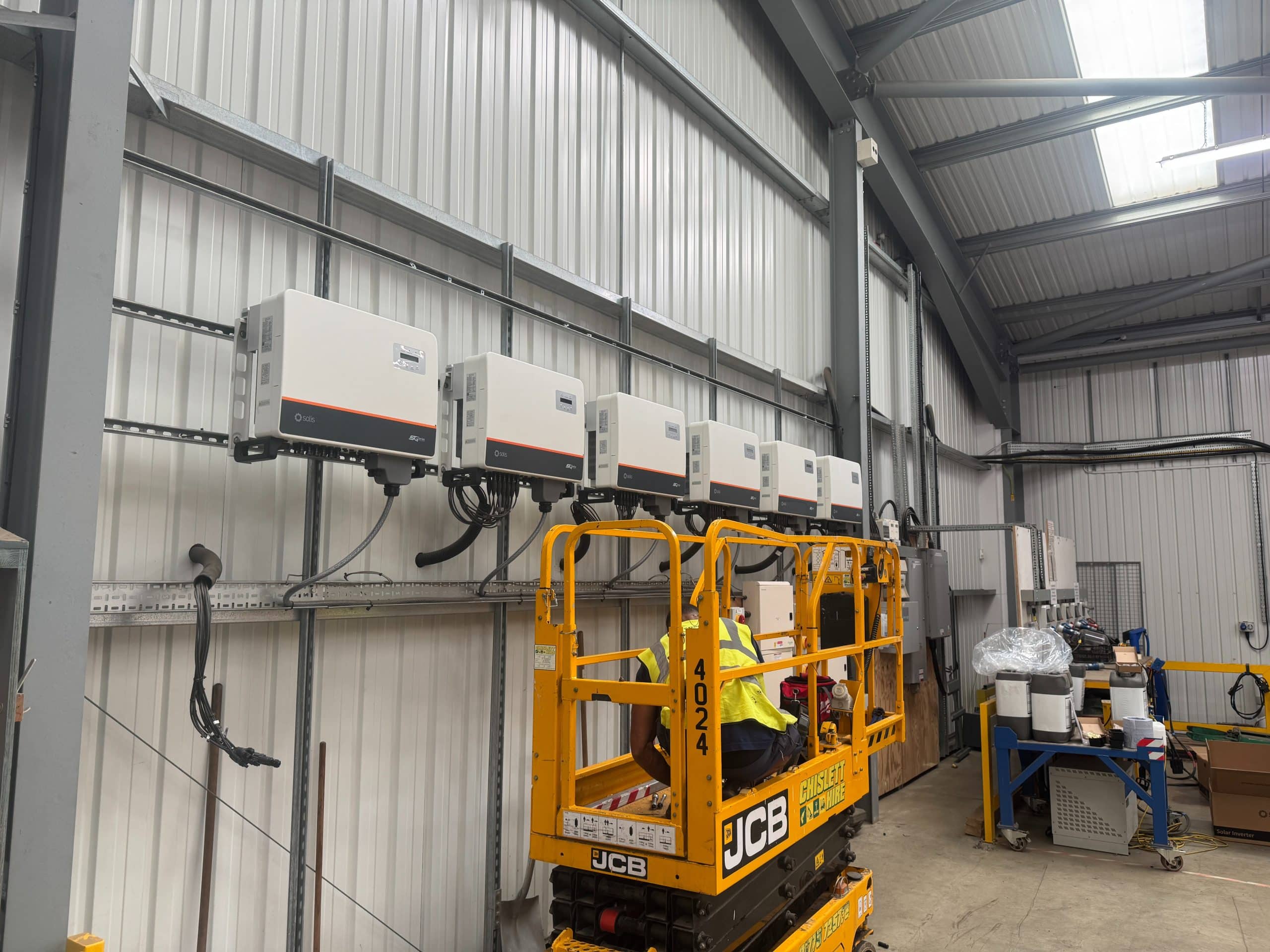
Call for help when a code repeats after one restart, when any isolation, leakage, ground or arc code appears, when the display is completely dead on a sunny day, or when generation has dropped and stayed low. Commercial sites should act faster: on a multi-inverter plant room like this one, a single tripped unit quietly costs money every daylight hour.
We service systems we did not install. If your original installer has disappeared, our takeover servicing guide explains how that works.
A Spectrum callout starts with a full system health check at £395 +VAT. That covers inverter diagnostics and fault log review, string testing, insulation resistance testing on the DC side, connection checks and a written report, through our solar system health check service. Because we test rather than guess, you find out whether the fix is a £40 connector or a new inverter before spending anything else.
Have this ready when you call
- The exact fault code and when it appears (photo of the display helps)
- The inverter make and model, from the label on the side
- Roughly when the system was installed, and by whom
- What the monitoring app shows: offline, zero generation, or alarms
- Anything that changed recently: new appliances, building work, heavy rain
Repair or replace: the honest line on old inverters
An inverter switches thousands of times a second inside a box that gets warm every day, so most last 10 to 15 years. Panels routinely outlive them. If your inverter is inside that window and throwing a hardware fault, repair or warranty replacement is usually the right call. If it is past 10 years old and faulting persistently, replacement is almost always better value than repair: parts for discontinued models are scarce, labour to fix an old unit costs a good share of a new one, and a modern hybrid inverter adds battery readiness and far better monitoring.
If the inverter is dead, a straight replacement typically costs £1,200 to £2,500 all-in, supplied, fitted and recommissioned. Our solar inverter replacement service covers what is included and how quickly it can be done.
Inverter showing a fault code?
Send us the code and the inverter model. We service Solis, SolarEdge, Sunsynk and most other brands across the East Midlands, whoever installed the system. MCS certified installer NIC200223.
Book a Diagnostic VisitFrequently asked questions
Why does my inverter say grid fault?
A grid fault code means the mains supply went outside the voltage or frequency limits your inverter is set to, so it disconnected to protect the network. It is usually the grid's doing, not your equipment's, and the inverter reconnects automatically once the supply settles. Investigate only if the same code repeats over several days.
Can I reset my solar inverter myself?
Once, yes, following the sequence in your manual: AC off, DC off, wait the stated time, then power back up in reverse order. Never open the casing, and never reset repeatedly. If the code comes back after one restart, the inverter is protecting you from a real fault, so book an engineer.
What does the ISO-PRO code mean on a Solis inverter?
PV ISO-PRO means the insulation resistance on the solar side is too low, which is a ground fault. ISO-PRO01 points to the negative cable, ISO-PRO02 to the positive. Common causes are moisture in a connector or damaged cable insulation. It needs on-site testing by an engineer, not repeated resets.
Why does my inverter trip on sunny afternoons?
Almost certainly grid voltage rise. When every solar system on the street exports at once, local voltage climbs, and UK inverters must disconnect above the G98/G99 limits. The fix is a settings adjustment within the permitted range or a conversation with your distribution network operator, which we can handle for you.
My inverter display is blank. Is it broken?
Not necessarily. First check for a power cut and check the AC breaker, because many inverter screens are powered from the mains side. Some models also sleep the display at night or dim it after inactivity. A screen that stays dead on a sunny day with the isolators on points to a failed unit.
Do fault codes mean my panels are faulty?
Rarely. Panels are the most reliable part of the system. Most codes point at the grid supply, the DC cabling and connectors, or the inverter itself. Isolation faults sometimes trace back to damaged cabling under the array, but the panels themselves are seldom the cause. Proper string testing identifies the real culprit.
How much does it cost to fix an inverter fault?
Our diagnostic health check is £395 +VAT and includes inverter fault log review, string and insulation testing and a written report. Simple fixes such as a connector or settings change cost little on top. A full inverter replacement, if the unit is dead, typically runs £1,200 to £2,500 all-in.
Will my solar panels work during a power cut?
Standard grid-tied systems shut down in a power cut, showing a NO-Grid style code, because anti-islanding rules stop them energising a dead network. That protects engineers working on the lines. Backup during an outage needs a hybrid inverter with a battery and a changeover arrangement fitted.
Related reading
- Problems with solar panels: a UK homeowner and business guide
- Why is my electric bill so high with solar panels?
- Solar repair when your installer goes bust
- The complete UK solar panel maintenance guide
For ongoing peace of mind, our domestic servicing plans catch faults before they cost you generation.