
How to Choose the Right Solar Panel Battery: A Complete UK Guide
Selecting the right solar battery involves balancing capacity, chemistry, and compatibility. With multiple technologies and dozens of brands available in the UK market, choosing solar battery storage for your home requires understanding what actually matters—and what's just marketing.
This solar panel battery selection guide cuts through the complexity to help you make an informed decision. Whether you're adding storage to an existing solar system or planning a complete new installation with home battery storage UK homeowners trust, you'll learn exactly what to look for and what to avoid.
What's in This Guide
- Quick Overview: Key Factors
- Understanding Solar Battery Basics
- Battery Chemistry Types Explained
- Determining Your Capacity Needs
- AC-Coupled vs DC-Coupled Systems
- Essential Specifications to Compare
- Popular Battery Brands in the UK
- Compatibility with Your Solar System
- Installation Location & Space
- Smart Features and Monitoring
- Warranty and After-Sales Support
- Future-Proofing Your Choice
- Safety and Certification Standards
- Common Mistakes to Avoid
- Step-by-Step Selection Process
- Real-World Selection Examples
- Frequently Asked Questions
- Conclusion: Making Your Decision
Need Expert Battery Advice?
Our MCS-accredited team has been designing and installing solar battery systems across Nottinghamshire, Derbyshire, Leicestershire, and Lincolnshire since 2011.
Get Your Free Quote Speak to Our TeamQuick Overview: Key Factors in Battery Selection
Before diving into technical specifications, consider these five factors that should guide your battery choice:
- Energy consumption patterns: When do you use most electricity? Evening-heavy usage suits different batteries than daytime or round-the-clock consumption.
- Solar system size and type: Your panel capacity, inverter brand, and system age determine which batteries are compatible.
- Available space and location: Indoor, garage, or outdoor installation affects which products suit your property.
- Future expansion plans: Planning an EV charger or home extension? Choose modular systems that can grow with your needs.
Understanding Solar Battery Basics
What Does a Solar Battery Do?
A solar battery stores excess electricity generated by your panels during daylight hours for use when the sun isn't shining. Without storage, surplus generation exports to the grid, only to be drawn back from the grid in the evening when you need it. Batteries capture this difference by enabling self-consumption of your own generation.
Beyond self-consumption, batteries provide backup power during grid outages, enable participation in time-of-use tariff optimisation, and reduce reliance on grid electricity during peak demand periods. Understanding the benefits of solar panel battery storage helps clarify whether storage suits your situation.
Grid-Tied vs Off-Grid Batteries
Most UK installations use grid-tied battery storage where batteries work alongside mains electricity. These systems automatically switch between solar, battery, and grid power based on availability and programming. Grid-tied batteries typically provide limited backup during outages unless specifically configured for emergency power supply (EPS).
Off-grid solar batteries require larger battery banks, backup generators, and more sophisticated charge controllers since there's no grid fallback. These suit rural properties without reliable mains connections but involve greater complexity and planning.
How Batteries Work with Solar Panels
Batteries integrate with solar systems through inverters, which convert direct current (DC) from panels into alternating current (AC) for home use. The connection method—AC-coupled, DC-coupled, or hybrid—affects efficiency and compatibility. We'll explore these options in detail below.
Key Understanding: Batteries charge and discharge through cycles. One full cycle equals discharging from 100% to 0% and back—though partial cycles (say, 80% to 20%) count proportionally. Solar battery lifespan is rated in total cycles, making battery depth of discharge an important consideration for longevity.
Battery Chemistry Types Explained
Lithium-Ion Batteries (Most Common)
Lithium solar batteries dominate the UK storage market, offering high energy density, long cycle life, and minimal maintenance. Two main chemistries compete for residential solar batteries:
Lithium Iron Phosphate (LFP/LiFePO4): Prioritises safety and longevity over energy density. LFP batteries typically deliver 4,000-6,000+ cycles, don't contain cobalt (reducing fire risk), and handle deep discharges well. Slightly larger and heavier than NMC alternatives but increasingly popular for residential applications.
Nickel Manganese Cobalt (NMC): Offers higher energy density, meaning more storage capacity in smaller packages. Most common in earlier home batteries (including Tesla Powerwall 2). Typical cycle life ranges from 1,000-2,500 cycles depending on operating conditions and depth of discharge. Requires more sophisticated thermal management than LFP.
Lead-Acid Batteries
Traditional lead-acid technology (AGM and gel variants) remains available but presents significant disadvantages for solar storage. Shorter lifespan (800-1,500 cycles), lower usable capacity (typically 50% depth of discharge), heavier weight, and ventilation requirements make lead-acid unsuitable for most modern home installations. These batteries may suit specific off-grid or backup applications where space and weight aren't constraints.
Emerging Technologies
Sodium-ion batteries are approaching commercial availability, promising sustainable chemistry without rare earth materials. Solid-state batteries may eventually offer superior safety and energy density. For current UK installations, however, lithium-ion remains the practical choice with proven track records and established supply chains.
Determining Your Battery Capacity Needs
This solar battery sizing guide helps you calculate the right battery capacity for solar panels based on your actual usage patterns and generation potential.
Calculating Daily Energy Consumption
Start with your electricity bills to understand actual consumption. The average UK household uses around 7-10kWh daily, though this varies significantly based on property size, occupant numbers, heating type, and appliance efficiency. Review your smart meter data or request half-hourly consumption figures from your supplier to understand when you use energy.
Focus on evening and overnight consumption—typically 4-8kWh for most households—since this represents the energy you'll draw from batteries when solar generation has stopped. Properties with electric vehicle charging, heat pumps, or electric heating will show higher figures.
Assessing Your Solar Generation
Your solar system's size determines how much energy is available for storage. A typical 4kWp system generates 10-14kWh daily during summer months but drops to 3-5kWh in winter. Monitoring data from your existing system provides the most accurate picture of available excess generation.
For new installations, professional solar design accounts for roof orientation, shading, and local conditions to predict realistic generation figures. Oversizing batteries relative to your solar capacity means storage you'll rarely fill.
Usable Capacity vs Total Capacity
Depth of Discharge (DoD) determines how much stored energy you can actually use. A 10kWh battery with 90% DoD provides 9kWh usable capacity. Most modern lithium batteries allow 90-100% DoD, though regularly discharging to very low levels may accelerate degradation.
Sizing Example: A household using 6kWh overnight with a 4kWp solar system might choose an 8kWh battery. This captures most summer excess whilst providing meaningful evening coverage. In winter, grid electricity supplements the reduced solar generation and shorter charging windows.
AC-Coupled vs DC-Coupled Battery Systems
Understanding AC vs DC coupled batteries is essential when selecting storage, particularly for retrofit installations. The choice affects efficiency and compatibility.
| Feature | DC-Coupled | AC-Coupled | Hybrid Inverter |
|---|---|---|---|
| Connection Point | Direct to solar panels | To home AC supply | Combines both approaches |
| Efficiency | Higher (fewer conversions) | Slightly lower (extra conversion step) | Highest (optimised pathway) |
| Retrofit Suitability | Limited (may require inverter replacement) | Excellent (works with any existing system) | Moderate (requires compatible panels) |
| Best For | New installations | Adding to existing solar | New integrated systems |
| Component Count | Shared inverter | Separate battery inverter | Single integrated unit |
| Brand Flexibility | Often locked to ecosystem | Maximum flexibility | Manufacturer-specific |
DC-Coupled Systems
DC-coupled batteries connect directly to solar panels, sharing the inverter or using a dedicated charge controller. Solar energy charges the battery before conversion to AC, minimising energy losses. This approach suits new installations where panel and battery selection can be coordinated from the outset.
AC-Coupled Systems
AC-coupled batteries connect to your home's electrical supply rather than directly to panels. This makes them compatible with virtually any existing solar system regardless of inverter brand or age. The battery includes its own inverter to manage charging and discharging. Slightly lower efficiency (typically 2-4% loss) is offset by installation flexibility and future upgrade potential.
Hybrid Inverter Systems
Hybrid inverters combine solar PV conversion and battery management in a single unit, streamlining installation and monitoring. These work well for new builds or complete system replacements but may limit future expansion to the same manufacturer's batteries.
Essential Battery Specifications to Compare
When conducting a solar battery comparison UK buyers should focus on these key specifications to find the best solar battery UK for their needs.
Capacity and Power Rating
Don't confuse capacity (kWh) with power output (kW). Capacity determines how much energy stores; power determines how quickly it can discharge. A 10kWh battery with 3kW output can power 3kW of appliances for approximately 3.3 hours, or lower loads for proportionally longer.
Continuous vs peak power matters for high-demand appliances. Kettles, toasters, and hair dryers draw 2-3kW briefly. If your battery's continuous output is 3kW but peak is 5kW, it handles these surges without issue.
Depth of Discharge (DoD)
Higher DoD percentages mean more usable capacity. Quality lithium batteries allow 90-100% DoD, though manufacturers may recommend limiting regular discharge to 80-90% for optimal longevity. Always compare usable capacity, not headline figures.
Round-Trip Efficiency
Solar battery efficiency measures energy lost during storage and retrieval. Round-trip efficiency shows how much stored energy you can actually use—typically 85-95% for lithium batteries. A 90% efficient battery storing 10kWh returns 9kWh. Higher efficiency batteries maximise the usable energy from the same solar generation.
Cycle Life and Warranty
Manufacturers warrant batteries by years, cycles, or throughput (total kWh delivered). Premium products offer 10+ years coverage with 70-80% capacity retention guarantees. Understand what's actually covered—some warranties exclude labour, limit claims after certain thresholds, or require specific installation conditions.
| Specification | Entry Level | Mid-Range | High Performance |
|---|---|---|---|
| Cycle Life | 2,000-3,000 cycles | 3,000-5,000 cycles | 5,000-10,000+ cycles |
| Warranty Period | 5-7 years | 10 years | 10-15 years |
| Capacity Retention | 60-70% at end of warranty | 70% at end of warranty | 70-80% at end of warranty |
| Round-Trip Efficiency | 85-88% | 90-92% | 92-96% |
| DoD | 80-90% | 90-95% | 95-100% |
Operating Temperature Range
UK climate suits most batteries, but installation location matters. Garages and outbuildings experience temperature extremes that may reduce efficiency or trigger protective shutdowns. Indoor installation typically ensures optimal operating conditions (5-25°C). Check manufacturer specifications for your intended location—some batteries include active heating or cooling for outdoor applications.
Popular Solar Battery Brands in the UK
Several solar battery brands UK homeowners commonly choose dominate the residential market, each with distinct strengths. Beyond the well-known Tesla Powerwall, alternatives UK installers recommend include GivEnergy, Enphase, and Sonnen. Your installer's experience with specific brands often matters as much as product specifications.
GivEnergy
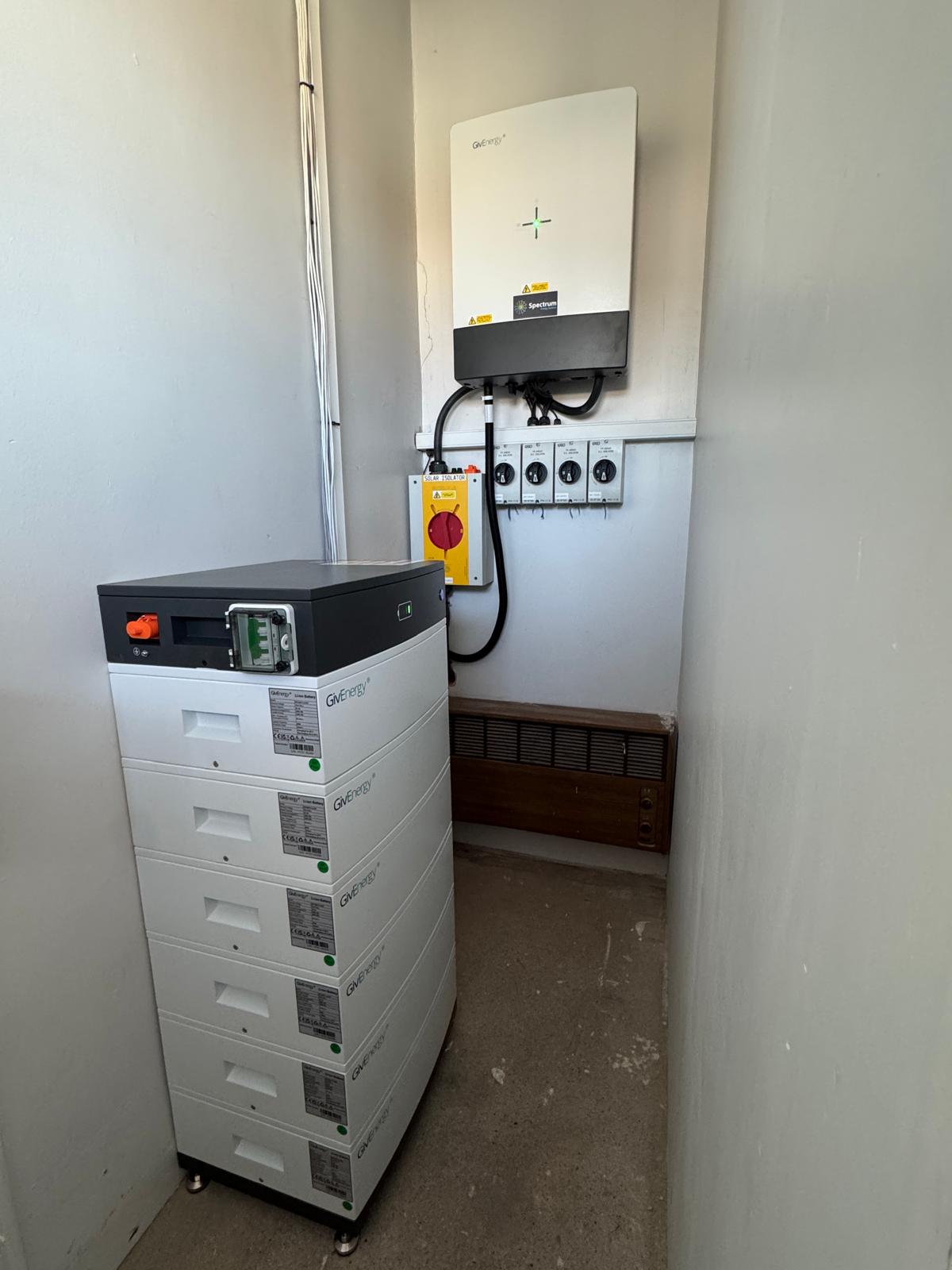
UK-based support, modular expansion (2.6kWh increments), excellent app interface, strong installer network. Popular choice for retrofit and new installations.
Tesla Powerwall
Proven track record, whole-home backup capability (Powerwall 3), sleek design, integrated solar gateway. Strong brand recognition with established UK support network.
Enphase IQ Battery
Modular micro-inverter approach, AC-coupled flexibility, excellent monitoring, suits existing Enphase solar systems. Highly scalable but multiple units needed for larger capacity.
Sonnen
German engineering, 10,000+ cycle LFP chemistry, Virtual Power Plant participation, outstanding build quality. Exceptional longevity with comprehensive warranty coverage.
BYD & Pylontech
Commercial-grade reliability, modular stacking, widely supported by hybrid inverter manufacturers. Popular with installers for flexibility and proven performance.
SolarEdge Energy Bank
DC-coupled efficiency, integrated with SolarEdge inverters and optimisers, comprehensive monitoring. Best suited for new SolarEdge installations.
Compatibility with Your Solar System
Inverter Compatibility
Some batteries work only with specific inverter brands (closed ecosystems), whilst others operate with any system (open protocol). If you have existing solar panels, check whether your current inverter supports battery integration or whether AC-coupled storage provides the most straightforward retrofit path.
Hybrid inverters from manufacturers like GivEnergy, SolarEdge, Solis, and Huawei often require matched batteries for full functionality. AC-coupled options from Enphase, Tesla, and Sonnen work independently of your solar inverter brand.
Expandability Options
Modular battery systems allow adding capacity later as needs evolve. GivEnergy, BYD, Pylontech, and Enphase offer stackable solutions. However, mixing battery ages or chemistries within strings can create imbalances—plan expansion within manufacturer-specified timelines (typically 2-3 years maximum between units).
Installation Location and Space Requirements
Indoor vs Outdoor Installation
IP ratings indicate environmental protection levels. IP65 or higher suits outdoor installation in UK conditions. Indoor installation (garage, utility room, or cupboard) provides better temperature control and accessibility for maintenance.
Physical Dimensions and Weight
A typical 10kWh battery measures approximately 600×1000×150mm and weighs 100-150kg. Wall mounting requires solid masonry or reinforced stud walls. Floor-standing units need stable, level surfaces. Consider access for installation—some properties require crane lifts or specialist handling for larger systems.
Ventilation and Safety
Lithium batteries require adequate ventilation and clearance from heat sources. Building regulations and manufacturer specifications define minimum distances from boilers, cookers, and other equipment. Professional installers ensure compliance with BS 7671 wiring regulations and any applicable fire safety requirements.
Smart Features and Monitoring
Mobile App Control
Modern batteries include smartphone apps showing real-time energy flows, charge levels, and consumption patterns. Features vary between manufacturers but typically include remote monitoring, historical data analysis, and notification alerts. Quality apps significantly enhance the ownership experience and help optimise usage patterns.
Time-of-Use Optimisation
Batteries compatible with variable tariffs like Octopus Agile, Intelligent Go, or Flux can automatically charge during off-peak periods (often overnight) and discharge during peak times. This tariff optimisation complements solar self-consumption by making better use of off-peak electricity.
Backup Power Management
Not all solar battery backup systems provide power during grid outages—this feature requires specific hardware and configuration. Systems with Emergency Power Supply (EPS) or whole-home backup capability automatically switch to battery power when the grid fails. Some allow selecting essential circuits (lights, fridge, internet) whilst excluding high-demand loads.
Grid Services and Virtual Power Plants
Some manufacturers (Sonnen, Tesla, OVO) offer Virtual Power Plant (VPP) participation where your battery contributes to grid balancing services. UK availability varies by region and provider, with participation requirements differing between schemes.
Warranty and After-Sales Support
Understanding Solar Battery Warranty Terms
Read solar battery warranty terms carefully. Coverage typically includes years (e.g., 10 years), cycle count (e.g., 4,000 cycles), throughput (e.g., 27,000kWh delivered), and capacity retention (e.g., minimum 70% remaining). Claims require proof of proper installation by certified installers and may exclude certain failure modes.
Manufacturer Reputation
Choose brands with established UK presence, responsive customer service, and strong installer networks. Check how warranty claims are processed—some manufacturers ship replacement units quickly whilst others require lengthy diagnostics. Your installer's relationship with manufacturers often determines claim resolution speed.
Installer Warranties
MCS-accredited installers provide workmanship guarantees covering installation quality separate from manufacturer product warranties. Ask about ongoing support packages, including system health checks and maintenance services.
Future-Proofing Your Battery Choice
Vehicle-to-Home (V2H) Readiness
Bidirectional EV charging allows electric vehicles to function as home batteries. Whilst UK V2H rollout remains limited, choosing compatible infrastructure now avoids future upgrades. Some batteries and inverters are already V2H-ready for when vehicle support expands.
Modular Expansion
Select systems allowing capacity additions within sensible timeframes. If you're planning an EV, home extension, or heat pump installation, initial battery sizing should account for increased future consumption. Modular systems from GivEnergy, BYD, and Pylontech accommodate growth without complete system replacement.
Software Updates
Quality manufacturers deliver firmware updates adding features, improving efficiency, and fixing issues throughout product life. Check manufacturer track records for ongoing software development—batteries should improve over time, not stagnate.
Safety and Certification Standards
UK and European Certifications
All batteries must carry UKCA or CE marking confirming compliance with safety standards. Grid-connected systems require G98 (under 3.68kW single-phase) or G99 (larger systems) compliance, with installers handling DNO notification as part of commissioning.
Battery Safety Features
Battery Management Systems (BMS) monitor cell voltages, temperatures, and charge states, preventing overcharge, over-discharge, and thermal events. Quality batteries include multiple protection layers plus thermal management systems maintaining optimal operating temperatures.
Professional Installation Requirements
Battery installation must comply with BS 7671 wiring regulations and be completed by qualified electricians. MCS certification ensures installers meet competency standards and enables access to relevant incentive schemes.
Common Mistakes to Avoid
Battery Selection Pitfalls
- Undersizing capacity: Account for future consumption growth, EV charging, and efficiency losses. A slightly larger battery often proves worthwhile.
- Ignoring compatibility: Locked ecosystems and retrofit challenges can limit future options. Verify your intended battery works with existing equipment.
- Overlooking specifications: Entry-level batteries may lack safety certifications, adequate warranties, or UK support. Performance over time matters more than initial specifications.
- Neglecting installer quality: Battery performance depends on correct installation. Choose MCS-accredited installers with specific battery experience.
Step-by-Step Battery Selection Process
Your Battery Decision Checklist
- Calculate daily energy needs — review smart meter data or bills to understand consumption patterns
- Determine storage goals — prioritise self-consumption, backup power, tariff optimisation, or all three
- Check compatibility — assess existing solar inverter, available space, and electrical capacity
- Compare battery chemistry — LFP for longevity, NMC for density, avoid lead-acid for most applications
- Evaluate AC vs DC coupling — retrofit typically suits AC-coupled; new installations can choose either
- Review specifications — compare usable capacity, power output, efficiency, and warranty terms
- Consider location — indoor installation typically optimal; check IP ratings for outdoor placement
- Verify support — check manufacturer UK presence and installer experience with chosen brand
- Choose MCS-certified installation — ensures quality, compliance, and access to relevant schemes
Real-World Battery Selection Examples
Small System for Evening Coverage
A household with 3kWp rooftop solar using 6kWh overnight might select a 5kWh AC-coupled battery. This captures summer excess whilst providing 4-5 hours evening coverage, effectively reducing grid dependence during peak demand periods.
Family Home with EV
A 6kWp system with home EV charging typically requires 10-13kWh storage. The larger capacity handles both household evening loads and partial vehicle charging from solar. Smart tariff integration (Octopus Intelligent Go, for example) optimises charging by utilising both battery and vehicle during off-peak periods.
Off-Grid Rural Property
Complete energy independence with an 8kWp system might specify 20kWh+ storage across multiple battery units, combined with a backup generator for extended low-generation periods. These systems require careful design accounting for winter consumption, seasonal generation variations, and emergency scenarios.
Frequently Asked Questions
Conclusion: Making Your Battery Decision
Choosing the right solar battery comes down to matching capacity to your actual needs, prioritising quality and warranty coverage, ensuring professional installation, and selecting proven brands with strong UK support. Whilst the technical specifications matter, the installer's experience often determines long-term satisfaction.
Focus on usable capacity rather than headline figures, understand the difference between AC and DC coupling for your situation, and prioritise quality over specification lists alone. Batteries represent a 10-15 year commitment—the right choice delivers reliable performance throughout that period.
Ready to Add Battery Storage to Your Home?
Spectrum Energy Systems has been designing and installing solar battery systems across the East Midlands since 2011. Our MCS-accredited team can assess your property, recommend suitable options, and deliver professional installation with ongoing support.
Get Your Free Quote Contact Our TeamRelated Resources: Explore our guides on solar battery storage benefits, grid-tied vs off-grid systems, smart EV charging, and our complete homeowner's guide to solar panels. For commercial battery storage, see our business battery storage solutions.